


1. Introduction
With the rapid development of the construction industry, its raw material consumption increases, as we all know, concrete as the main raw material of the construction industry, its consumption is the largest, then the most important part of concrete is aggregate, aggregate is the support in concrete, its own nature will affect the performance of concrete, So researchers are looking for aggregates that are more environmentally friendly, cheaper and more abundant, and researchers have done a lot of research on the impact of aggregates on concrete.1-3) Therefore, by adding different aggregates into the concrete, the concrete will have a different impact, so in order to make more environmentally friendly and economical concrete, we need to use some low cost, in large quantities of aggregate. Aggregate is generally divided into natural aggregate and artificial aggregate, so we have common natural aggregate limestone,4,5) granite,6,7) basalt, such as mechanism of artificial aggregate with recycled aggregates, sand, etc., all of the aggregate listed above have been widely applied in the construction industry, but less basalt as aggregate of research at present, Basalt is silicate rock formed by sudden cooling of magma spewing out of the ground during volcanic eruption. It is widely distributed at the bottom of continents and oceans, often with stomatal and almond structures.8) Its main components are SiO2, Fe2O3, Al2O3, CaO and MgO, among which SiO2 content is the most, accounting for about 40 % ~ 50 %. Its porous gas structure is also called porous basalt, basalt has high density, brittle lithology and high hardness.9) It is not only durable, but also has good heat and sound insulation effect. Therefore, it is widely used in building materials industry as aggregate for concrete, and is also used in highways and expressways, as well as airport pavements because of its high compressive strength, strong corrosion resistance and some excellent properties.10)
Using basalt as aggregate to prepare concrete is of environmental significance and economic benefit, so researchers at home and abroad are also exploring, and some conclusions have been drawn. Most of them are study basalt aggregate the impact on the mechanical properties and durability of the concrete, Ma Qingqing et al. made the basalt, ground into powder, and slag, silicon powder and other industrial waste residue to preparation of C45, discuss its compressive strength, bending strength and concrete electric flux, insert found 30 % basalt can still meet the requirements of concrete, 11) Hanififi Binici et al. also made basalt into powder to substitute cement and sand to prepare concrete, and discussed the durability and mechanical properties of concrete. The results showed that the compressive strength, wear resistance, water absorption, freeze-thaw strength and sulfate erosion resistance of basalt concrete were significantly improved.12) Chang Jinke et al. crushed basalt into 0 ~ 5 mm machinemade sand, 5 ~ 25 mm basalt as coarse aggregate, and prepared C50 concrete. The designed mix ratio met its economic and construction requirements.13) Li Qiang et al. used basalt as coarse aggregate to prepare concrete and compared it with limestone concrete, and found that under the condition of the same ratio, the compressive and flexural strength of basalt concrete was better than that of limestone concrete, and the durability was basically the same. As for the crack resistance of concrete,14) Li Guangwei found that the crack resistance of basalt artificial aggregate concrete was worse than that of limestone concrete, but the strength characteristics, wear resistance and long-term deformation performance of basalt concrete under load were better than those of limestone artificial aggregate concrete.15) From early studies, we can find that basalt from the beginning as a fine aggregate of concrete, and then used as a coarse aggregate of concrete, compared with other aggregates, the mechanical strength and wear resistance of its concrete is better than the partial aggregate of concrete. In summary, in this paper, the low price of porous basalt production mechanism sand with fine aggregate, porous basalt with coarse aggregate to prepare C50 concrete.
Because concrete in the hydration process will appear dry and lead to shrinkage, It can affect its durability and mechanical properties,16) so this article in view of the porous basalt aggregate, for maintenance of its experiment, the porous basalt aggregate flooding will reach saturated water, water absorption of saturated porous basalt instead of different proportion of drying of porous basalt aggregate volume, By testing the durability and mechanical properties of concrete replaced by different saturated basalt, the influence of internal curing of porous saturated basalt aggregate on the durability and strength of concrete was studied.17-19) The novelty of this article is C50 concrete is prepared with porous basalt aggregate, the effect of different replacement rate of porous basalt saturated aggregate on concrete performance was also studied.
2. Experimental
2.1. Experimental Raw Materials

2.1.2. Aggregate
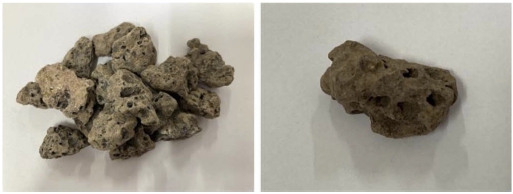
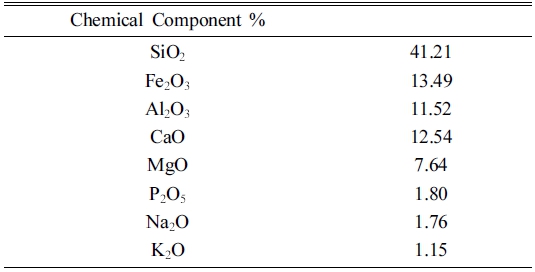
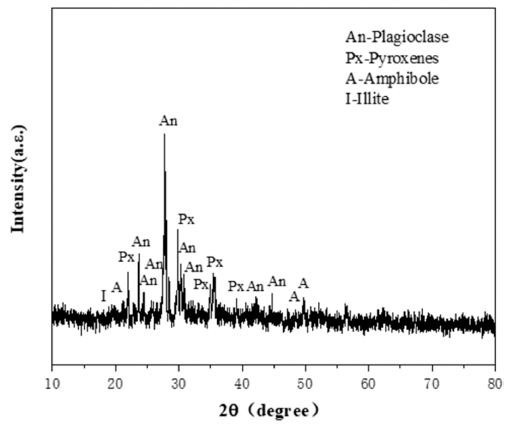
The aggregate is from porous basalt in Chuzhou city, Anhui Province, China. The porous basalt is composed of 60 % plagioclase, 35 % pyroxene, 5 % ferric oxide and clay minerals. The coarse aggregate is made of 4.75 ~ 19 mm porous basalt gravel as shown in Fig. 1, and the fine aggregate is made of mechanized sand broken by porous basalt gravel. Its physical properties are shown in Table 2. Chemical composition of porous basalt is shown in Table 3. XRD images are shown in Fig. 2. The XRD diffractogram indicates that in mineralogical composition, the plagioclase rich in anorthite particle (Ca-Plagioclase) dominate and pyroxene and amphibole also. Illite is present in a small amount, which is probably the effect of plagioclases weathering.
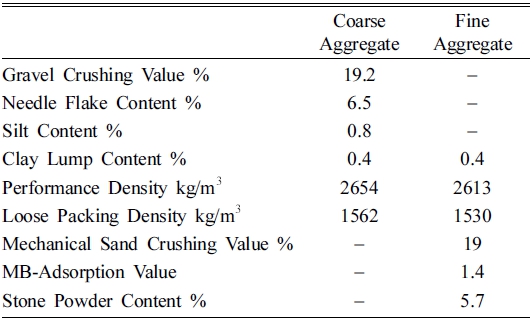
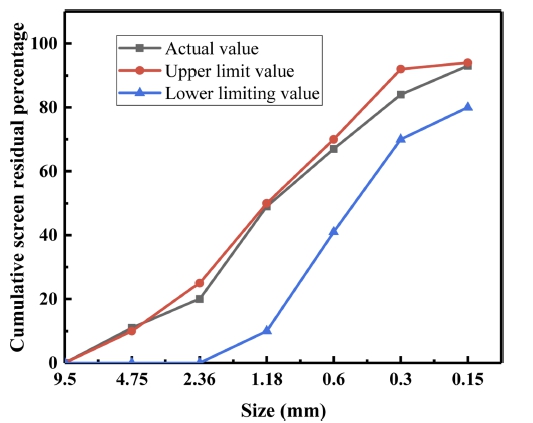
According to “Building Sand (GB/T 14684-2001)”.20) Its MB value and stone powder content are determined to meet the requirements of class Ⅱ machine-made sand. It can be seen from Fig. 3 that the gradation of the machinemade sand is not good, and the fineness modulus calculated is 3.4, which is too coarse. The sand ratio should be appropriately increased when mixing concrete.
2.1.4. Admixture
The admixture is produced by a company in Hefei, and the water reduction rate is 20 %.
2.1.5. Mixing Water
The mixing water is in accordance with the concrete mixing requirements of “Ordinary Concrete Proportion Design Regulations (JGJ 55-2011)”.21)
2.2. Test Method
2.2.1. Preparation of Concrete Samples
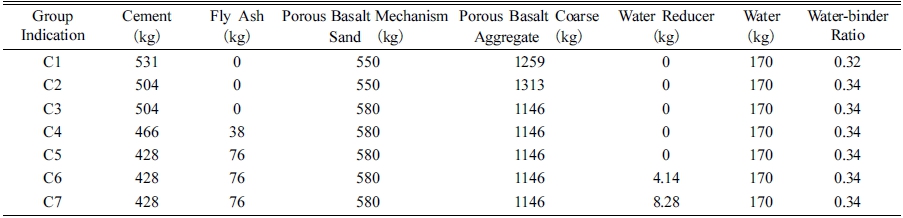
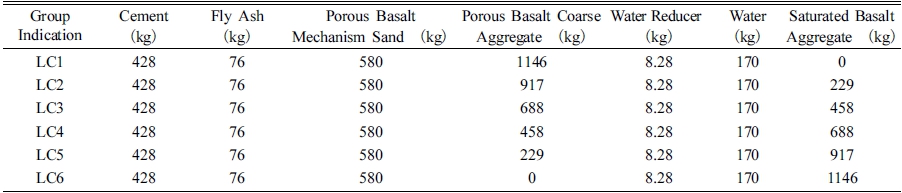
According to the “Design Specification for Mix Ratio of Ordinary Concrete (JGJ 55-2011)”,21) the mix ratio of C50 concrete prepared with porous basalt aggregate is shown in Table 4. In this experiment, the optimal C50 concrete is prepared by different water cement ratio, fly ash dosage and admixture dosage. For the preparation of saturated basalt concrete test, the mixture ratio of C50 concrete prepared with saturated porous basalt aggregate is shown in Table 5. The porous basalt coarse aggregate was saturated for 48 h, 0 %, 20 %, 40 %, 60 %, 80 % and 100 % saturated basalt aggregate are used to replace dry basalt aggregate respectively. The workability and flow performance of fresh mixed concrete were determined by settlement test. Slump test is used in this experiment, which is carried out by slump meter.
2.2.2. Compressive Strength of Samples
The sample pressure and strength test instrument are YAW-2000 microcomputer-controlled pressure testing machine produced by Shanghai Sansizongheng Machinery Manufacturing Co., LTD. The compressive strength of the standard cubic sample was measured at 3 d, 7 d and 28 d. Within 3 d, the strength of the cement increased rapidly. Generally, can reach more than 75 % of the maximum strength, can be basic use. 3 d to 7 d, cement strength growth slowed, generally can achieve the maximum strength of more than 95 %, can be used. Cement strength increases more slowly after 7 d, reaching its maximum strength at 28 days.
2.2.3. Electric Flux of Sample
Electric flux method is one of the most widely used test methods for chloride ion permeability resistance of concrete in the world at present. The instrument used in this experiment is NJ-DTL type concrete chloride ion electric flux tester to measure the electric flux of sample concrete. The chloride ion penetration and diffusion test refer to the American standard ASTM C1202-97. The average quantity of electricity passed by the three specimens in the same group in 6 h was used to evaluate the chloride ion permeation and expansion of concrete, providing a parameter for durability evaluation. The concrete test block is cut into cylinder samples of ø 100 × 50 mm. The specimens should be maintained for 28 d, with 3 specimens in each group. The sample was vacuum-saturated for 24 h with a vacuum water-saturated device for testing.
2.2.4. Water Absorption Rate of Porous Basalt
According to GJG51-2002 “Technical Specification for Light Aggregate Concrete”,22) the saturated water absorption rate of porous basalt aggregate of 4.75 ~ 19 mm was tested. The coarse porous basalt aggregate was divided into 6 parts and completely soaked for 1 h, 2 h, 4 h, 12 h, 24 h and 48 h respectively. After removal, the water stains on the surface were wiped with wet cloth. No natural dripping.
3. Results and Discussion
3.1. Concrete Mix Design and Detection
According to the Design Specification of Mix Ratio of Ordinary Concrete, the water-binder ratio of C50 concrete was calculated, as shown in Table 4. The results of C1 found that concrete was more viscous and difficult to vibrate, and there were bubbles on the surface of the test block. Reason: cementitious material is too much, cause concrete is too thick, it can be in the condition that guarantees the strength to raise water cement ratio appropriately. On the basis of C1, C2 improved the waterbinder ratio of concrete and reduced the amount of cement. The results showed that the concrete slurry was less, the wrapping property was poor, the exposed stone was serious and the appearance of the test block was poor. The reason may be poor stone gradation or low sand rate. C3 on the basis of C2, improve the sand rate of concrete, the results found that the slump is 200 mm, good workability. In order to better improve the workability and strength of concrete, reduce the phenomenon of bleeding and segregation of concrete, and reduce the cost, further explore the following four groups of mixing ratio, keep the water-binder ratio unchanged, on the basis of C3, C4 uses 10 % fly ash to replace cement, C5 uses 15 % fly ash to replace cement. In order to improve the flow performance of concrete and reduce water consumption per unit, C6 added 1 % of water reducing agent on the basis of C5, C7 added 2 % of water reducing agent on the basis of C5.
3.2. Compressive Strength of Concrete Specimens
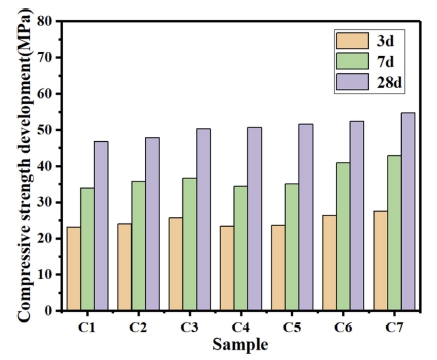
The compressive strength of C50 concrete specimens is shown in Fig. 4. At the same age, the compressive strength of C2 is higher than that of C1, indicating that the water-cement ratio is improved and the strength of concrete is improved. At the same age, the compressive strength of C3 is greater than that of C2, indicating that the sand ratio is improved and the strength of concrete is increased. At the same age, the use of fly ash instead of early compressive strength of concrete specimen is lower than C3, because of mixed with fly ash can make the early strength of concrete decreases,23-25) C4 and C5 of late strength is greater than C3, on the basis of the set of C5, C6 added 1 % of water reducing agent, C7 added 2 % water reducing agent, It can be found that the concrete design strength is higher when the addition of water reducing agent is 2 %, because the workability of concrete can be improved by adding water reducing agent.26,27)
3.3. Electric Flux of Concrete
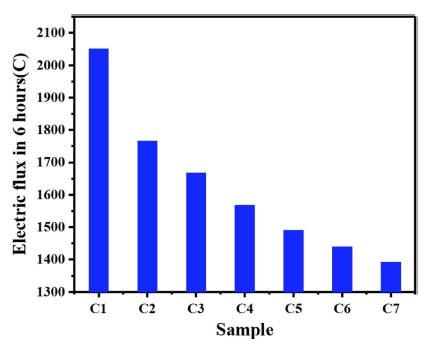
The experimental results of electric flux are shown in Fig. 5 and Table 6, and the evaluation criteria for the results of electric flux method are shown in Table 7. It can be seen from the 6 h electric flux in Table 6 that the electric flux of C1 and C2 is relatively high and the chloride ion permeability is high. Due to the poor workability and lack of density of concrete itself, the concrete has many pores, so the chloride ion permeability is high and the durability is poor. C3, C4 and C5 show that fly ash can effectively improve the internal pore structure of concrete and enhance the chloride ion permeability resistance of concrete by replacing part of cement. It is found that the addition of 20 % fly ash is stronger than that of 10 % fly ash in chloride ion permeability. Because filled and compacted, directly refining the pores and filling the fine pore channels. With the growth of age and the pozzolanic reaction, the gel formed by the active effect of fly ash fills part of the void in concrete, and meanwhile turns the unstable calcium hydroxide into a dense gelling substance with dense structure and stable performance, reducing the permeability of concrete.28,29) Compared with the previous groups, the electric flux of C6 and C7 decreased, mainly because the addition of water reducing agent improved the structure and pore size distribution of concrete, increased the proportion of less harmful holes, reduced the proportion of more harmful holes and harmful holes, and had little effect on harmless holes.30,31)


3.4. Water Absorption Rate of Porous Basalt Aggregate
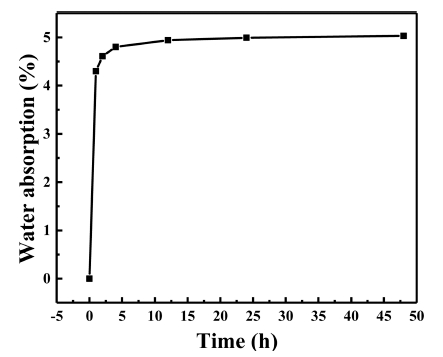
The saturated water absorption of porous aggregate is beneficial to the later improvement of concrete strength.17,32) Therefore, the measurement of saturated water absorption of porous basalt is of great significance to the internal curing of concrete and facilitate the preparation of concrete with better performance. Fig. 6 shows the curve of water absorption of porous basalt aggregate with time change. It can be seen from the figure that the water absorption rate of aggregate is faster in the period from 1 to 4 h, but the water absorption rate is slow in the later period. The reason is that porous basalt is produced by volcanic eruption. There are a large number of closed and connected pores in the bone, and the size distribution of pores inside the bone is not uniform, with cellular porous structure.8,33) The drier the porous basalt gets, the more water it absorbs. Therefore, it can be seen from the figure that the water absorption effect of porous basalt is close to saturation state in 4 hours.
3.5. Compressive Strength of Saturated Basalt Concrete
The compressive strength of concrete prepared by hydration of porous basalt aggregate is shown in Fig. 7. As the replacement rate of saturated porous basalt aggregate increases, the compressive strength of concrete at 3 d and 7 d shows a downward trend. The compressive strength of LC6 at 3 d and 7 d was 7 MPa and 6.5 MPa lower than that of LC1 group, respectively. However, at the age of 28 d, only 20 % of the compressive strength of LC2 group was lower than that of LC1 group, while the compressive strength of LC3, LC4, LC5 and LC6 groups reached 51.1 MPa, 51.8 MPa, 52.4 MPa and 52.9 MPa respectively, which exceeded that of LC1 (50.9 MPa).
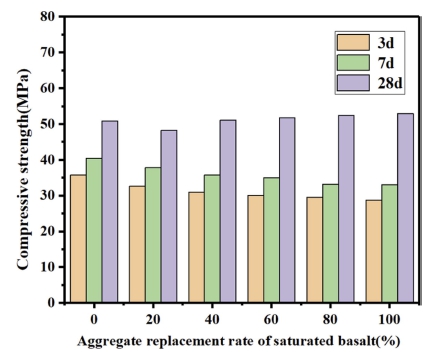
The reasons for the experimental phenomena of 3 d and 7 d are as follows: Full of water in concrete hardening early not basalt aggregate absorbed moisture from the water slurry, reduce the interface deteriorating water cement ratio, thereby reducing the porosity of the interface area, enhances the compressive strength of concrete, but with full water basalt aggregate replacement rate increases, the basalt aggregate loss of water from the water slurry, interface deteriorating water cement ratio decline slowed, Meanwhile, since the early strength of lightweight aggregate concrete is mainly affected by the strength of the interface zone,34) the compressive strength of lightweight aggregate concrete at 3 d and 7 d decreases with the increase of the replacement rate of saturated basalt aggregate. The main reasons for the experimental phenomenon of 28 d are as follows: With the extension of hydration, the water is consumed, change of the relative humidity in the interior of the concrete, when relative humidity is less than the basalt aggregate in cement paste, relative humidity, the water in the basalt aggregate in humidity difference by and under the action of migration in the basalt aggregate to cement paste, cement hydration more fully and more hydration products will fill the pore, concrete is more compact, Macroscopically, the compressive strength of concrete is improved.35) Therefore, the late compressive strength of saturated basalt aggregate increases more obviously than that of non-saturated basalt aggregate, which also indicates that the basalt aggregate with the characteristic of “water absorption and return” has the “self-curing” effect of light aggregate concrete, which can gradually improve the long-term strength of concrete and ensure the safety of the project.36)
3.6. Electrical Flux of Saturated Basalt Concrete
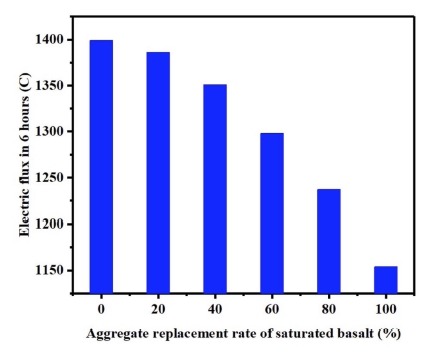
By the Fig. 8 and table 8 shows different saturated porous basalt aggregate replacement rate of basalt concrete 28 d electric flux, six groups of concrete, full water basalt aggregate replacement rate of 0, 20 %, 40 % of the three groups of electric flux of lightweight aggregate concrete is opposite bigger, full water aggregate replacement rate of 60 % of the electric flux of lightweight aggregate concrete is relatively high, the electric flux at 6 h was 1298 C. The electric flux of saturated porous basalt concrete with substitution rate of 80 % and 100 % is relatively small. The electric flux of saturated aggregate concrete with substitution rate of 100 % is relatively low in the six groups of light aggregate concrete, and the electric flux of 6 h is 1154 C. However, the electric flux of the six groups of concrete is slightly higher than that of ordinary C50 concrete, exceeding 1000 C. Because with the increase of curing time, porous basalt aggregate itself has porosity, can store part of the water, prewetting of porous basalt aggregate, can improve the durability of porous basalt aggregate concrete to a certain extent;37) It basically conforms to the law that the higher the aggregate replacement rate of porous basalt, the lower the electric flux. This is due to the porous lightweight aggregate of lightweight aggregate concrete in internal play “micro pump effect”, provide moisture during cement hydration, increase the degree of cement hydration, the lightweight aggregate concrete interface more close-grained,38) the longer the prewetting, lightweight aggregate in cement hydration to provide water more, the structure of the cement floor, although local defects, However, compared with the whole, the effect is not significant. Therefore, the porous basalt aggregate concrete saturated with 100 % water has better chloride ion permeability resistance.

3.7. TG Analysis
The TG-DTG curves of LC1 and LC6 are shown in Fig. 9. At 50 °C ~ 150 °C, the first main peak is detected to be caused by dehydration of C-S-H gel and ettringite. Thermal decomposition of Ca(OH)2 occurs at 350 °C ~ 450 °C, 39)and at 650 °C ~ 750 °C, indicating that the decomposition of CaCO3 causes heat loss.40) The loss of concrete with saturated basalt aggregate replacement rate of 0 (LC1) is greater than that with saturated basalt aggregate replacement rate of 100 % (LC6) in the range of 50 °C to 200 °C. It can be seen that the amount of CS- H gel and ettringite generated by LC1 is greater than that of LC6 at this stage. There was little difference in mass loss between LC1 and LC6, but the amount of Ca(OH)2 in LC1 was higher than that in LC6. It can be seen that when the replacement rate of saturated basalt aggregate was 100 %, the hydration rate of cement in early concrete was slightly slowed down.
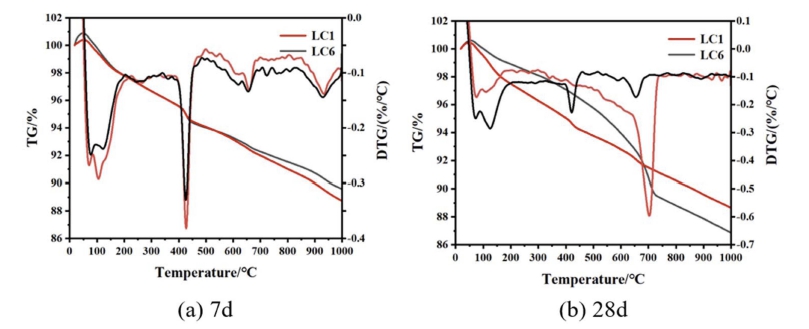
After curing to 28 days, the mass loss of LC1 was higher than that of LC6 at 50 °C ~ 150 °C and 650 °C ~ 720 °C, but after 720 °C, the mass loss of LC6 was greater than that of LC1. It was found that the final loss of LC6 was greater than that of LC1, so the final hydration product generated by LC6 was greater than that of LC1. This indicates that LC6 decomposed more substances in the final CaCO3 than LC1. It is also further indicated that when the replacement rate of saturated aggregate is 100 %, the hydration reaction of cement in concrete can be promoted and the strength of concrete can be improved.
3.8. Microstructure Analysis
Fig. 10(a) and Fig. 10(b) are SEM images of two kinds of concrete after standard curing for 7 d. As can be seen from Fig. 10(a), there are more hydration products in the early stage of the benchmark concrete, and a large amount of cubic sheet Ca(OH)2 is generated in the whole concrete, and crystal, granular and fibrous C-S-H gelation is generated, which leads to enhance of cement matrix in this area.41-43) It can be seen from Fig. 10(b) that the hydration products in the early basalt concrete are not as good as the reference concrete, so the early strength is lower than the reference concrete.
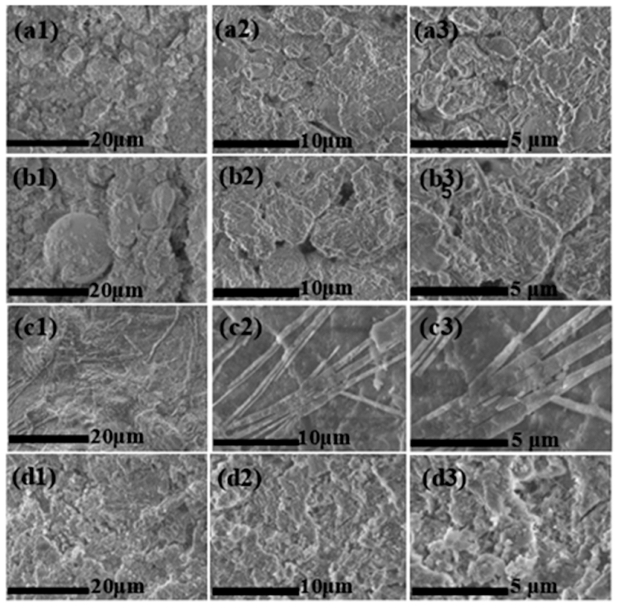
Fig. 10
SEM image of concrete (a is the 7 d SEM image of concrete with saturated basalt aggregate replacement rate of 0, b is the 7 d SEM image of concrete with saturated basalt aggregate replacement rate of 100 %. c is the 28 d SEM image of concrete with saturated basalt aggregate replacement rate of 0, and d is the 28 d SEM image of concrete with saturated basalt aggregate replacement rate of 100 %.)
Fig. 10(c) and Fig. 10(d) are the microscopic morphologies of hydration products of two cementation materials at 28 d. As can be seen from Fig. 10(c), hydration products of cement used for reference concrete in later period gradually increase, and a large number of granular and amorphous C-S-H crystals and gels are produced. Cubic sheet CH crystals are widely distributed, and a large number of acinar AFt are distributed between C-S-H gel and CH crystals, and the whole material is cemented as a whole. It can be seen from Fig. 10(d) that the hydration products of basalt concrete cementitious materials increased in the late period, with the presence of fly ash, a large number of granular and amorphous C-S-H gels, and a small number of acinar AFt crossing each other. The cubic sheet CH crystals were filled, and the overall structure was quite dense without large cracks, holes and other microscopic defects. In conclusion, saturated porous basalt aggregate concrete can give full play to its comprehensive physical and chemical effects in the later stage, and has stronger mechanical properties and durability than non-saturated basalt concrete.
4. Conclusion
In this paper, C50 porous basalt concrete was prepared, and its mechanical properties and durability were studied, as well as the mechanical properties and durability of concrete with different replacement rates of saturated porous basalt aggregate. The conclusions are as follows:
(1) Through the debugging of porous basalt C50 concrete, the mechanical properties and durability of concrete prepared by C7 is the best, in fact, C3, C4, C5, C6 can also be prepared C50 concrete.
(2) With the increase of the replacement rate of porous basalt aggregate, the early compressive strength of concrete decreases, and the later compressive strength basically increases with the increase of the replacement rate of porous basalt aggregate. The chloride ion permeability resistance of basalt concrete also increases with the increase of porous basalt aggregate replacement rate.
(3) Porous basalt is low in price and has good activity. Being used as concrete aggregate is not only conducive to promoting the recycling of solid wastes, improving their utilization value, but also saving the cost for the preparation of high-strength and ultra-high-strength concrete.