


1. Introduction
Typical ferroelectric ceramics are widely used in various devices such as thermoelectric transducers(pyroelectrics), electromechanical transducers(piezoelectrics), actuators and sensors. In addition, most of the piezoelectric ceramic oxides are being used in filters, micro electromechanical systems(MEMS), resonators, and memory storage accessories.1,2) The majority of these devices are synthesized from the lead-based intermetallic inorganic compounds, such as lead zirconate titanate(Pb[ZrxTi1-x] O3, PZT), because of its high piezoelectric performance. 3,4) However, the use of lead-based ceramics gives rise to serious pollution and causes environmental problems due to its high toxicity of lead. As being a focus of research, for the improvement of high performance ecofriendly materials, there is a great need to reduce the pollution created by lead-based ceramics in electronic industry.3-5)
Recently, new lead-free materials such as bismuth ferrite(BiFeO3, BF) have been studied to substitute leadbased materials in electronic industries.6-13) BF is a leadfree perovskite(ABO3) material with high Curie temperature( TC ≈ 825 °C).14-19) However, high conductivity of pure BF piezoceramics is problematic.20,21) To enhance its insulation, the lead-free BF-perovskite ceramics were modified by barium titanate(BaTiO3, BT),22-25) bismuth sodium titanate(Bi0.5Na0.5TiO3, BNT),26) bismuth potassium titanate(Bi0.5K0.5TiO3, BKT),27,28) bismuth zinc titanate (Bi(Zn0.5Ti0.5)O3, BZT),15) and sodium potassium niobate ((Na0.5K0.5)NbO3).29)
Among these BF-based ceramics, the binary BF-BT system is most promising due to its high piezoelectric properties. Many researchers have tried to adapt BF-BT materials by substitution of individual A/B-site cations, however, the A/B-site cations replacement was not fully explored.7,10,18,30,31) Researchers also found improved piezoelectric properties by ABO3 modifications.32) In this scenario, lithium tantalate(LiTaO3, LT), a well-known crystalline ABO3 which possesses unique pyroelectric, optical and piezoelectric properties, is selected to modify BF-BT system.7,10) In the BF-based systems, where domain walls are pinned by the charge-defects due to volatility of A-site cation(Bi3+) at high temperature and the coexistence of 3+ and the 2+ oxidation states of Bsite cation(Iron(Fe), Fe+3 to Fe+2) during heat-treatment processes. When samples are rapidly cooled (by using quenching process) from the sintering temperature, many defects were modified during processing.6,7,11,15,17,19)
According to compositional analysis, the doping of a small quantity of suitable materials enhanced the electromechanical properties of piezoelectric ceramics. MnO2 and CuO were the effective additive materials to enhance the resistivity and sintering behavior of piezoelectric ceramics, respectively.33)
In the present work, lead-free solid ceramics solution (1-x)(0.675BiFeO3-0.325BaTiO3)+0.6mol.%MnO2+0.4mol.% CuO-xLiTaO3 (abbreviated as BFBT-xLT, where x = 0.00, 0.01, 0.02, and 0.03) were studied from view-point of crystal structure, dielectric, ferroelectric and static piezoelectric behaviors.
2. Experimental Method
BFBT-xLT ceramics were fabricated by conventional solid-state reaction method, followed by air-quenching. Starting materials, namely Bi2O3, Fe2O3, CuO, MnO2, BaCO3, Ta2O5, Li2CO3, and TiO2(99.9 %) (All are from Sigma Aldrich Co. St. Louis, MO), were used as raw materials. For each composition, the starting materials were weighed according to the stoichiometric formula and ball-milled for 20 h in ethanol with zirconia balls, and then dried at 120 °C for 6 h in oven. The dried slurries were calcined at 800 °C for 5 h and then ballmilled again for 6 h with addition of CuO in BFBT-xLT ceramics. The granulated powders were mixed with small amount of an aqueous polyvinyl alcohol(PVA) solution as a binder, and then pressed into disc-type pellets of diameter 10 mm. The samples were sintered at 1000 °C for 3 h in a capped alumina crucible. To reduce the volatility of Bi, the pellets were embedded in a powder of the same composition.
Phase study of the sintered specimens was carried out by using an X-ray diffractometer(XRD, X’pert MPD 3040, Philips). Experimental/Relative density of the sintered ceramic samples was determined by the Archimedes principle. The temperature dependent dielectric properties were measured at 100 kHz by an impedance analyzer(HP4192A). Polarization vs. electric field(P-E) hysteresis loops were measured in silicon oil with the aid of ferroelectric test system(Precision LC, Radian Technologies Inc., Albuquerque, NM) at 10 Hz. The static piezoelectric constant(d33) was determined by using a Belincourt-meter(ZJ-6B; Institute of acoustics academia sinica(IACAS), Beijing, China).
3. Results and Discussion
The room temperature(RT) XRD-diffraction patterns of the BFBT-xLT (x = 0.00, 0.01, 0.02, and 0.03) ceramics with the 2θ range of 20°-70° are shown in Fig. 1(a). An entire solid solution with ABO3-structured single phase pseudocubic symmetry is obvious in all specimens, indicating that LT effectively incorporated into the lattice structure of the BFBT ceramics. All ceramics have a pure perovskite phase, and no secondary phases can be observed. Close examination of the XRD profile reveals no characteristic deviation in the positions and relative intensities of all reflections. Still, the observed broader peaks unlike cubic structure may suggest the presence of some pseudocubic/non-cubic phase which is an essential characteristic for the presence of ferroelectricity and piezoelectricity in the ceramics.7,10,13,18,34,35) Fig. 1(a-c) displays the as-sintered SEM micrographs recorded for the selected compositions. The ceramics are of high density with different grain sizes and morphologies.
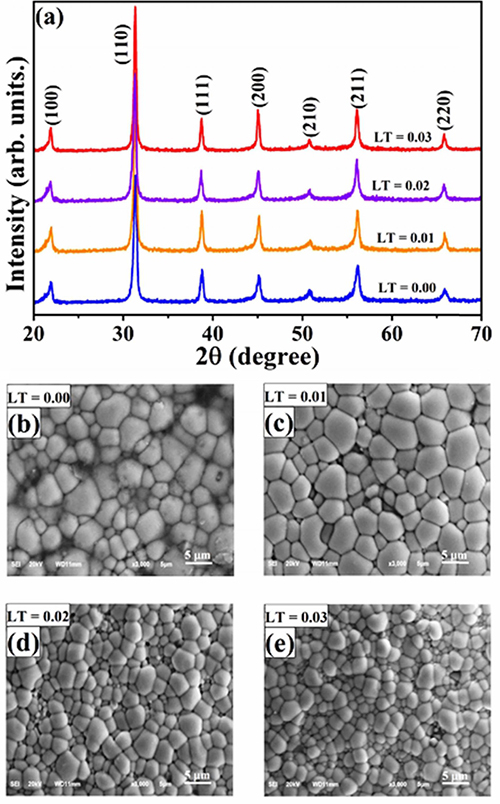
Fig. 1
(a) X-ray diffraction patterns and (b-e) SEM micrographs of pure and LT-modified BFBT ceramics.
Fig. 2 provides the plots of average grain sizes and relative densities of BFBT piezoceramics with various amounts of LT content. The average grain sizes, determined with the linear intercept method, are 3.20, 3.70, 2.24, and 1.82 μm for x = 0.00, 0.01, 0.02, and 0.03, respectively. Dense ceramics could be obtained at the optimum sintering temperature(1000 °C) with small pores for all composition. The theoretical densities are 7.6, 7.63, 7.67, and 7.69 g/cm3 for x = 0, 0.01, 0.02, and 0.03, respectively. All the experimental densities were higher than 7.02 g/cm3, corresponding to a relative density of more than 92 %.
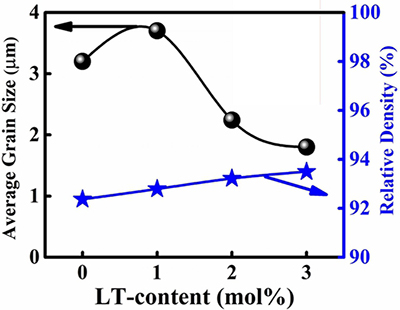
Fig. 2
Average grain size and relative density of BFBT-xLT (x = 0.00, 0.01, 0.02, and 0.03) ceramics.
The temperature-dependent dielectric constant(ε) and tangent loss(tanδ) of the poled specimens of LT-modified BFBT (x = 0.00, 0.01, and 0.03) ceramics studied at fixed frequency(100 kHz) are presented in Fig. 3. Figure shows that, the ε, tanδ and maximum temperature(Tmax) decreased with increasing LT-content. It can also be seen from Fig. 3, that the dielectric curves of BFBT-LT ceramics exhibit broad transition peaks around Tmax, which exhibits the characteristics of diffuse phase transition.6-13,36,37) Furthermore, the selected ceramic compositions with relaxor-like characteristics are strongly dependent upon the LT concentration, which shift the Tmax towards a lower temperature by increasing LT-modifier in BFBT ceramics. The behavior may suggest that the introduction of Ta5+ cations into B-site of BFBT system softens the forces of short-range repulsion, which is against the ferroelectric ordering.38,39) The Tmax for the ternary BFBT-LT system are higher than 420 °C(shown in Fig. 3(d)), which is better than other BNT-based materials.40,41)
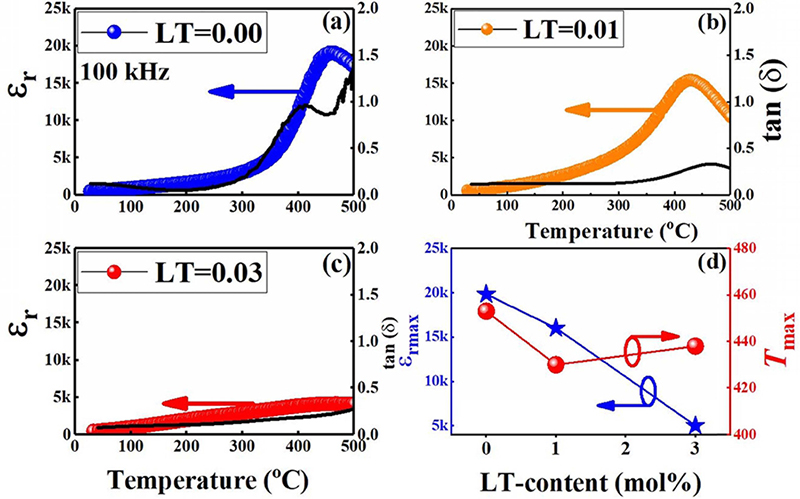
Fig. 3
(a-c) Temperature dependence of the dielectric constant(ε) and dielectric loss(tanδ) of poled LT-modified BFBT ceramics (at 100 kHz), and (d) maximum relative permittivity(εrmax) and maximum temperature(Tmax) as a function of LT-content in BFBT ceramics.
Fig. 4(a-c) shows the polarization vs. electric field(PE) hysteresis and current density(J-E) loops of the BFBTxLT ceramics with x = 0.00, 0.01, and 0.03 measured at 10 Hz. LT addition in BFBT ceramics have a clear response on the ferroelectric properties. The maximum polarization(Pmax), remnant polarization(Prem), and the coercive field(Ec) of the LT-modified BFBT ceramics are compiled in Fig. 4(d). The undoped BFBT ceramics (x = 0.00) exhibited typical ferroelectric behavior and had Pmax, Prem and Ec of 23.37 μC/cm2, 15.24 μC/cm2 and 24.38 kV/cm, respectively. By the addition of 0.01 LTcontent, the maximum values of Pmax = 31.01 μC/cm2, Prem = 22.82 μC/cm2 and Ec = 28.98 kV/cm were observed, and then gradually decreased at 3 mol% LT-content. This gradual decrease in Prem, Pmax, and Ec suggests that the long-range ferroelectric order is dominant in unmodified ceramics and disturbed with the addition of LT-content due to stabilization of a high temperature “weak” ferroelectric phase with a very small non-cubic distortion or a “non-polar” phase.10,13,15) Recently, similar behavior have been investigated in a substitution of (K0.5Na0.5)NbO3 for (Bi0.5Na0.5)TiO3 in (Bi0.5Na0.5)TiO3-(Bi0.5K0.5)TiO3-(K0.5Na0.5) NbO3 ceramics.4,42)
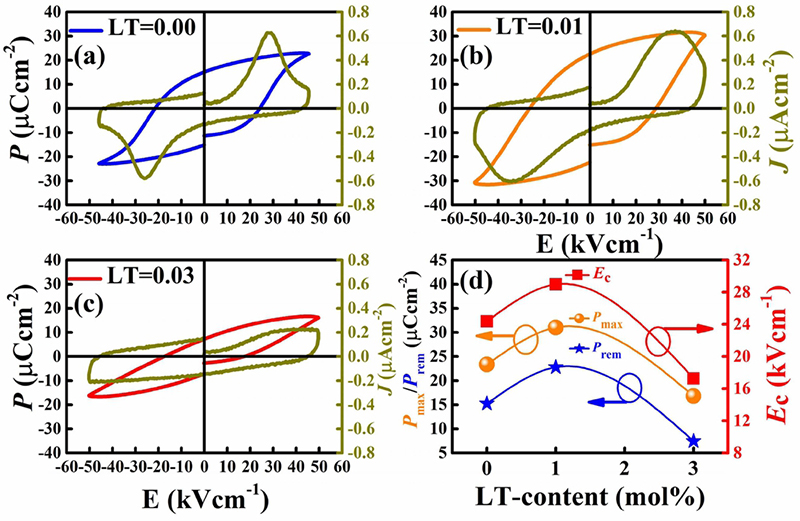
Fig. 4
Room temperature ferroelectric properties of (a-c) P-E loops and (d) characteristics values of maximum polarization(Pmax), remnant polarization(Prem), and coercive electric field(Ec) of LT-modified BFBT ceramics.
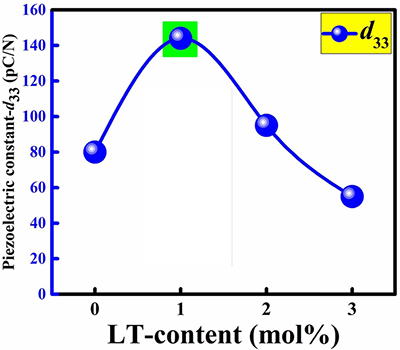
The static piezoelectric constant(d33) of the BFBT-xLT ceramics with x = 0.00, 0.01, 0.02, and 0.03 measured at room temperature for the poled samples (at 35 kV/cm) are plotted in Fig. 5. The unmodified BFBT ceramics without LT-content shows a typical ferroelectric material with maximum d33 of 80 pC/N. At composition of LTcontent (x = 0.01), an enhancement in d33(145 pC/N) was obtained, consistent with ferroelectric(P-E) Loops (shown in Fig. 4), which is comparatively better than other BFbased ceramics.43-45) The drastic increase of d33 value is closely linked to remnant polarization(Prem).44,45) The trend in d33 can be explained according to the expression d33 = 2Q11Prem εT33, where Q11 represents the electrostrictive coefficient, which is constant for perovskite materials. εT33 represents the dielectric constant of the material.46-48) The d33 is proportional to Prem, which decreased drastically at LT = 3 mol% as shown in Fig. 4(d), resulting in a significant reduction in d33.49,50) It is believed that the piezoelectric properties of the BFBT-LT ceramics are attributed to the maximum Prem, the relatively large εT33, and the low tangent loss of the BFBT-LT system at the room temperature. Similar behaviors were also studied in BNT-based materials.47-50)
4. Conclusion
Lead-free BFBT-xLT piezoceramics were synthetized by the conventional solid-state reaction. XRD analysis showed that the LT-modified BFBT(LT = 0.00, 0.01, 0.02, and 0.03) ceramics formed the pure perovskite phase. Well-densified microstructures with more than 92% relative density were observed for all the composition range of BFBT-LT ceramics. At room temperature, the ferroelectric and piezoelectric properties of the BFBT ceramics have been improved by adding appropriate LTcontent. At the optimum BFBT-xLT (x = 1 mol%) composition, maximum polarization(Pmax ≈ 31.01 μC/cm2), remnant polarization(Prem ≈ 28.98 μC/cm2), and static piezoelectric constant(d33 = 145 pC/N) were observed.