


1. Introduction
Scheelite-structured compounds belonging to the tungstates family have been interested and attracted great application due to their unique spectroscopic properties and dramatically excellent upconverted(UC) optical properties. 1) These UC characteristics of the scheelitestructured compounds have current applications in many fields, including optoelectronic devices and luminescence imaging, due to their excellent UC luminescencent behaviors. They could overcome the present limitations and enhance the applications of the traditional photoluminescence materials.2,3) In particular, rare-earth doped binary NaLn(WO4)2 (Ln = La3+, Gd3+ and Y3+) compounds belong to the space group I41/a with the tetragonal phase, and have the family of sheelite-type structure.4,5) The trivalent lanthanide ions are partially substituted into the crystalline lattices of the tetragonal double tungstate crystal phase. The possible doping could be attributed to the very similar radii of the trivalent lanthanide ions and bring to the excellent properties for UC photoluminescence. 6) Multicolor and white light emissions can be generated via tri-doping system based on blue, green and red emission bands. Many lanthanide doping materials such as laser active Ho3+ and Tm3+ are employed as an activator in luminescent centers for Yb3+ as a sensitizer, because their unique electronic energy levels. The tridoped Yb3+, Ho3+ and Tm3+ ions can remarkably enhance the UC efficiency for the shift from infrared to visible light due to the efficiency of the energy transfer from Yb3+ to Ho3+ and Yb3+ to Tm3+. Ho3+ exhibits 5S2/5F4→ 5I8 transitions in the green region, 5F5→ 5I8 transitions in the red region in upconversion process, while Tm3+ shows the 1G4→ 3H6 transitions in the blue region, and 1G4→ 3F4 and 3H4→ 3H6 transitions in the red region.7-9) These ions are effectively doped into the crystal lattices of the tetragonal phase due to the similar radii of the trivalent rare-earth ions, this results in high red emitting efficiency, and superior thermal and chemical stability in white emitting diode.
NaY(WO4)2 phosphors have been developed via specific preparation processes, including solid-state reactions, 10,11) the hydrothermal method,12,13) the Czochralski method.14,15) Compared with the usual methods, microwave synthesis has the advantages of a very short reaction time, small-size particles, narrow particle size distribution, and high purity of final polycrystalline samples. Microwave heating is delivered to the material surface by radiant and/or convection heating, which is transferred to the bulk of the material via conduction.16) A microwave sol-gel process is a cost-effective method that provides high homogeneity and is easy to scale-up, and it is emerging as a viable alternative approach for the quick synthesis of high-quality luminescent materials. However, the synthesis of Ho3+/Yb3+/Tm3+ tri-doped NaY (WO4)2 phosphors via the microwave sol-gel route has not been reported. In this study, the double tungstate NaY(WO4)2 phosphors with the proper doping concentrations of Ho3+, Yb3+ and Tm3+ (x = Ho3+ + Yb3+ + Tm3+, Ho3+ = 0.04, 0.03, 0.02, 0.01, Yb3+ = 0.35, 0.40, 0.45, 0.50 and Tm3+ = 0.01, 0.02, 0.03, 0.04) were successfully prepared by the microwave sol-gel method, followed by heat treatment. The synthesized particles were characterized by X-ray diffraction(XRD) and scanning electron microscopy(SEM). The pump power dependence of the UC emission intensity and Commission Internationale de L’Eclairage(CIE) chromatic coordinates were evaluated in detail. The optical properties were examined comparatively using photoluminescence(PL) emission and Raman spectroscopy.
2. Experimental Procedure
Appropriate stoichiometric amounts of Na2WO4·2H2O (99 %, Sigma-Aldrich, USA), Y(NO3)3·6H2O (99 %, Sigma-Aldrich, USA), (NH4)6W12O39·xH2O (99 %, Alfa Aesar, USA), Ho(NO3)3·5H2O (99.9 %, Sigma-Aldrich, USA), Yb(NO3)3·5H2O (99.9 %, Sigma-Aldrich, USA), Tm(NO3)3·5H2O (99.9%, Sigma-Aldrich, USA), citric acid (99.5 %, Daejung Chemicals, Korea), NH4OH (A.R.), ethylene glycol (A.R.) and distilled water were used to prepare the compounds. Table 1 shows the chemical compositions and sample notations of NaY1-x(WO4)2: Ho3+/Yb3+/Tm3+(x =Ho3++Yb3++Tm3+). To prepare NaY0.60 (WO4)2:Ho0.04/Yb0.35/Tm0.01, 0.2 mol% Na2WO4·2H2O and 0.067 mol% (NH4)6W12O39·xH2O were dissolved in 20 mL of ethylene glycol and 80 mL of 5M NH4OH under vigorous stirring and heating. Subsequently, 0.24 mol% Y(NO3)3·6H2O with 0.016 mol% Ho(NO3)3·5H2O, 0.14 mol% Yb(NO3)3·5H2O and 0.004 mol% Tm(NO3)3·5H2O, and citric acid (with a molar ratio of citric acid to total metal ions of 2:1) were dissolved in 100 mL of distilled water under vigorous stirring and heating. Then, the solutions were mixed together under vigorous stirring and heating at 80-100 °C. Finally, highly transparent solutions were obtained and adjusted to pH = 7-8 by the addition of 8M NH4OH. In order to prepare NaY0.55 (WO4)2:Ho0.03/Yb0.40/Tm0.02, the mixture of 0.22 mol% Y(NO3)3·6H2O with 0.012 mol% Ho(NO3)3·5H2O, 0.16 mol% Yb(NO3)3·5H2O and 0.008 mol% Tm(NO3)3·5H2O was used for the creation of the rare-earth solution. In order to prepare NaY0.50 (WO4)2:Ho0.02/Yb0.45/Tm0.03, the mixture of 0.20 mol% Y(NO3)3·6H2O with 0.008 mol% Ho(NO3)3·5H2O, 0.18 mol% Yb(NO3)3·5H2O and 0.012 mol% Tm(NO3)3·5H2O was used for the creation of the rare-earth solution. In order to prepare NaY0.45(WO4)2: Ho0.01/Yb0.50/Tm0.04, the rare-earth containing solution was generated using 0.18 mol% Y(NO3)3·6H2O with 0.004 mol% Ho(NO3)3·5H2O, 0.20 mol% Yb(NO3)3·5H2O and 0.016 mol% Tm(NO3)3·5H2O.
Table 1
Chemical compositions and sample notations of NaY1-x(WO4)2:Ho3+/Yb3+/Tm3+ (x = Ho3+ + Yb3+ + Tm3+).
 |
The transparent solutions were placed into a microwave oven operating at a frequency of 2.45 GHz with a maximum output-power of 1250 W for 30 min. The working cycle of the microwave reaction was controlled very precisely using a regime of 40 s on and 20 s off for 15 min, followed by further treatment of 30 s on and 30 s off for 15 min. The samples were treated with ultrasonic radiation for 10 min to produce a light yellow transparent sol. After this, the light yellow transparent sols were dried at 120 °C in a dry oven to obtain black dried gels. The black dried gels were ground and heattreated at 900 °C for 16 h with 100 °C intervals between 600-900 °C. Finally, pink particles were obtained for the doped compositions. The phase composition of the synthesized particles was identified using XRD (D/MAX 2200, Rigaku, Japan). The microstructure and surface morphology of the synthesized particles were observed using SEM (JSM-5600, JEOL, Japan). The PL spectra were recorded using a spectrophotometer (Perkin Elmer LS55, UK) at room temperature. Raman spectroscopy measurements were performed using a LabRam Aramis (Horiba Jobin-Yvon, France). The 514.5-nm line of an Ar ion laser was used as the excitation source, and the power on the samples was kept at 0.5 mW.
3. Results and Discussion
Fig. 1 shows the X-ray diffraction patterns of the (a) JCPDS 48-0886 data of NaY(WO4)2, the synthesized (b) NaY0.60(WO4)2:Ho0.04/Yb0.35/Tm0.01, (c) NaY0.55(WO4)2: Ho0.03/Yb0.40/Tm0.02, (d) NaY0.50(WO4)2:Ho0.02/Yb0.45/Tm0.03, and (e) NaY0.45(WO4)2:Ho0.01/Yb0.50/Tm0.04 particles. All of the XRD peaks could be assigned to the tetragonalphase NaY(WO4)2 with the space group of I41/a, which was in good agreement with the crystallographic data of NaY (WO4)2 (JCPDS 48-0886). It is observed that the diffraction peaks of the doped samples in Fig. 1(b-e) shift slightly to the higher angles, as compared to that of the standard data NaY(WO4)2 shown in Fig. 1(a). It is well known that the relationship of the interplanar space(dhkl), diffraction angle(θ) and wavelength of Xray(λ) is expressed by the Bragg’s equation:
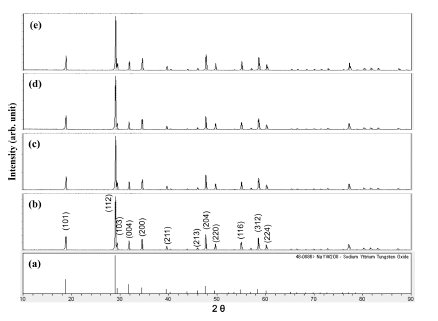
Fig. 1
X-ray diffraction patterns of the (a) JCPDS 48-0886 data of NaY(WO4)2, the synthesized (b) NaY0.60(WO4)2:Ho0.04/Yb0.35/Tm0.01, (c) NaY0.55(WO4)2:Ho0.03/Yb0.40/Tm0.02, (d) NaY0.50(WO4)2:Ho0.02/Yb0.45/ Tm0.03, and (e) NaY0.45(WO4)2:Ho0.01/Yb0.50/Tm0.04, particles.
In pure NaY(WO4)2 crystals, the unit cell decrease occurs due to the substitution of Ho3+(R = 1.015 Å), Yb3+ (R = 0.985 Å) and Tm3+(R = 0.994 Å) ions in the Y3+(R = 1.019 Å) sites.17) According to Bragg equation (1), the diffraction peaks shift to higher angles with the decrease of dhkl values. Post heat-treatment plays an important role in a well-defined crystallized morphology. To achieve a well-defined crystalline morphology of NaY0.60(WO4)2: Ho0.04/Yb0.35/Tm0.01, NaY0.55(WO4)2:Ho0.03/Yb0.40/Tm0.02, NaY0.50(WO4)2:Ho0.02/Yb0.45/Tm0.03, and NaY0.45(WO4)2: Ho0.01/Yb0.50/Tm0.04 particles, phases need to be heat treated at 900 °C for 16 h. It is assumed that the doping amount of Ho3+/Yb3+/Tm3+ has a great effect on the crystalline cell volume of the NaY(WO4)2, because of the different ionic sizes. This means that the obtained samples possess a tetragonal-phase after partial substitution of Y3+ by Ho3+, Yb3+ and Tm3+ ions, and the ions are effectively doped into crystal lattices of the NaY(WO4)2 phase due to the similar radii of Y3+, Ho3+, Yb3+ and Tm3+.
Fig. 2 shows SEM images of the synthesized (a) NaY0.60(WO4)2:Ho0.04/Yb0.35/Tm0.01, (b) NaY0.55(WO4)2:Ho0.03 /Yb0.40/Tm0.02, (c) NaY0.50(WO4)2:Ho0.02/Yb0.45/Tm0.03, and (d) NaY0.45(WO4)2:Ho0.01/Yb0.50/Tm0.04 particles. The assynthesized samples are very similar morphologies and have no discrepancy in aspect of morphological feature, showing well crystallized and homogeneous microcrystalline morphology with particle size of 1-2 μm. The agglomerated particles are induced by the atom interdiffusion between the grains. It should be noted that the morphological feature is insensitive to the Ho3+/Yb3+/ Tm3+ doping concentrations. The microwave sol-gel method in application to the double tungstates provides the energy to synthesize the bulk of the material uniformly, so that fine particles with controlled morphology can be fabricated in a short time period. The method is a costeffective way to fabricate highly homogeneous products with easy scale-up. It is a viable alternative for the rapid synthesis of UC particles. This suggests that the microwave sol-gel route is suitable for the creation of homogeneous NaY1-x(WO4)2:Ho3+/Yb3+/Tm3+ crystallites. This suggests that the microwave sol-gel route is suitable for the creation of homogeneous NaY1-x(WO4)2:Ho3+/Yb3+/ Tm3+ crystallites and it can be successfully applied for other tungstaes from this crystal family.
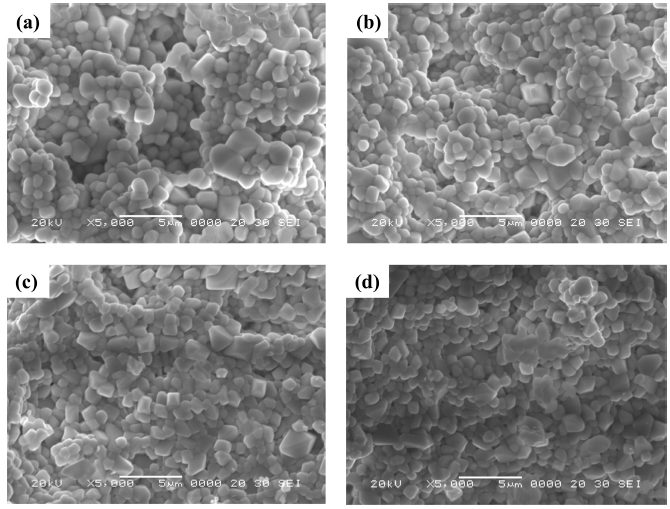
Fig. 2
Scanning electron microscopy images of the synthesized (a) NaY0.60(WO4)2:Ho0.04/Yb0.35/Tm0.01, (b) NaY0.55(WO4)2:Ho0.03/Yb0.40/Tm0.02, (c) NaY0.50(WO4)2:Ho0.02/Yb0.45/Tm0.03, and (d) NaY0.45(WO4)2:Ho0.01/Yb0.50/Tm0.04, particles.
Fig. 3 shows the UC photoluminescence emission spectra of the as-prepared (a) NaY0.60(WO4)2:Ho0.04/Yb0.35/ Tm0.01, (b) NaY0.55(WO4)2:Ho0.03/Yb0.40/Tm0.02, (c) NaY0.50 (WO4)2:Ho0.02/Yb0.45/Tm0.03, and (d) NaY0.45(WO4)2:Ho0.01 /Yb0.50/Tm0.04 particles. particles excited under 980 nm at room temperature. Under excitation at 980 nm, the doped particles exhibited white emissions based on blue, green and red emission bands, which correspond to the 1G4→ 3H6 transitions of Tm3+ in the blue region, the 5S2/ 5F4→ 5I8 transitions of Ho3+ in the green region, the 5F5→ 5I8 transitions of Ho3+ as well as the 1G4→ 3F4 and 3H4→ 3H6 transitions of Tm3+ in the red region. The UC intensity of (d) NaY0.45(WO4)2:Ho0.01/Yb0.50/Tm0.04 exhibits the strongest 475-nm emission band in the blue region due to higher content of Tm3+, while the UC intensity of (c) NaY0.50(WO4)2:Ho0.02/Yb0.45/Tm0.03 provides the strongest 545-nm emission band in the green region and the strongest 655-nm emission band in the red region due to appropriate ratio of Yb3+:Ho3+ + Tm3+ = 9:1. Thus, the optimal Yb3+:Ho3+ + Tm3+ ratio is as high as 9:1 for the white emitting diode based on the blue, green and red emissions.
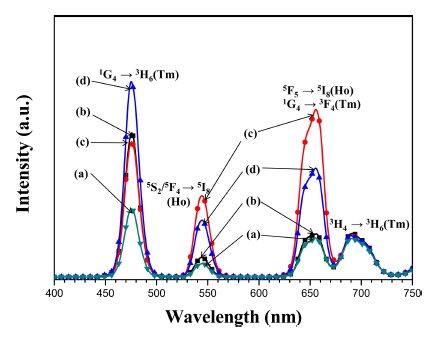
Fig. 3
Upconversion photoluminescence emission spectra of (a) NaY0.60(WO4)2:Ho0.04/Yb0.35/Tm0.01, (b) NaY0.55(WO4)2:Ho0.03/Yb0.40/ Tm0.02, (c) NaY0.50(WO4)2:Ho0.02/Yb0.45/Tm0.03, and (d) NaY0.45(WO4)2: Ho0.01/Yb0.50/Tm0.04 particles excited under 980 nm at room temperature.
The logarithmic scale dependence of the UC emission intensities at 475, 545, 655 and 695 nm on the working pump power over the range of 20 to 110 mW in the NaY0.50(WO4)2:Yb0.02/Ho0.45/Tm0.03 sample is shown in Fig. 4. In the UC process, the UC emission intensity is proportional to the slope value n of the irradiation pumping power, where n is the number of pumped photons required to produce UC emission:18)
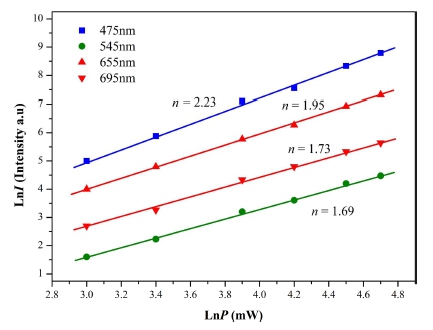
Fig. 4
Logarithmic scale dependence of the upconversion emission intensity on the pump power in the range from 20 to 110 mW at 475, 545, 655 and 695 nm in the NaY0.50(WO4)2:Ho0.02/Yb0.45/Tm0.03 sample.
where value n is the number of the pumped photons required to excite the upper emitting state, I is the UC luminescent intensity and P is the laser pumping power. As evident from Fig. 4, the slope value calculations indicate n = 2.23 for green emission at 475 nm, n = 1.95 for green emission at 545 nm, and n = 1.73 and 1.69 for red emissions at 655 and 695 nm, respectively. These results show that the UC mechanism of the blue, green and red emissions can be explained by the multi-step energy transfer process in Ho3+/Yb3+/Tm3+ tri-doped phosphors. 7-9,22-25)
Fig. 5 shows schematic energy level diagrams of Ho3+/ Tm3+(activators) and Yb3+ ions(sensitizer) ions in the NaY1-x(WO4)2:Ho3+/Yb3+/Tm3+ system and the UC mechanisms accounting for the blue, green and red emissions during 980 nm laser excitation. The UC emissions are generated by the multi-step process through excited state absorption(ESA) and energy transfer(ET). For the emissions for Ho3+ activator, initially the Yb3+ ion sensitizer is excited from the 2F7/2 level to the 4F5/2 level under excitation of 980 nm pumping, and transfers its energy to Ho3+ ions. Then, Ho3+ ions are populated from the 5I8 ground state to the 5I6 excited state. This is a phonon-assisted energy transfer process because of energy mismatch between the 2F5/2 level of Yb3+ and the 5I6 level of Ho3+. Secondly, the Ho3+ in the 5I6 level is excited to the 5S2 or 5F4 level by the same energy transfer from Yb3+. In addition, the 5S2 /5F4 level of Ho3+ can be also populated through excited state absorption. Finally, the green emission around 545 nm corresponding to 5S2/5F4→ 5I8 transition takes place. For red emission of Ho3+, the population of the 5F5 level is generated by two different channels. One channel is that Ho3+ in the 5S2/5F4 level relaxes nonradiatively to the 5F5 level. Another channel is closely related to the 5I7 level populated by non-radiative relaxation from the 5I6 excited state. The Ho3+ in the 5I7 level is excited to the 5F5 level by the energy transfer from Yb3+. Therefore, the red emission around 655 nm is corresponding to the 5F5→ 5I8 transition.19,20)
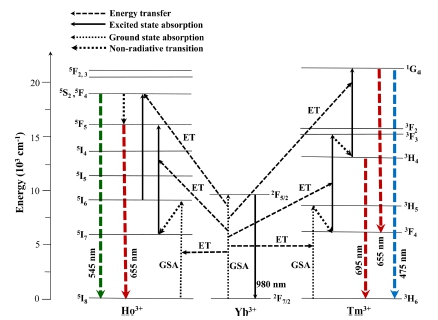
For the emissions for Tm3+ activator, the Yb3+ ion sensitizer is excited from the 2F7/2 level to the 4F5/2 level under excitation of 980 nm pumping, and transfers its energy to Tm3+ ions. Then, Tm3+ ions is populated from the 3H6 ground state to the 3H5 excited state. During the phonon-assisted energy transfer process, the energy mismatch occurs between the 2F5/2 level of Yb3+ and the 3H5 level of Tm3+. Continuously, the Tm3+ in the 3H5 level relaxes non-radiatively to the 3F4 level. The Tm3+ in the 3F4 level is excited to the 3F3 level by the energy transfer from Yb3+. Furthermore, the Tm3+ in the 3F3 relaxes also non-radiatively to the 3H4 level, and is generated to the red emission of 695 nm. Subsequently, the Tm3+ in the 3H4 level is excited to the 1G4 level by the energy transfer from Yb3+. Finally, the red emission at 655 nm corresponding to the 1G4→ 3F4 transitions is developed, and the blue emission at 475 nm corresponding to the 1G4→ 3H6 transitions is created.21,22)
Fig. 6 shows (A) calculated chromaticity coordinates(x, y) values and (B) CIE chromaticity diagram for (a) NaY0.60(WO4)2:Ho0.04/Yb0.35/Tm0.01, (b) NaY0.55(WO4)2:Ho0.03 /Yb0.40/Tm0.02, (c) NaY0.50(WO4)2:Ho0.02/Yb0.45/Tm0.03, and (d) NaY0.45(WO4)2:Ho0.01/Yb0.50/Tm0.04 particles. In Fig. 6, (A) the calculated chromaticity coordinates(x, y) and (B) CIE chromaticity diagram are shown for the compositions (a) NaY0.60(WO4)2:Ho0.04/Yb0.35/Tm0.01, (b) NaY0.55 (WO4)2:Ho0.03/Yb0.40/Tm0.02, (c) NaY0.50(WO4)2:Ho0.02/Yb0.45 /Tm0.03, and (d) NaY0.45(WO4)2:Ho0.01/Yb0.50/Tm0.04. The triangle depicted in Fig. 6(B) indicates standard coordinates for blue, green and red colors. The inset in Fig. 6(B) shows the chromaticity points for the samples (a), (b), (c) and (d). The chromaticity coordinates(x, y) are strongly dependent on the Ho3+/Yb3+/Tm3+ concentration ratio. As shown in Fig. 6(A), the calculated chromaticity coordinates x = 0.332 and y = 0.345 for (a) NaY0.60(WO4)2: Ho0.04/Yb0.35/Tm0.01, x = 0.324 and y = 0.332 for (b) NaY0.55(WO4)2:Ho0.03/Yb0.40/Tm0.02, x = 0.325 and y = 0.325 for (c) NaY0.50(WO4)2:Ho0.02/Yb0.45/Tm0.03, and x = 0.313 and y = 0.312 for (d) NaY0.45(WO4)2:Ho0.01/Yb0.50/Tm0.04 are corresponding to the standard equal energy point in CIE diagram in Fig. 6(B).
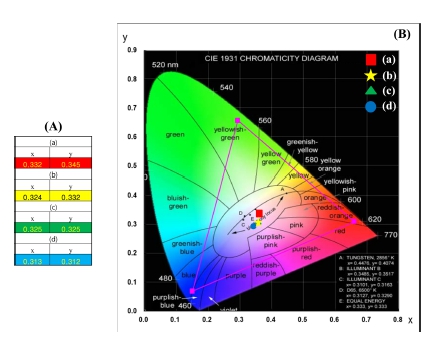
Fig. 6
(A) Calculated chromaticity coordinates(x, y) values and (B) CIE chromaticity diagram for NaY1-x(WO4)2:Ho3+/Yb3+/Tm3+ phosphors. The inset shows the emission points for the sample synthesized (a) NaY0.60(WO4)2:Ho0.04/Yb0.35/Tm0.01, (b) NaY0.55(WO4)2:Ho0.03/Yb0.40 /Tm0.02, (c) NaY0.50(WO4)2:Ho0.02/Yb0.45/Tm0.03, and (d) NaY0.45(WO4)2: Ho0.01/Yb0.50/Tm0.04, particles.
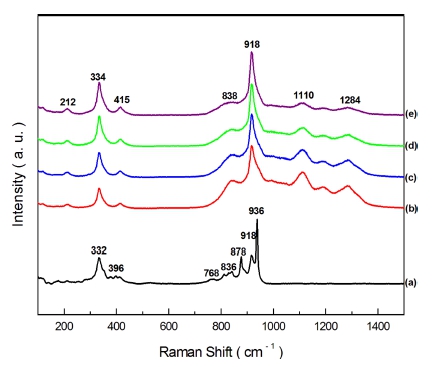
Fig. 7 shows the Raman spectra of the synthesized (a) pure NaY(WO4)2, (b) NaY0.60(WO4)2:Ho0.04/Yb0.35/Tm0.01, (c) NaY0.55(WO4)2:Ho0.03/Yb0.40/Tm0.02, (d) NaY0.50(WO4)2: Ho0.02/Yb0.45/Tm0.03, and (e) NaY0.45(WO4)2:Ho0.01/Yb0.50/ Tm0.04 particles excited by the 514.5-nm line of an Ar ion laser at 0.5 mW. The internal modes for the (a) pure NaY(WO4)2 particles were detected at 332, 396, 768, 836, 878, 918 and 936 cm−1, respectively. The well-resolved sharp peaks for the NaY(WO4)2 indicate a high crystallinity state of the synthesized particles. The internal vibration mode frequencies are dependent on the lattice parameters and the strength of the partially covalent bond between the cation and molecular ionic group WO4. The Raman spectrum of the NaY(WO4)2 crystal in Fig. 7(a) shows the typical tungstate compounds, which is divided into two parts with a wide empty gap of 400-750 cm−1.23-25) The stretching vibrations of W-O bonds are observed at 768~936 cm−1. For these stretching vibrations, strong mixing occurs between the W-O bonds and the WO4. The bands at 332 and 396 cm−1 could be assumed to originate from vibrations of the longer W-O bonds, which are employed in the formation of the W-W bridge. The translational vibration motion of the Na3+ ions is observed around 200 cm−1, whereas the Y3+ translations were located below 180 cm−1.26,27) The Raman spectra of the doped particles indicate the very strong and dominant peaks at higher frequencies of 838, 918, 1110 and 1284 cm−1 and at lower frequencies of 212, 334 and 415 cm−1. These strong disordered peaks at higher and lower frequencies are attributed the strong mixing between the W-O bonds and the WO4 stretching vibrations as well as the concentration quenching effect of Ho3+ and Tm3+ ions. It is assumed that the highly modulated structure has strong absorption in the near ultraviolet region, so that energy transfer processes from the WO4-x group to rare earth ions can easily occur, which can greatly enhance the external quantum efficiency of rare earth ions doped materials. These results lead to high emitting efficiency and superior thermal and chemical stability, and these materials, which can be considered potentially active components in new optoelectronic devices and in biomedical applications.
4. Conclusions
The double tungstate NaY1-x(WO4)2:Ho3+/Yb3+/Tm3+ phosphors were successfully synthesized by microwave solgel method. The well-crystallized particles formed after heat-treatment at 900 °C for 16 h showed the fine and homogeneous microcrystalline morphology with particle sizes of 1-2 μm. Under excitation at 980 nm, the UC doped particles exhibited white emissions based on blue, green and red emission bands, which correspond to the 1G4→ 3H6 transitions of Tm3+ in the blue region, the 5S2/ 5F4→ 5I8 transitions of Ho3+ in the green region, the 5F5 → 5I8 transitions of Ho3+ as well as the 1G4→ 3F4 and 3H4→ 3H6 transitions of Tm3+ in the red region. The calculated slope value n indicated n = 2.23 for green emission at 475 nm, n = 1.95 for green emission at 545 nm, and n = 1.73 and 1.69 for red emissions at 655 and 695 nm, respectively. The calculated chromaticity coordinates were corresponding to the standard equal energy point in CIE diagram. The strong disordered peaks at higher and lower frequencies in Raman spectroscopy were attributed the strong mixing between the W-O bonds and the WO4 stretching vibrations as well as the concentration quenching effect of Ho3+ and Tm3+ ions. The results led to high emitting efficiency and the involved materials can be considered as potentially active components in new optoelectronic devices and in the field of biomedical applications.