


1. Introduction
Reliable sealing technology is becoming increasingly popular in many manufacturing applications.1,2) These techniques have been intensively researched in the packaging systems such as display, dye sensitized solar cells, organic light-emitting diodes, solid oxide fuel cells, etc.3-5) If it is not completely sealed, it may cause a decrease in the durability of internal materials or components in the device. Recently, research has been conducted to apply laser sealing using a glass fiber sealant as an advanced method.6,7) The main purpose of sealing is to secure durability by protecting materials and elements located inside the panel from the external environment. In addition to glass panels used in the visible light region, there is a growing demand for sealing infraredtransmitting materials in various fields.
Various optical materials used in special environments must satisfy both durability and optical characteristics. Representative materials used in infrared optical system are ZnS, Spinel, ALON, etc., for missile domes and windows because of their broadband optical transparency. Zinc sulfide is an attractive candidate for infrared windows, missile domes, and infrared lenses because of its optical transparency ranging from visible to infrared region (12 μm). However, ZnS is a relatively soft and weak material (compared to Sapphire, ALON and Spinel) and is therefore subject to thermal resistance damage when exposed to the rigors of environmental loading, during high-speed missile flight. Therefore, it is intended to improve the durability by double bonding zinc sulfide multispectral (MS ZnS) windows and dome-shaped optical components exposed to temperature rise and thermal shock.
In this study, it is intended to develop an infrared chalcogenide glass that transmits infrared wavelength and possesses a sealing ability to improve the durability of the dome-type material while retaining the optical characteristics and thermal and thermo-mechanical performance. Chalcogenide glass for bonding was prepared to minimize infrared transmission loss, improve heat resistance and bonding strength. Optical, thermal and thermo-mechanical properties of developed chalcogenide glass were evaluated. In order to minimize the infrared transmission loss of sealed MS ZnS substrates, transmittance was predicted through simulation according to chalcogenide glass. The sealing process of MS ZnS substrates was developed and the feasibility of practical use was confirmed by securing sufficient bonding strength.
2. Experimental Procedure
In this study, Ge-Sb-Se-based chalcogenide glass was fabricated to be used as infrared transmitting sealing material. The batch ingredients were weighed using a balance in a glove box under N2 atmosphere in order to block the binding of oxygen and melted at 1,000 °C for 12 h using a rocking electric furnace. For thermal analysis, Differential Scanning Calorimeter (DSC, Netzsch, DSC 200 F3) was used for the determination of glass transition temperature (Tg) and crystallization temperature (Tc). Thermal analysis was performed at 10 °C/min of heating rate in the range of 50 to 550 °C. A dilatometer (Netzsch, DIL402C) was used to measure the amount of sample length change according to temperature change for thermomechanical properties. It was carried out at 5 °C/min in the temperature range of 25 to 500 °C using a sample with a size of 5 × 5 × 8 mm3 in an N2 atmosphere. From this measurement, glass transition temperature (Tg), softening temperature (Ts), and coefficient of thermal expansion (CTE) were confirmed. Transmittance was measured in the range of 3~12 μm using a Fourier transform infrared spectrometer (FT-IR, Perkin Elmer) to confirm energy absorption of MS ZnS, chalcogenide glass and the sealed MS ZnS substrates.
Wetting tests were conducted to analyze the flowability as a function of temperature by considering the Tg and Ts. The tests were performed in an electric furnace at a heating rate of 5 °C/min and holding for 1 h under N2 atmosphere. The flow characteristics and wetting angle of the chalcogenide pellets were analyzed at each set temperature, and the sealing temperature was determined based on the results. After placing the chalcogenide glass disk in the center between MS ZnS substrates (20 × 30 mm), the sealing test was performed under the temperature conditions determined through the wettability test. Sealing process was conducted at a heating rate of 5 °C/min under N2 atmosphere. It was maintained at the target temperature for 1 h and then cooled it naturally. The bonding strength characteristics of the sealed MS ZnS substrates were evaluated by placing the sealed MS ZnS substrates between the upper and lower jigs on a tensile tester (Shimadzu, AG-X). Tensile test conditions were conducted at a speed of 5 mm/min, and test conditions were designed so that the equipment stopped when fractured.
3. Results and Discussion
Table 1 shows a physical and optical properties of the developed and selected commercial (Shott AG, IRG series) chalcogenide glasses.
Table 1
Physical and optical properties of the developed and selected commercial chalcogenide glasses.
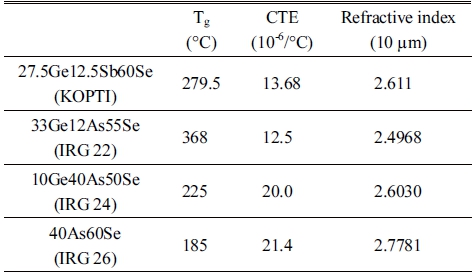 |
Schott AG is mass-producing IRG series infrared chalcogenide glass materials for far infrared optical lens. Considering a composition, 33Ge12As55Se (IRG22) shows the lowest refractive index, but has a relatively high glass transition temperature. In the case of 10Ge40As50Se (IRG24) and 40As60Se (IRG 26) containing more than 40 % As, the thermal expansion coefficient is very high over 20 (×10-6/K), and as a sealing glass material, the probability of crack generation is high during cooling. In this work, 27.5Ge12.5Sb60Se (KOPTI) was used because of relative low Tg and CTE, which is suitable for bonding MS ZnS substrates. The more detail analysis and bonding process is explained as below.
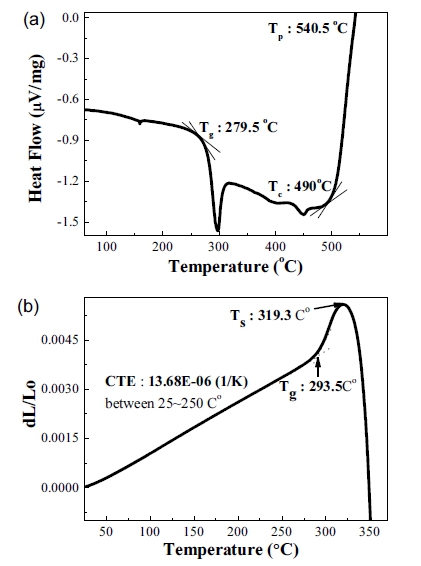
The DSC curve is obtained at a heating rate of 10 °C/min for the glass system, and the DSC curve of 27.5Ge12.5Sb60Se glass is divided into two parts: endothermic and exothermic peaks. The first endothermic peak corresponds to the glass transition region and subsequent exothermic peaks are related to the crystallization peaks.
As shown in Fig. 1(a), it was found that the glass transition temperature (Tg) of the 27.5Ge12.5Sb60Se glass was observed to be 279.5 °C and the crystallization temperature (Tc) was 490 °C. The thermal stability (△T = Tc-Tg) of the 27.5 Ge12.5Sb60Se glass was determined and found to be >210 °C.8) Coefficient of thermal expansion (CTE) represents the intrinsic properties due to the volume changes of materials with a change in temperature. It was observed that the glass transition temperature (Tg) of the 27.5Ge12.5Sb60Se glass using a dilatometer was 293.5 °C and the softening temperature (Ts) was 319.3 °C. The thermal expansion coefficient and thermal conductivity of 27.5Ge12.5Sb60Se were 13.68 (×10-6/K) and 0.208 [W / (m × K)], respectively. The thermal shock resistance index expressed as the thermal expansion coefficient/thermal conductivity ratio, which was noted to be 65.76 (×10-6, W/m). This means that the 27.5Ge12.5Sb60Se glass has a relative superiority compared to commercial chalcogenide glass materials (Schott AG, IRG22 = 50.42 × 10⁻⁶, W/m, IRG23 = 60.91 × 10⁻⁶, W/m, IRG25 = 56 × 10-6, W/m).9) It indicates that improvement in durability can be expected against thermal shock in sealed MS ZnS.
In the case of bonded MS ZnS substrates, the sealing material must also secure the transmittance in the region 8~12 μm. In order to evaluate the transmittance of the chalcogenide infrared glass, the optical transmittance was measured in the 2~12 μm region using a FT-IR spectrometer. Specimens for analysis were prepared in the form of disks with a thickness of 2 mm and a diameter of 25 mm, and both sides were processed into a machined surface with a surface roughness of RMS 3 nm through two stages of grinding and λ/4 polishing.
As shown in Fig. 2(a), the infrared transmission edge of 27.5Ge12.5Sb60Se glass was observed around 16 μm. This is because the edge located near the long-wavelength cutoff of 16 μm by the binding energy of Ge-Se (205.607 kJ mol-1) is mainly determined by the Ge-Se intrinsic harmonic vibration mode.10) This absorption edge is determined by multi-phonon of constituent elements. Strong absorption occurs around 12.8 μm, which is attributed to the formation of the strongest chemical bond Ge-O and moisture and oxygen contamination along with 2.8 and 6.3 μm.11)
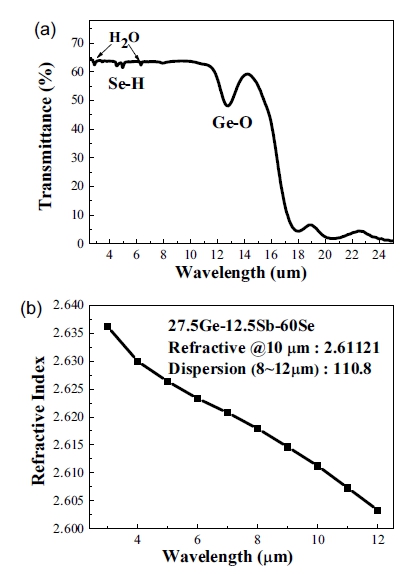
The refractive index of the 27.5Ge12.5Sb60S chalcogenide glass material was measured using a Trioptics high resolution spectrometer. The Apex angle is 20° of a prism and passing area of ϕ = 17 mm or more is required for transmitting infrared light source. Since the intensity of the light source is small, light loss due to surface scattering must be minimized for accurate measurement. It was found that 2.6178 at 8 μm, 2.6112 at 10 μm, and 2.6033 at 12 μm as shown in Fig. 2(b). In the far-infrared region, the dispersion value was 110.8. A dispersion value of 100 or more in the far-infrared band at 8~12 μm is considered to be suitable for use as optical components. This shows that the 27.5Ge12.5Sb60S chalcogenide glass has both sealing function and optical performance in the far-infrared band.
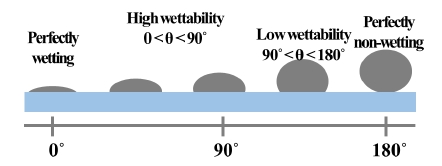
Wetting means the property of the sealant to be in close contact with the substrate and spread. Various forces act between the substrate and the sealant ensures excellent sealing and the wettability allows for a wider contact surface. As a result, the excellent wettability is a physical property indicating the ability of adhesion formation. The wetting property of the sealant can be attributed to the surface tension or critical surface energy of the substrate and the sealant. In order to have excellent adhesive characteristics, the critical surface energy of the substrate should be higher than the critical surface energy of the sealant. Substrates with higher critical surface energy are more easily bonded than substrates with lower energy.12) One of the methods of evaluating the result of ‘Wetting’ is to measure the contact angle between the sealant and the surface. Surface wettability characteristics with contact angle measurements are described in Fig. 3.13)
In order to analyze the wetting characteristics of the fabricated chalcogenide glass, a wetting test was performed. The wetting tests were performed at 30 °C intervals in the temperature range of 320 °C to 470 °C. The chalcogenide glass sample was machined and polished in the form of a pallet. A sample with a height of 20 mm was placed in an electric furnace and tested at a heating rate of 5 °C/min under N2 atmosphere. The sample shape changed according to each temperature condition can be divided into three stages as shown in Fig. 4.14) In the first stage, the pellet shaped chalcogenide sample was sintered at 320 °C and 350 °C for 60 min, respectively, and at this time, the sample form was not deformed. This shape can be seen as the ‘Square shape’ stage. In 2nd step, the chalcogenide sample was sintered at 380 °C for 60 min and observed a shape change to a swollen sphere. This stage is called ‘Swollen shape’, and it can be seen that chalcogenide glass sample with Ts = 327 °C has shown sufficient fluidity at 380 °C. Wetting angle of the sample melted at 380 °C was 69°.
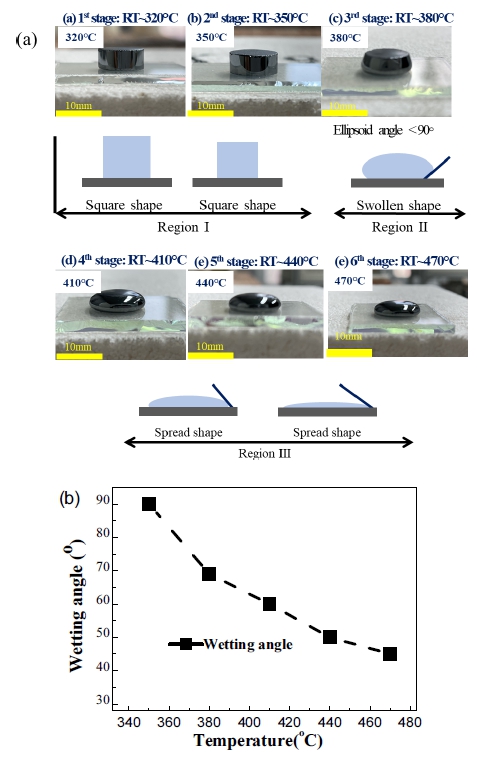
As can be seen in Fig. 3, it can be confirmed that this is the first section indicating the ‘Good wetting’ characteristic. In the last three steps, the melting state of glass sample at every 30 °C from 410 °C to 470 °C can be presented in the form of ‘Spread shape’. At this time, the wetting angles of the chalcogenide glass samples at each melting temperature were measured to be 60°, 50°, and 45°, respectively. Through this wetting test, it was confirmed that the viscous flow of the chalcogenide glass sample at 470 °C was suitable for sealing process. This means that this sample does have good wetting performance at this temperature.
Multispectral ZnS substrates are to be sealed each other using chalcogenide glass disk. First, two double-sided polished Multispectral ZnS substrates (20 × 30 × 4 mm) and chalcogenide glass disks (5 × 5 mm, thickness 0.5~1 mm) were polished for sealing. After placing chalcogenide glass disks between MS ZnS substrates in a sandwich method using a self-made jig, pressure was applied using the 300 g or 400 g of brass block inside the electric furnace, the heating rate was 5 °C/min and the melting temperature was 440~485 °C for 1 h under N2. As shown in the Fig. 5, chalcogenide glass disk was not completely melted after melting at 440 °C for 1 h, and cracks occurred due to stress during cooling. A spread shape occurred in melting for 60 min at a temperature of 470 °C, where the viscous flow of chalcogenide glass disk obtained in the relatively wetting test was the best. It was found that the temperature rise was necessary because the relatively smooth surface was not observed. It seems that the relative temperature blocking effect appeared when placing the MS ZnS substrates and brass block on top of the chalcogenide sealing glass. Therefore, it was melted at a temperature of 485 °C for 60 min to improve the homogeneity of the inside of the sealed surface of MS ZnS substrates. It was shown that the chalcogenide sealing glass performed homogeneous sealing between the MS ZnS substrates. Considering the Tc = 490 °C of 27.5Ge12.5Sb60Se chalcogenide glass as shown in Fig. 1(a), heat sealing process at 485 °C for 60 min resulted the homogeneous surface without internal defects or crystallization.
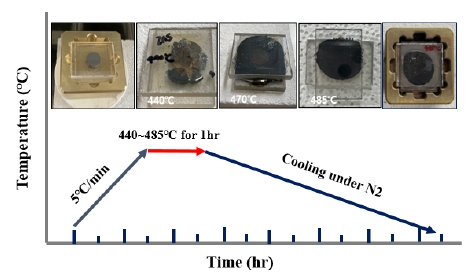
Fig. 6(a) is a graph predicting the infrared transmission loss through Macleod program when MS ZnS and 27.5Ge 12.5Sb60S glass are bonded. It presented the simulation of transmittance of 4 mm thick MS ZnS substrate in the region 3~12 μm and MS ZnS substrates sealed with 0.2 mm thick 27.5Ge12.5Sb60S glass without air gap. The transmittance of two of 4 mm MS ZnS substrates sealed with 27.5Ge12.5 Sb60S glass was plotted as a function of inserted chalcogenide thickness as shown in Fig. 6(b). The 27.5Ge12.5Sb60S glass samples used in this experiment were prepared by polishing down to 1 mm, 0.9 mm and 0.65 mm, respectively. As a result of the experiment, the chalcogenide glass sample having a smaller thickness showed relatively higher transmittance.
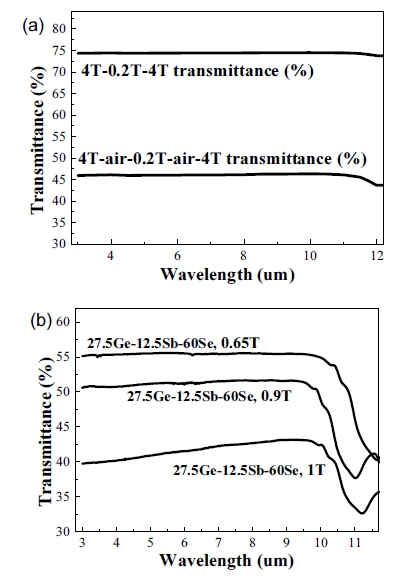
Fig. 6
Transmittance of (a) single and double MS ZnS substrates and (b) sealed MS ZnS substrates with 27.5Ge12.5Sb60S glass disk as a function of thickness.
The tensile strength is one of the general tests for evaluating the properties of sealing property. The sealing strength of the junction between the chalcogenide glass and MS ZnS substrates was evaluated using a tensile strength tester (Shimadzu, AG-X). As shown in inset of Fig. 7, the tensile strength test was conducted with the MS ZnS substrates sealed at 485 °C, which showing the homogeneous sealing state. Fig. 7(a) is a schematic diagram of the sealed MS ZnS substrates mounted on a jig for tensile strength test. It can be confirmed that the sealed MS ZnS substrates is positioned on the jig composed of up and down. Fig. 7(b) is a graph showing the change in tensile load during tensile strength test over time. ‘Max’ shown in the graph represents the strength at the point of fracture.
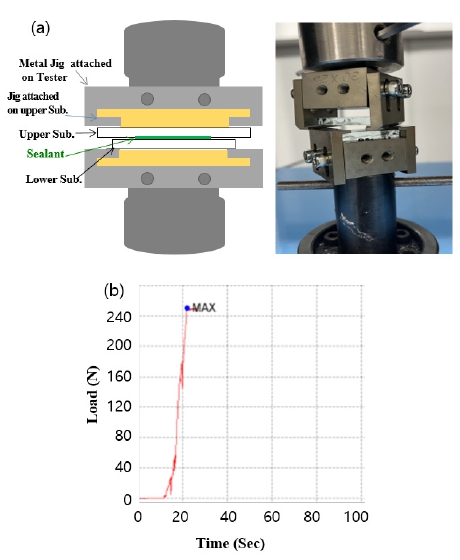
The tensile strength of the sealed MS ZnS substrates is maintained up to a maximum load of about 240 N. Compared to the results of tensile strength of samples bonded with PbObased or V2O5-based sealing glass in previous studies,6,7) the value of the tensile strength was shown at a load of about 100 N in this work showed relatively high tensile strength.6,7) There are various variables which can be applied to the tensile strength. A. Della Bona and R. van Noort et al. reported that different bond strengths were caused by the difference in modulus of elasticity of substrate materials created in surface treatment.15) In this experiment, chalcogenide glass disk and MS ZnS substrates are polished to a surface roughness of λ/4 or less which enable the physical difference is relatively small. It is thought that the effect on bonding strength is expected to be small because of surface roughness. Therefore, the chalcogenide glass applied in this study led to relatively high bonding strength even when compared to PbO-based or V2O5- based sealing glass, confirming its suitability as a sealing material.
4. Conclusion
The 27.5Ge12.5Sb60Se chalcogenide glass was fabricated to be used as infrared transmitted and sealing materials. The durability of MS ZnS substrates was improved by sealing 27.5Ge12.5Sb60Se chalcogenide glass. After the sealing test was performed at a temperature of 485 °C for 60 min, it was founded that the tensile strength is maintained up to a maximum load of about 240 N confirming its suitability as a sealing material as well as maintaining the 55 % of transmittance between 8~12 μm. The results indicated the feasibility of double sealed MS ZnS window or dome with higher durability under harshment environment conditions.