


1. Introduction
2. Experimental Procedure
2.1. Materials
2.2. Synthesis of Cu nanosheets
2.3. Preparation of Cu-decorated MgO fillers
2.4. Preparation of filler-epoxy composites
3. Results and Discussion
4. Conclusion
1. Introduction
Efficient thermal management has become a critical challenge for next-generation electronic devices owing to the increasing power density and miniaturization of semiconductor packages, power modules, light-emitting diodes, electric vehicles, and communication systems.1,2,3) Excessive heat accumulation not only degrades device performance but also accelerates material degradation and significantly shortens operational lifetime.4,5) Accordingly, polymer-based thermal interface materials have attracted considerable attention owing to their excellent processability, lightweight nature, electrical insulation, and compatibility with large-area manufacturing.6,7,8,9) However, the intrinsically low thermal conductivity of polymer matrices (typically below 0.3 W/m・K) hinders their practical applications in advanced thermal management systems.3) The incorporation of inorganic fillers with high thermal conductivity is a widely adopted strategy for improving the thermal conductivity of polymer composites.1,8,10,11) Ceramic fillers, such as Al2O3, AlN, BN, SiC, and MgO, have been extensively investigated because they offer both high thermal conductivity and excellent electrical insulation.10,12,13) Among them, MgO has emerged as an attractive filler owing to its relatively high intrinsic thermal conductivity, low dielectric constant, excellent chemical stability, and low material cost.10,14) Moreover, MgO exhibits good compatibility with epoxy matrices and has a thermal expansion coefficient comparable to that of many electronic substrates, making it suitable for electronic packaging applications.1,10,15)
Although increasing filler loading generally increases the thermal conductivity of composites, the increase eventually plateaus because heat transport becomes increasingly dominated by interfacial thermal resistance rather than by the intrinsic thermal conductivity of individual fillers. Numerous interfaces are generated between neighboring fillers and between fillers and the polymer matrix, leading to substantial phonon scattering and inefficient heat transport. In addition, inefficient particle packing leaves interstitial voids between adjacent fillers, limiting the formation of continuous thermal conduction pathways throughout the composites. In particular, commercial ceramic fillers generally exhibit narrow particle-size distributions, leading to considerable amounts of interstitial space between neighboring particles after composite fabrication.12,16,17) These void regions are predominantly occupied by the polymer, the thermal conductivity of which is a few orders of magnitude lower than that of ceramic fillers. Therefore, even at high filler loadings, polymer-rich regions interrupt continuous heat- conduction pathways, limiting effective thermal transport. Several approaches have been proposed to address the aforementioned limitations. For example, hybrid fillers with multiple particle sizes can be used to improve the packing density by allowing smaller particles to fill the voids between larger particles.12,16,18) Such hierarchical packing reduces the polymer volume fraction within the filler network and increases the number of direct filler-filler contacts, thereby facilitating phonon transport. Nonetheless, the thermal resistance at ceramic-ceramic interfaces remains high because of the limited contact area between neighboring MgO particles, and surface roughness and residual epoxy trapped at the interfaces hinder efficient heat transfer.
Another promising strategy involves the incorporation of metallic fillers with intrinsically high thermal conductivity.1,18,19) The thermal conductivities of metals such as Ag, Cu, and Al are several orders of magnitude higher than those of polymers, and these metals can effectively bridge neighboring ceramic particles.19,20) Among them, copper is particularly attractive because of its excellent thermal conductivity (~400 W/m・K), low cost, and high industrial availability. Recent studies have demonstrated that metallic coatings or metallic nanostructures deposited on ceramic surfaces form efficient thermal bridges and can substantially reduce interparticle thermal resistance.19,20,21) Nevertheless, excessive metallic filler incorporation often compromises electrical insulation and may degrade composite processability owing to particle agglomeration.1,10,18,22) Therefore, simultaneously improving filler packing efficiency and reducing interfacial thermal resistance remains a crucial challenge in the development of high-performance thermally conductive polymer composites.
In this study, we propose a hierarchical interstitial-site engineering strategy combined with Cu nanosheet surface modification to simultaneously optimize filler packing and thermal transport. First, spherical MgO microparticles were employed as the primary thermally conductive filler. Smaller MgO particles were subsequently introduced to fill the interstitial spaces between the larger particles, significantly increasing packing density and leading to the formation of a dense three-dimensional thermal-conduction network. Subsequently, Cu nanosheets were uniformly deposited onto the MgO surface to form localized metallic bridges between neighboring ceramic particles while maintaining the structural integrity of the insulating MgO framework. The influence of hierarchical filler networks on thermal transport was investigated using polymer composites containing up to 90 wt% hybrid fillers. The combined effects of hierarchical particle packing and Cu-mediated interfacial bridging on the microstructure and thermal conductivity were systematically investigated. The optimized composite exhibited a thermal conductivity of 4.8 W/m・K, corresponding to a 33% increase compared to that of the pristine MgO composite (3.6 W/m・K). This strategy provides an effective route for simultaneously minimizing polymer-rich interstitial regions and interfacial thermal resistance, offering a scalable approach for the fabrication of high- performance thermally conductive polymer composites used in advanced thermal management applications.
2. Experimental Procedure
2.1. Materials
Magnesium oxide (MgO, 120 µm) and aluminum oxide (Al2O3) with three different sizes (3, 20, and 90 µm) powders were purchased from Denka Korea Co., Ltd. (Seoul, Republic of Korea). MgO (≥ 99 %, 325 mesh) was purchased from Sigma-Aldrich. The diglycidyl ether of bisphenol A (DGEBA) monomer, methyl tetrahydrophthalic anhydride (MTHPA), and benzyldimethylamine (BDMA) were purchased from Kukdo Chemical Co., Ltd. (Seoul, Republic of Korea). Copper (II) chloride dihydrate (CuCl2・2H2O, 99.0 %), hexadecylamine (HDA, 98 %), glucose (≥ 99.5 %), chloroform (≥ 99.5 %) and iodine (≥ 99.8 %) were purchased from Sigma-Aldrich.
2.2. Synthesis of Cu nanosheets
Cu nanosheets were synthesized through a solution-phase reduction process following a previously reported procedure.21,22,23,24) Initially, 37.8 g of iodine (when applicable) was dissolved in 1.2 L of deionized (DI) water, followed by the addition of 7.56 g of CuCl2・2H2O. 62.88 g of HDA was then added, and the mixture was heated to 80 °C under continuous stirring for 3-4 h until complete dissolution. After cooling to room temperature, 8.76 g of glucose was added, and the reaction mixture was heated to 100 °C under continuous stirring (500 rpm) for 16 h to produce the Cu nanosheets. After completion of the reaction, the Cu nanosheets were collected by centrifuging the resulting solution at 4,000 rpm for 5 min. The collected precipitate was washed with chloroform and subsequently with DI water, with each washing step carried out by centrifugation at 8,000 rpm for 10 min. The purified Cu nanosheets were stored in chloroform for subsequent experiments.
2.3. Preparation of Cu-decorated MgO fillers
Cu nanosheets were deposited onto MgO-120 particles through a physical adsorption process assisted by ultrasonication. 4 g of MgO-120 powder was dispersed together with Cu nanosheets suspended in 10 mL of chloroform. The concentration of the Cu nanosheet stock suspension was determined from the recovered mass of Cu nanosheets, and the amount of Cu added was adjusted to achieve Cu loadings of 0, 1, 2, 4, 10, 17, and 23 wt% in the final Cu-decorated MgO powders. The MgO suspension and Cu dispersion were mixed using a probe-type ultrasonicator operating in pulse mode (10 s on/ 10 s off) at 40 % amplitude for a total sonication time of 45 min. After sonication, the suspension was left in an open container at room temperature to allow complete evaporation of the chloroform. The resulting powders were designated as Cu-decorated MgO hybrid fillers.
2.4. Preparation of filler-epoxy composites
Cu-decorated MgO/epoxy composites were fabricated with filler loadings of 60, 80, and 90 wt%. The composites were designated as MgO/Cu-120-60, MgO/Cu-120-80, and MgO/ Cu-120-90, where “120” denotes the average MgO particle size (120 µm) and the suffix indicates the filler loading (wt%) in the composite. Predetermined amounts of filler and epoxy resin consisting of 10 g of DGEBA, 9 g of MTHPA, and 0.1 g of BDMA were mixed using a planetary mixer (SK -350TII, SHASHIN KAGAKU CO., LTD., Kusatsu, Shiga, Japan) at 800 rpm for 90 s to obtain a homogeneous mixture. The mixture was then transferred into a cylindrical mold (12.7 mm in diameter and 2 mm in height) and cured by hot pressing (QM900M) at 150 °C under 50 MPa for 40 min to ensure adequate densification and minimize void formation. For the 60 wt% filler loading, the composite was molded without hot pressing because its relatively low viscosity enabled complete mold filling without the application of pressure. The reference MgO-only composites and Al2O3- filled composites were prepared in the same way. The morphologies of the pristine Al2O3 and MgO particles are shown in Fig. S1 and Fig. S2, respectively. The smaller sized MgO-40 particles were introduced as secondary fillers to occupy the interstitial spaces between the primary 120 µm MgO particles. Here, the amounts of MgO-120 and epoxy were fixed, while the amount of MgO-40 was varied. The specific amounts of the components are listed in the Tables S1-S3.
3. Results and Discussion
Scanning electron microscopy (SEM) images of Al2O3-3, 20, 90 and MgO-120 fillers with average particle sizes of approximately 3, 20, 90, and 120 µm, respectively, are shown in [Fig. 1(a-d)]. All fillers exhibited a nearly spherical morphology. However, the Al2O3 particles exhibited smoother surfaces, whereas the MgO particles exhibited rough surfaces with microscopic grooves depending on the sintering conditions. These surface features are expected to reduce the contact area between neighboring particles and increase the interfacial thermal resistance in highly filled composites, even though the intrinsic thermal conductivity of MgO (~45-60 W/m・K) is substantially higher than that of Al2O3 (~20-35 W/m・K). The crystal structures of the ceramic fillers were examined via X-ray diffraction (XRD) [Fig. 1(e)]. All XRD peaks of Al2O3 were indexed to the α-Al2O3 (corundum) phase with a rhombohedral crystal structure (space group R-3c, No. 167; a = 4.785 Å and c = 12.99 Å). The MgO fillers exhibited a cubic rock-salt structure (space group Fm-3m, No. 225; a = 4.21 Å). No impurity phases or secondary crystalline phases were detected in either ceramic filler, indicating their high phase purity and crystallinity. Phonon transport within ceramic particles is highly sensitive to crystallographic defects and impurity scattering. Accordingly, the absence of secondary phases indicates that impurity-induced phonon scattering is negligible in both fillers.
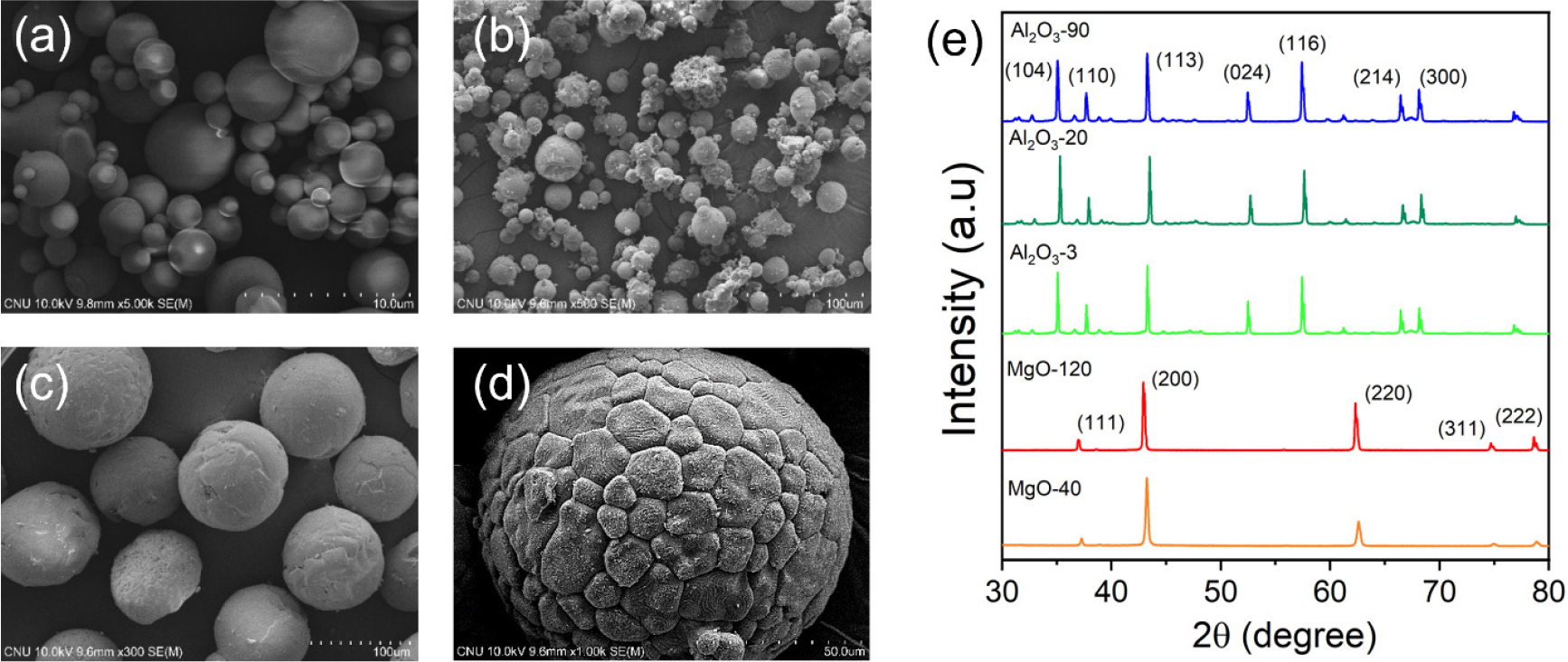
Fig. 2(a-d) shows cross-sectional SEM images of epoxy composites containing 90 wt% ceramic fillers (i.e., Al2O3 and MgO). Additional cross-sectional SEM images of the Al2O3 composites at various magnifications are shown in Fig. S3. All composites exhibited densely packed ceramic particles embedded in the polymer matrix. However, numerous interstitial regions were observed between neighboring particles regardless of the filler type. These interparticle voids were occupied by the epoxy resin, resulting in the formation of multiple ceramic-polymer-ceramic interfaces along the heat- flow pathway, which, in turn, interrupted the formation of continuous thermally conductive networks. The thermophysical properties of the composites are summarized in Fig. 2(e-h). As the filler loading increased from 20 to 90 wt%, the specific heat capacity (Cp) decreased gradually from approximately 1.20 J/g・K for neat epoxy to 0.78 and 0.92 J/g・K for Al2O3- filled and MgO-filled composites, respectively [Fig. 2(e)]. This reduction originates from the ceramic fillers with lower heat capacities (0.88 J/g・K for Al2O3 and 0.923 J/g・K for MgO) replacing the epoxy matrix (1.10 J/g・K). The composite density (ρ) increased almost linearly with filler loading from approximately 1.20 g/cm3 for neat epoxy to 3.20 and 2.85 g/cm3 for the Al2O3-filled and MgO-filled composites at 90 wt% [Fig. 2(f)]. The thermal diffusivity (α) increased only marginally at filler concentrations below 40 wt%, and it remained below ~0.30 mm2/s for all filler systems because the ceramic particles were largely isolated by the surrounding epoxy [Fig. 2(g)]. In contrast, at filler loading above 60 wt%, the thermal diffusivity increased rapidly, indicating the formation of increasingly interconnected heat-conduction pathways. At 90 wt%, the MgO-filled composite exhibited the highest thermal diffusivity of approximately 1.40 mm2/s, whereas the Al2O3-filled composites exhibited thermal diffusivities ranging from 1.03 to 1.30 mm2/s, depending on the particle size.
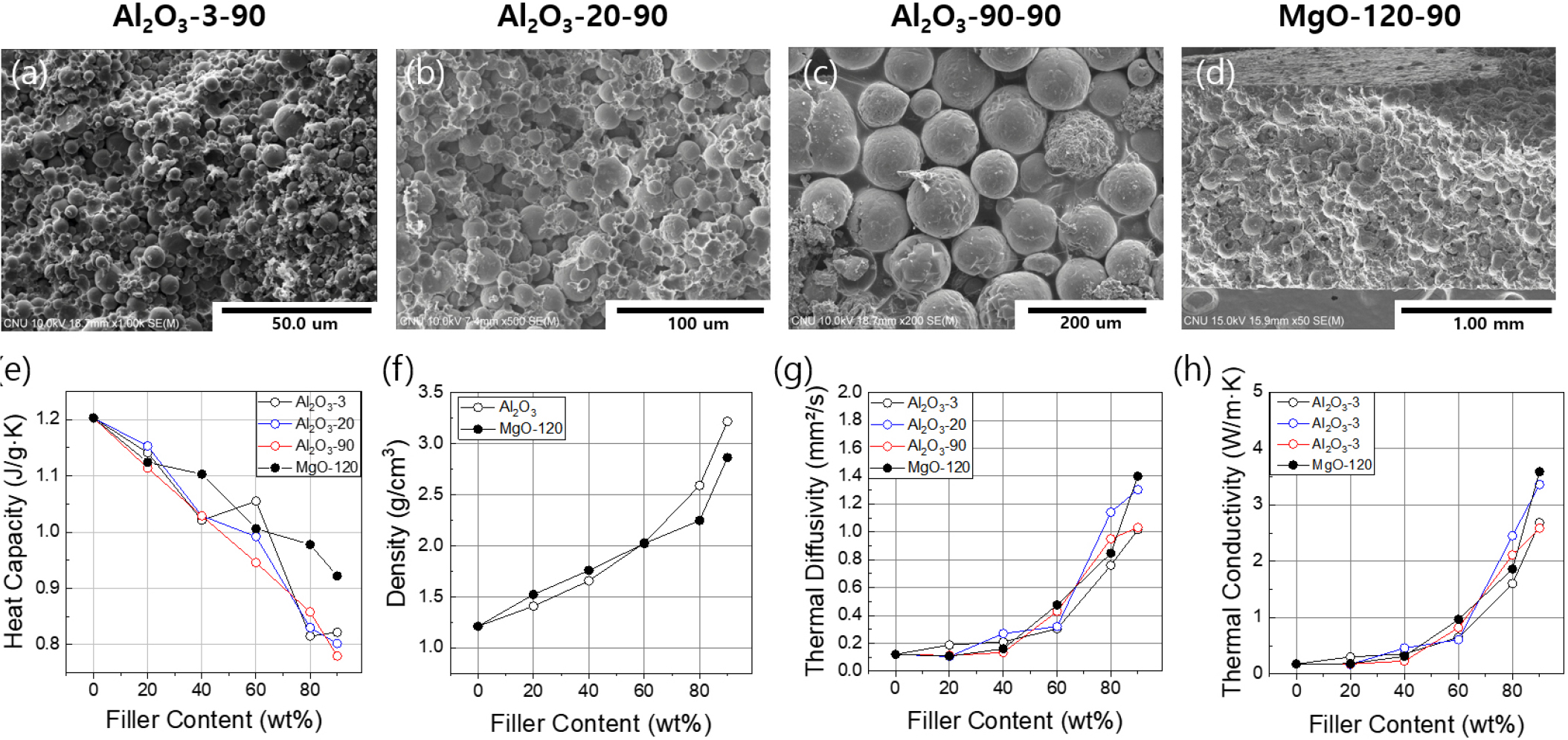
Fig. 2.
Microstructure and thermophysical properties of epoxy composites containing Al2O3 and MgO fillers. Cross-sectional SEM images of epoxy composites containing (a) Al2O3-3, (b) Al2O3-20, (c) Al2O3-90, and (d) MgO-120 fillers at 90 wt% filler loading. Dependence of (e) specific heat capacity, (f) density, (g) thermal diffusivity, and (h) thermal conductivity on the filler type and loading.
The thermal conductivity was calculated as k = α・ρ・Cp, where α, ρ, and Cp denote the thermal diffusivity, density, and specific heat capacity, respectively. As shown in Fig. 2(h), the trends for thermal conductivity were linear and similar to those for thermal diffusivity. Increasing the filler loading from 20 to 60 wt% resulted in only a modest increase in thermal conductivity from approximately 0.2-0.3 to 0.6- 1.0 W/m・K. In contrast, the thermal conductivity increased considerably above 80 wt% filler loading, at which the average interparticle distance was small enough to facilitate the formation of continuous heat-transfer pathways. At 90 wt%, the MgO-filled composite exhibited the highest thermal conductivity of approximately 3.6 W/m・K, and the Al2O3- filled composites exhibited thermal conductivities ranging from 2.6 to 3.4 W/m・K. Although the intrinsic thermal conductivity of MgO (~45-60 W/m・K) is substantially higher than that of Al2O3 (~20-35 W/m・K), the improvement in the thermal conductivity of the composite was relatively modest. These results indicate that the intrinsic thermal conductivity of ceramic fillers is not the primary factor governing heat transport in composites with high filler loading. Instead, heat transfer is predominantly limited by thermal resistance at neighboring particle contacts. Numerous epoxy-filled interstitial regions interrupt direct ceramic-ceramic contacts, forcing heat transfer through the low-thermal-conductivity polymer matrix [Fig. 2(a-d)]. Moreover, actual contact between adjacent spherical particles occurs only over localized asperities rather than across entire particle surfaces, leading to significant heat resistance associated with the large acoustic mismatch between the inorganic ceramic fillers and the organic epoxy matrix.25,26) Therefore, engineering the filler packing structure to minimize polymer-rich interstitial regions while increasing the effective contact area between neighboring particles can be an effective route toward constructing continuous heat- conduction networks with reduced interfacial thermal resistance.
Smaller MgO particles (MgO-40) were introduced into the MgO-120/epoxy composite as secondary fillers while maintaining the primary MgO-120 framework. Fig. 3(a-c) show cross- sectional SEM images of the MgO-120-90 composites containing 0.4, 1.2, and 2.0 g of MgO-40, respectively. Compared with that in the monomodal MgO-120 composite shown in Fig. 2(d), MgO-40 introduction progressively reduced the polymer- rich interstitial regions between neighboring MgO-120 particles. At a MgO-40 content of 0.4 g, numerous fine particles occupied the voids between adjacent MgO-120 particles while preserving the original particle framework [Fig. 3(a)]. Increasing the MgO-40 content to 1.2 g resulted in a denser ceramic packing, where most of the interstitial spaces were filled by the secondary particles [Fig. 3(b)]. A further increase in the MgO-40 content to 2.0 g resulted in nearly complete occupation of the interparticle voids, resulting in a highly compact ceramic skeleton throughout the composite [Fig. 3(c)]. The packing evolution of MgO fillers was evident in higher-magnification SEM images [Fig. 3(d-f)]. As the MgO-40 content increased to 1.2 g, the smaller particles effectively bridged adjacent MgO-120 particles, significantly reducing the separation distance between neighboring fillers [Fig. 3(e)]. At the highest MgO-40 loading, the secondary particles almost completely occupied the interstitial regions, resulting in extensive ceramic-ceramic contacts and a much more continuous three- dimensional filler network [Fig. 3(f)].
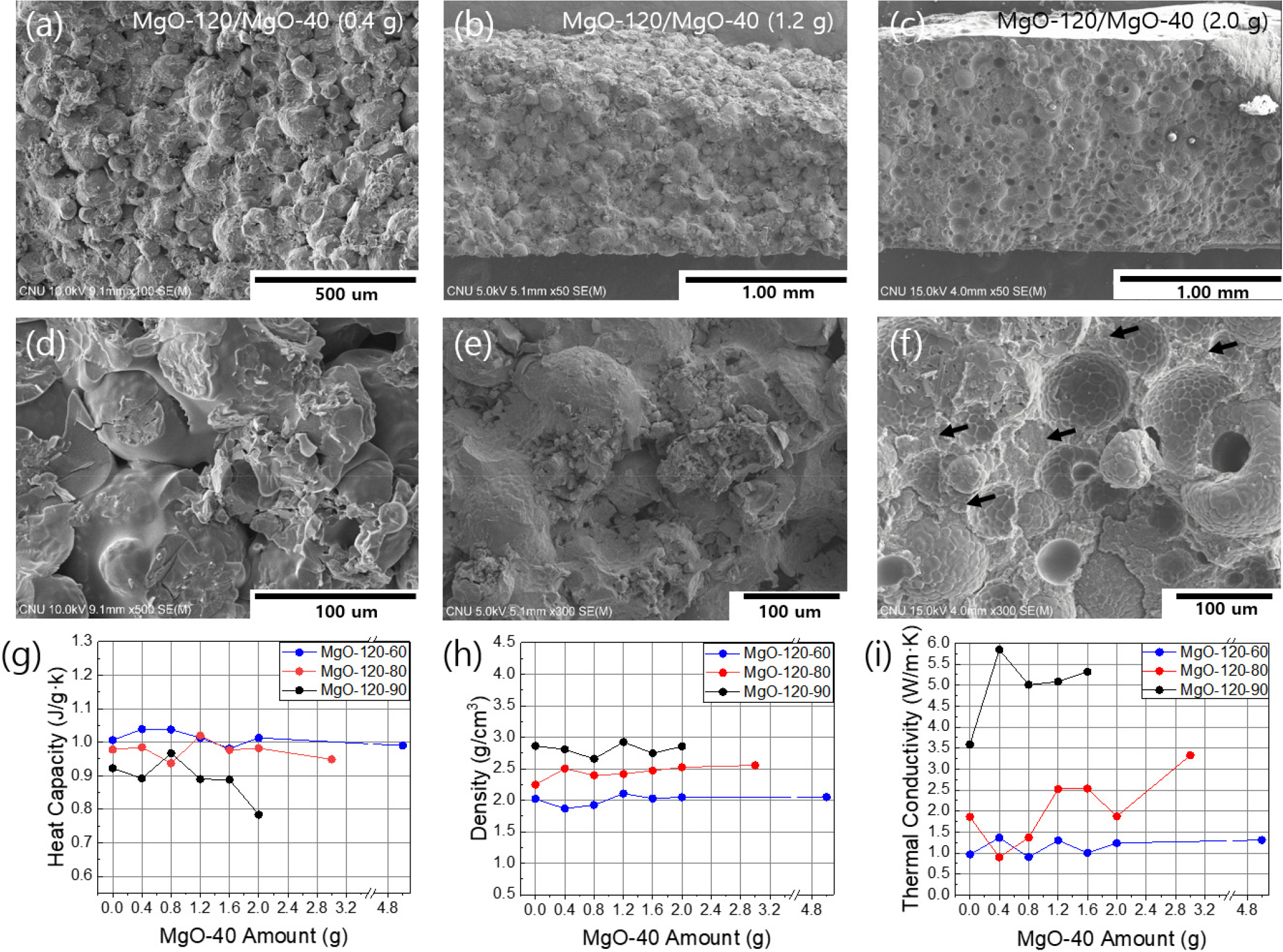
Fig. 3.
Interstitial-site engineering using bimodal MgO fillers. Cross-sectional SEM images of epoxy composites prepared by introducing (a) 0.4, (b) 1.2, and (c) 2.0 g of MgO-40 into the MgO-120 (90 wt%) composite. High-magnification SEM images of the corresponding composites with (d) 0.4, (e) 1.2, and (f) 2.0 g of MgO-40. Dependence of (g) specific heat capacity, (h) density, and (i) thermal conductivity on the MgO-40 content.
The specific heat capacity increased only marginally with increasing MgO-40 content owing to identical compositions of the primary and secondary fillers [Fig. 3(g)]. The variation in composite density was also marginal with increasing MgO-40 content [Fig. 3(h)], and the densities of the MgO-120-60, MgO-120-80, and MgO-120-90 composites were approximately 2.0, 2.5, and 2.8 g/cm3, respectively. In contrast, the thermal conductivity exhibited a markedly different trend [Fig. 3(i)]. For the 60 wt% composites, the thermal conductivity remained nearly constant at approximately 1.0-1.3 W/m・K, indicating that the relatively low filler loading was insufficient to lead to the formation of an interconnected ceramic network, despite the introduction of smaller MgO-40 particles. However, at 80 wt% filler loading, the thermal conductivity increased from 1.85 W/m・K for the monomodal MgO-120 composite to 3.30 W/m・K after the addition of 3.0 g of MgO-40, corresponding to an increase of approximately 78 %. For the 90 wt% composites, the thermal conductivity increased from 3.58 W/m・K (without MgO-40) to a maximum of 5.80 W/m・K after the addition of 0.4 g of MgO-40. Although the introduction of secondary MgO-40 particles effectively reduced polymer-rich interstitial regions, the thermal conductivity did not increase monotonically with increasing MgO-40 content [Fig. 3(i)]. Instead, noticeable fluctuations were observed, particularly at higher MgO-40 loadings, owing to significant increases in the slurry viscosity. The addition of fine MgO-40 particles reduces mixing homogeneity and promotes local filler agglomeration during composite fabrication. Consequently, excessive incorporation of secondary fillers can deteriorate filler dispersion and limit the reproducible increase of thermal transport.
Although interstitial-site engineering effectively reduced polymer-rich regions between neighboring MgO particles, the thermal conductivity remained limited by the interfacial resistance at MgO-MgO contacts. To further improve interparticle heat transport, two-dimensional (2D) Cu nanosheets were introduced onto the MgO-120 surface to construct hybrid ceramic-metal fillers (Fig. 4). The synthesized Cu nanosheets exhibited well-defined 2D platelet structures with smooth surfaces, sharp edges, and an average lateral size of 2.50 ± 1.10 µm [Fig. 4(a)]. The (111), (200), and (220) planes of face-centered cubic Cu were observed in the XRD patterns, confirming the high crystallinity of the metallic nanosheets without detectable impurity phases [Fig. 4(b)]. Unlike conventional mechanical mixing of ceramic and metallic fillers, the Cu nanosheets were immobilized onto the MgO- 120 surface via ultrasonication-assisted assembly [Fig. 4(c)]. Repeated cavitation and microstreaming during ultrasonication promote intimate collisions between the nanosheets and MgO-120 particles, resulting in the selective adsorption of Cu nanosheets onto the ceramic surface rather than random aggregation in solution.27,28,29)
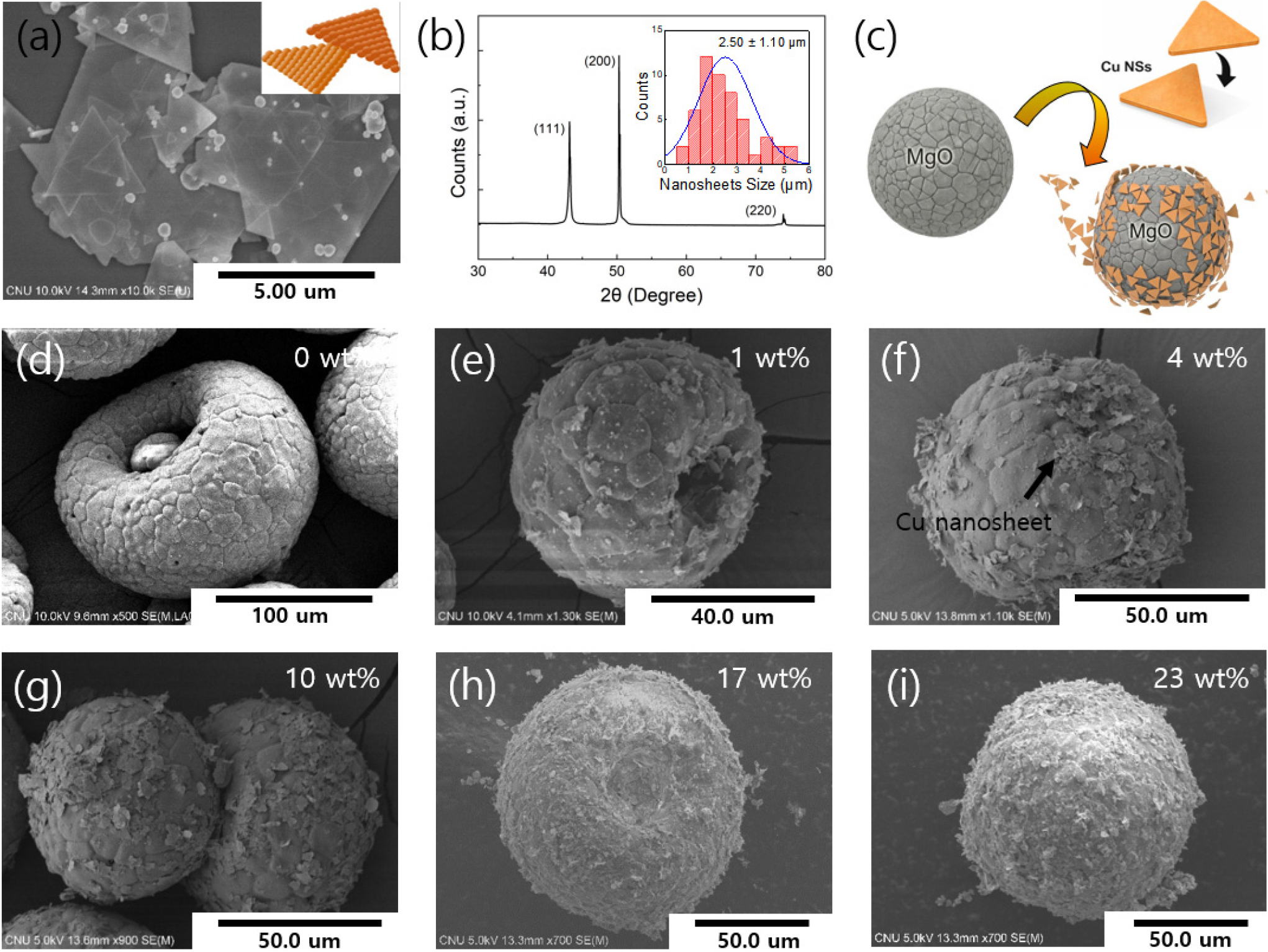
Fig. 4.
Surface modification of hierarchical MgO-120 fillers using Cu nanosheets. (a) SEM image of Cu nanosheets (inset: schematic of the Cu nanosheet morphology). (b) XRD pattern of the Cu nanosheets (inset: size distribution). (c) Schematic of Cu nanosheet deposition on MgO-120 fillers. SEM images of MgO-120 fillers coated with (d) 0, (e) 1, (f) 4, (g) 10, (h) 17, and (i) 23 wt% Cu nanosheets.
The evolution of the MgO-120 surface with increasing Cu content is shown in [Fig. 4(d-i)]. At a Cu nanosheet content of 1 wt%, a small number of Cu nanosheets were sparsely distributed over the particle surface [Fig. 4(e)]. As the Cu content increased to 10 wt%, the Cu nanosheet density increased, and partially interconnected metallic domains began to form [Fig. 4(f, g)]. A further increase in the Cu loading to 17-23 wt% resulted in nearly continuous surface decoration, where the MgO-120 particles were uniformly covered by densely packed Cu nanosheets while preserving the original spherical morphology of the ceramic particles [Fig. 4(h, i)]. Such progressive surface decoration is expected to play an important role in reducing the interparticle thermal resistance after composite fabrication. Because Cu features a much higher thermal conductivity (~400 W/m・K) and substantially greater ductility than brittle MgO, the deposited nanosheets can deform more readily during composite processing and establish larger effective contact areas between neighboring particles. Thus, the Cu nanosheets serve as localized thermally conductive bridges that improve physical contact between adjacent MgO-120 particles, thereby reducing the thermal boundary resistance across the filler network without disrupting the overall ceramic framework.30)
The uniform deposition of Cu nanosheets on the MgO surface was verified via SEM-EDS (energy-dispersive X-ray spectroscopy) elemental mapping of the Cu-decorated MgO fillers (Fig. 5). SEM images revealed that the overall morphology of the MgO particles was well preserved after surface modification, indicating that Cu deposition did not induce noticeable particle degradation or severe agglomeration [Fig. 5(a)]. The corresponding elemental maps are presented in [Fig. 5(d-f)]. The Mg and O signals were uniformly distributed, confirming the presence of a MgO framework [Fig. 5(d, e)]. Furthermore, the Cu map indicated a homogeneous distribution over the entire particle surface rather than localized aggregation [Fig. 5(f)]. This observation indicates that the Cu nanosheets were successfully anchored to the MgO surface by the deposition process, resulting in hybrid ceramic-metal fillers with a relatively uniform surface coverage. The overlap of the Mg, O, and Cu elemental maps and the corresponding EDS spectrum further demonstrated that the Cu domains were spatially correlated with the MgO particles, confirming that the metallic phase exists predominantly as surface- decorated particles rather than as isolated Cu agglomerates [Fig. 5(b, c)]. These interfacial metallic domains are expected to function as localized thermal bridges that facilitate heat transfer across adjacent ceramic particles. Furthermore, surface-decorated Cu minimizes the amount of metal required to improve thermal transport while maximizing effectiveness at particle-particle contact regions. Therefore, the proposed architecture simultaneously preserves the electrically insulating ceramic framework and improves thermal conduction through localized reduction of interfacial thermal resistance. Although Cu nanosheets are intrinsically conductive, macroscopic electron transport is effectively prevented by controlling their deposition concentration below the percolation threshold. The 2D Cu nanosheets conformally adhere to the rough MgO surface, forming localized thermal bridges while remaining electrically isolated by the insulating MgO framework and the epoxy matrix. Therefore, this interfacial bridging enhances thermal conductivity without degrading the electrical insulation stability of the composite.
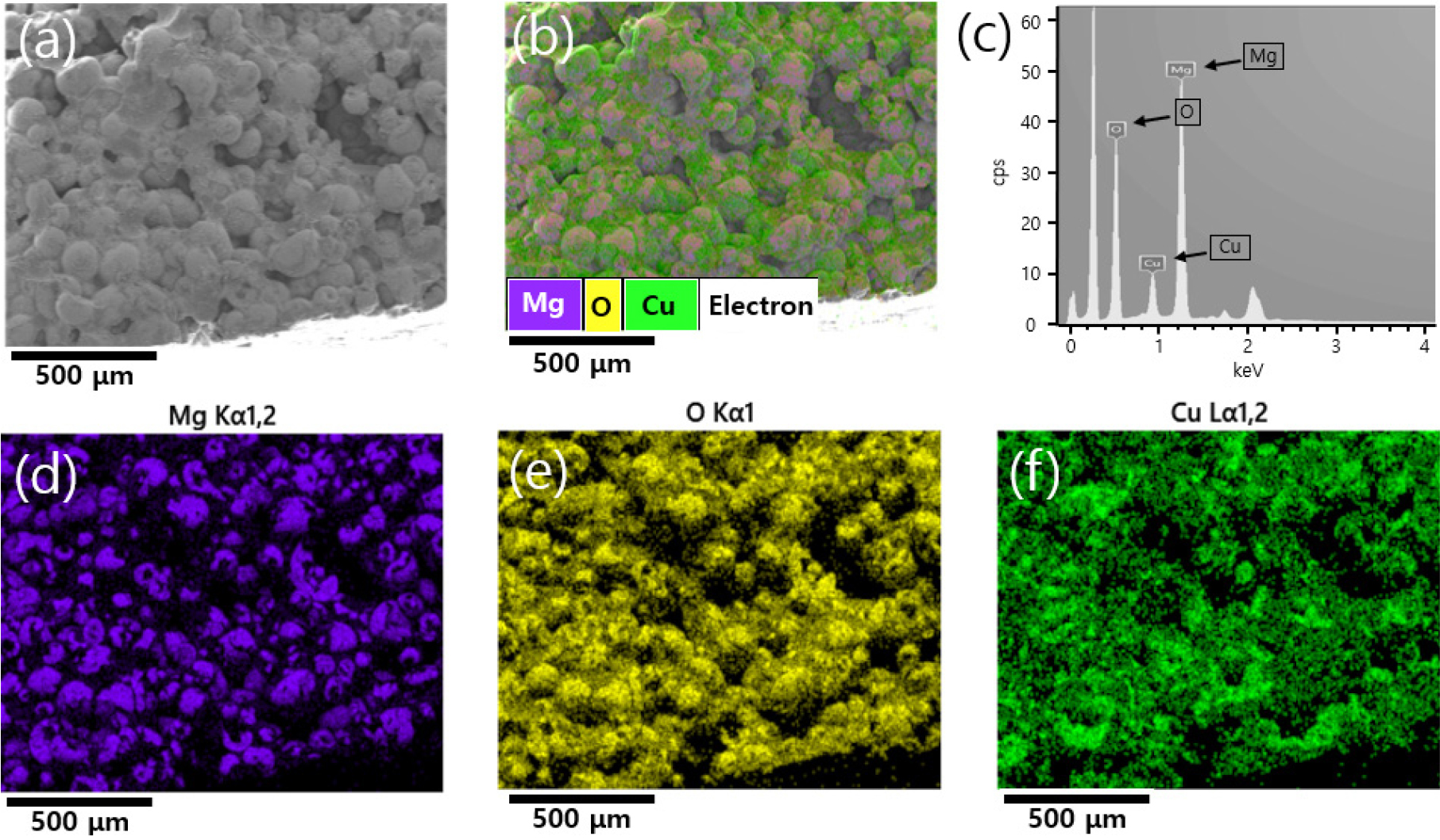
Fig. 5.
SEM-EDS elemental mapping of Cu-coated MgO-120 fillers. (a) Cross-sectional SEM image of the MgO/Cu hybrid filler and the corresponding (b) overlay elemental map and (c) EDS spectrum. EDS elemental maps of (d) Mg, (e) O, and (f) Cu confirming the uniform distribution of Cu nanosheets on the MgO surface.
The practical impact of the Cu-decorated MgO fillers was evaluated by fabricating epoxy composites containing pristine MgO and Cu-decorated MgO fillers at identical total filler loadings of 60, 80, and 90 wt% (Fig. 6). As revealed by representative cross-sectional SEM images, the Cu nanosheets remained preferentially attached to the MgO surface after composite fabrication and were located primarily within the microscopic grooves and contact regions between neighboring fillers [Fig. 6(a-d)]. Such selective surface decoration is expected to increase the effective contact area and reduce the interfacial thermal resistance between adjacent MgO particles. The influence of Cu decoration on thermal conductivity depended strongly on filler loading [Fig. 6(e)]. At a filler loading of 60 wt%, both pristine MgO and Cu-decorated MgO composites exhibited nearly identical thermal conductivities of ~1.0 W/m・K, indicating that the ceramic particles remain largely isolated by the epoxy matrix. Interestingly, the thermal conductivity increased from approximately 1.8 W/m・K for the pristine MgO composite to 2.3 W/m・K (~28 % increase) after Cu decoration at 80 wt%. A further increase was achieved at 90 wt%, where the thermal conductivity increased from 3.6 to 4.8 W/m・K (~33 % enhancement). This confirms that the adjacent MgO particles are brought into close contact, allowing the surface-bound Cu nanosheets to bridge neighboring fillers, thereby promoting the formation of continuous thermally conductive pathways. Owing to the high thermal conductivity and ductility of metallic Cu, these interfacial bridges effectively increase the actual contact area between adjacent particles and substantially reduce the thermal boundary resistance.
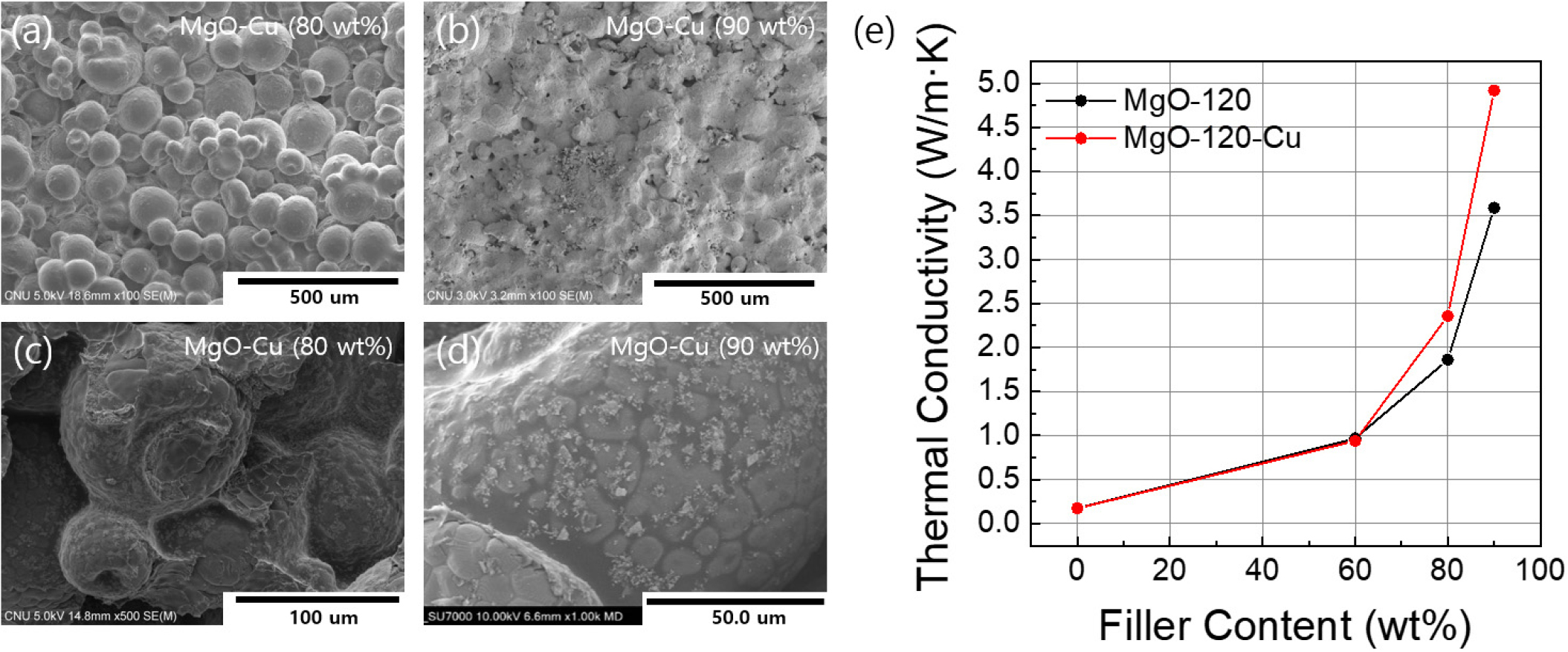
Fig. 6.
Thermal performance of epoxy composites containing Cu-coated hierarchical MgO fillers. Low-magnification SEM images of epoxy composites containing (a) 80 and (b) 90 wt% Cu-coated hierarchical MgO fillers. High-magnification SEM images corresponding to (c) 80 and (d) 90 wt% filler loading. (e) Thermal conductivity of epoxy composites as a function of filler loading (60, 80, and 90 wt%).
4. Conclusion
A hierarchical filler-network strategy combining interstitial- site engineering and Cu nanosheet-mediated interfacial bridging was developed to enhance the thermal conductivity of highly filled MgO/epoxy composites. Cu nanosheets uniformly deposited on the MgO surface served as localized thermal bridges between neighboring particles. This strategy effectively reduced polymer-rich interstitial regions and interfacial thermal resistance. As a result, the thermal conductivity increased from 1.8 to 2.3 W/m・K at 80 wt% filler loading and from 3.6 to 4.8 W/m・K at 90 wt%, corresponding to improvements of approximately 28 % and 33 %, respectively. These results demonstrate that simultaneous optimization of filler packing and particle-particle interfacial contact is an effective strategy for constructing highly efficient thermal conduction networks. The proposed approach provides a simple and scalable route for developing high-performance thermally conductive polymer composites for advanced thermal management applications.