


1. Introduction
Hydrogels are used in various fields, such as biology, medicine, and material science, and have been used in contact lenses due to their high water content and biocompatibility. 1) Hydrogel polymers consist of hydrophilic monomers allowing interaction with water, resulting in comfort and a high water content. Hydrogel materials, however, have low oxygen permeability, thus limiting the oxygen supply to the cornea, causing various ocular health complications, including corneal neovascularization, resulting in vision loss.2) To solve these problems, studies have been conducted by adding polydimethylsiloxane (PDMS) and tris-(trimethyl-silyl-propyl-methacrylate) (TRIS), etc. to greatly improve not only the mechanical and optical properties but also the oxygen permeability.3) Studies on the low wetting and durability issues due to silicon’s hydrophobic property have also been conducted.4-8)
Silane is a silicon analogue with four substituents on silicon, has excellent oxygen permeability due to its molecular structure, and has a tendency to form complexes with metals as hydrogen has higher electronegativity compared to silicon. In addition, metal elements can form a wide variety of oxides through bonding with oxygen. These oxides are used in the manufacture of microelectronic circuits, sensors, piezoelectric systems, fuel cells, surface coatings and catalysts, etc.9-13) In particular, metal oxides can exhibit unique physical and chemical properties when they exist as nano-sized particles, due to their limited size and density; as such, they have been playing an important role in various fields, including chemistry, physics, and material science.14-19) It is known that cobalt oxide has a black color in dark rust and a strong blue color depending on the concentration. Through this coloring effect, we wanted to UV protection effect and at the same time improve other physical properties such as water content and oxygen permeability.20)
This study was thus conducted to confirm the applicability of synthesized silicon materials, including silane group and cobalt oxide nanoparticles, as optical lenses, and to improve several of their properties, such as their oxygen permeability and water content. In addition, this study aimed to confirm the stability of the lenses manufactured by adding metal oxide nanoparticles to silicon hydrogel monomer, and to analyze its effect on the physical properties of the lenses.
2. Experiment
2.1 Polymerization
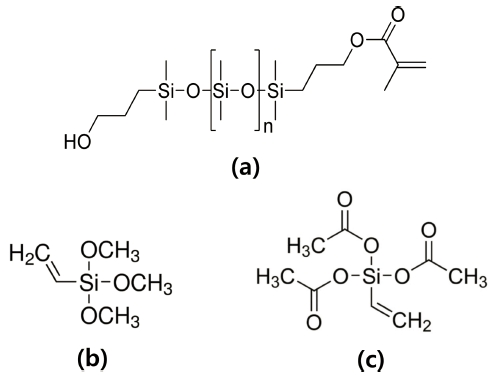
SilM (Silicon monomer), DMA (N,N–dimethyl acrylamide), MMA (methyl methacrylate), and MA (methyl acrylate) were used to manufacture contact lenses, while EGDMA (ethylene glycol dimethacrylate) was used as a crosslinking agent, and AIBN (azobisisobutyronitrile) was used as an initiator. To provide functionality to the lenses, VTMS (vinyltrimethoxysilane), TAVS (triacetoxyvinyl silane), and cobalt oxide nanoparticles of 50 nm size were used. All monomers, except for the synthesized silicon monomer, used products of Sigma-Aldrich. The structural formulas of the synthesized silicon monomer and additives that were used in the experiment are shown in Fig. 1.
To prepare the polymerization solution, it was stirred for 45 minutes at room temperature using a stirrer, then it was stirred again for another 30 min using an ultrasonic stirrer. For the polymerization method, the solution was heat-treated at 80 °C for 1 h, then heat-polymerized at 130 °C for 30 min for more stable polymerization. For the preparation, the cast-molding method was used, then the physical properties of the lenses were measured and compared after hydrating the hydrogel sample in 0.9 % normal saline for 24 h.
2.2 Experimental Analysis
The refractive indices of the manufactured lenses were measured from the contact lenses in a hydrated state using an ABBE refractometer (ATAGO DR-A1, Japan)21) and the water content was measured using the gravimetric method.22) The spectral transmittance was measured using a spectral transmittance meter (Cary 60 UV-Vis, Agilent) by categorizing it into the UV-B (280-315 nm), UV-A (315-380 nm), and visible-light regions (380-780 nm). The wetting was evaluated by measuring a contact with the sessile drop method using a contact angle measurement instrument (DSA30, Kruss GMBH).23) The oxygen permeability was measured using the polarographic method using Rehder Singlechamber System-O2 Permeometer (Rehder, USA).24) To observe the surfaces of the lenses, the roughness was examined via atomic force microscopy using SEM (Mira III, Tescan). The pH and potassium permanganate-reducing substance were measured to confirm the eluate.25) The TGA (thermogravimetric analyzer) analysis was performed to analyze the thermostability through the weight changes based on the pyrolysis temperature.
3. Results and Discussion
3.1 Fabrication and Polymerization Process
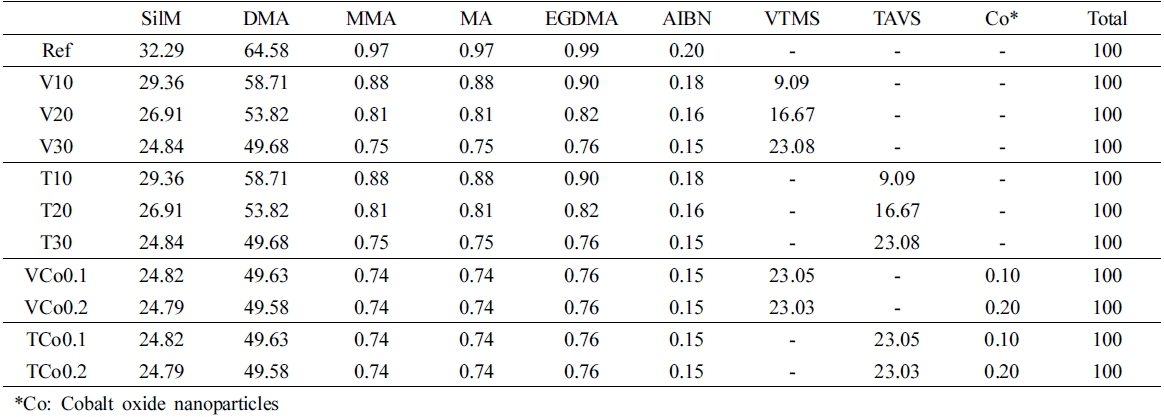
Among the samples copolymerized through the thermal polymerization method, the samples that were used in the experiment were named as follows. The experimental group with no additives was named “Ref.” The amounts of VTMS and TAVS were varied from 10 to 30 % to improve the physical properties of the lenses, and such lens samples were named “V10,” “V20,” “V30,” “T10,” “T20,” and “T30,” respectively. The most ideal combination was explored to maximize the reaction with the metal oxides, and V30 and T30, the groups with 30 % additives, were selected, then the experimental groups to which 0.1-0.2 % cobalt oxide nanoparticles were added were named “VCo0.1,” “VCo0.2,” “TCo0.1,” and “TCo0.2,” respectively. The compounding ratios of the different combinations are presented in Table 1.
3.2 Analysis of Synthesized Polymer through TGA Analysis
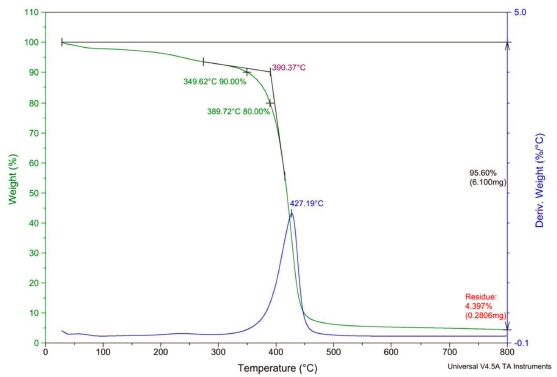
TGA analysis was conducted to investigate the thermal properties of the polymerized samples. The results of the TGA analysis of the different samples are shown in Fig. 2. The Ref sample started pyrolysis at an average temperature of 390.37 °C, and showed a peak at 427.19 °C. It was shown that 90 % of the weight remained at 349.62 °C, and that 80 % of the weight remained at 389.72 °C. The contact lens sample was found to have high thermal stability and was judged to have no effect on the physical properties regardless of whether the synthesized silicone material was copolymerized. The Ref combination was a copolymer of several monomers and showed a graph pattern similar to the pyrolysis graph of a single material; as such, it is considered to have undergone homogeneous polymerization.
3.3 Polymerization Stability
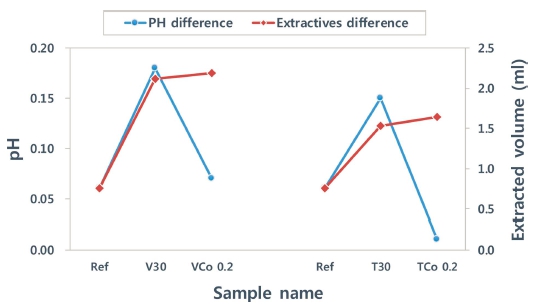
To evaluate the polymerization stability according to the additives that were used, the pH and potassium permanganate reduction tests were conducted. The Ref, V30, T30, VCo0.2, and TCo0.2 samples were compared with one another to determine whether the additives that were used (VTMS, TAVS, and cobalt oxide nanoparticles) maintain stable polymerization without dissolution. Fig. 3 shows eluate results according to the pH and potassiumpermanganate- reducing substances. The pH differences of the Ref, V30, T30, VCo0.2, and TCo0.2 manufactured lenses were 0.06, 0.18, 0.15, 0.07, and 0.01, respectively; as such, it is considered that there were no differences among all the combinations. Also in Fig. 3, the measurement of the potassium-permanganate-reducing substance showed that the values obtained for Ref, V30, T30, VCo0.2, and TCo0.2, respectively, had 0.75, 2.12, 1.53, 2.19, and 1.65 ml differences from those for Ref sample, which showed that the addition of VTMS and TAVS slightly increased the amount of eluate but the addition of cobalt oxide nanoparticles again decreased the amount of eluate. Therefore, it was determined that the combination of silane and metal oxide nanoparticles improved the polymerization of the lenses. It is considered that the bonding state with the basic monomer will be different based on the type of metal added and its ion status, and this will affect the polymerization stability; thus, further studies are needed. It is considered that continuous elution test over time is necessary for further stability verification.
3.4 Physical Properties
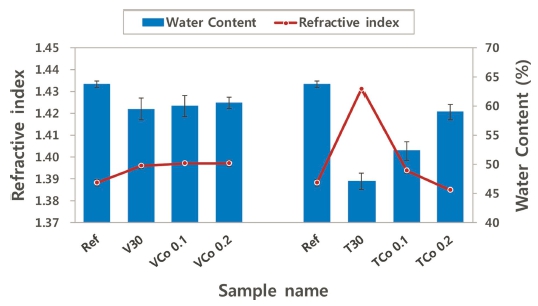
The measurement of the refractive indices of the samples manufactured through thermal polymerization showed the value of 1.388 for the Ref combination without additives; 1.396 and 1.431 for V30 and T30, respectively; and 1.397, 1.397, 1.394, and 1.385 for VCo0.1, VCo0.2, TCo0.1, and TCo0.2, to which cobalt oxide nanoparticles were added by ratio.
The water content was 63.709 % for the Ref combination; 59.46 and 47.10 % for V30 and T30, respectively; and 59.95, 60.48, 52.27, and 58.95 % for VCo0.1, VCo0.2, TCo0.1, and TCo0.2, to which cobalt oxide nanoparticles were added by ratio. Fig. 4 shows the relationship between the refractive index and the water content of each combination. When the gap between the polymers becomes loose, a medium having a low density is formed, the refractive index is lowered, and the water content is increased by containing water in the space therebetween. These results showed that the addition of VTMS and TAVS decreased the water content and increased the refractive index. Furthermore, as the amount of cobalt oxide nanoparticle added increased, the water content also increased, resulting in a refractive index decreasing tendency. In particular, although the polymerization of VATS and the cobalt oxide nanoparticles did not have any impact on the water content, it was shown that the polymerization of TAVS and the cobalt oxide nanoparticles significantly improved the water content.
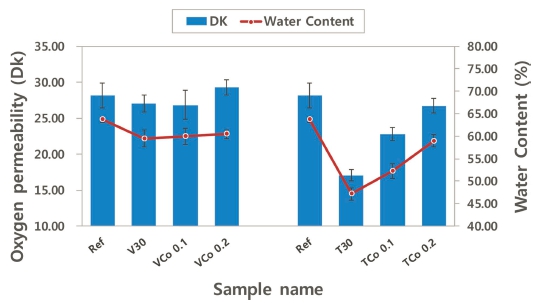
The measurement of the oxygen permeability showed a value of 28.13 × 10⁻¹¹ cm2/sec (mlO2/ml×mmHg) for the Ref combination; 27.07 × 10⁻¹¹ and 17.06 × 10⁻¹¹ cm2/sec (mlO2/ml×mmHg) for V30 and T30, respectively; and 26.85 × 10⁻¹¹, 29.27 × 10⁻¹¹, 22.80 × 10⁻¹¹, and 26.72 × 10⁻¹¹ cm2/sec (mlO2/ml×mmHg) for VCo0.1, VCo0.2, TCo0.1, and TCo0.2, to which cobalt oxide nanoparticles were added by ratio. These results show that the addition of VTMS increased the oxygen permeability, and that the oxygen permeability increased further as the amount of cobalt oxide nanoparticle that was added increased.
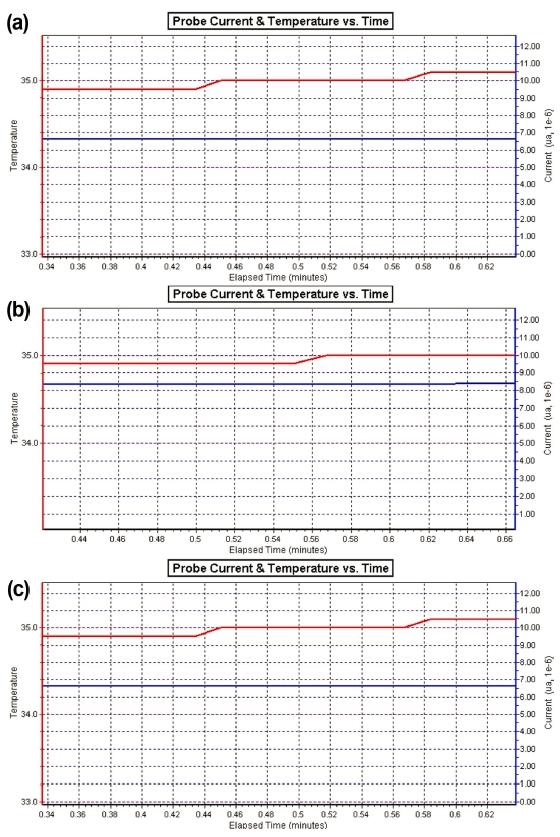
Fig. 5 shows the relationship between the oxygen permeability and the water content. It was determined that the oxygen permeability was increased by increasing the water content, and that the addition of cobalt oxide nanoparticles increased the water content, resulting in increased oxygen permeability. Based on these results, the addition of VTMS increased the samples’ water contents due to the former’s water content, which showed the same tendency as the previous studies,1) and that the cobalt oxide nanoparticles increased both the water content and the oxygen permeability in the polymerization with TAVS. The oxygen permeability current change graph is shown in Fig. 6. As shown in the Fig. 6, the higher the measured current value, the higher the oxygen permeability.
3.5 Optical Properties
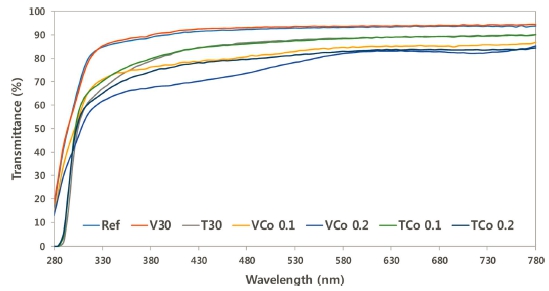
The measurement of the permeability of the UV-B, UV-A, and visible-light fields of each contact lens sample showed in Fig. 7 that the permeability was 52.39 % in Ref, 52.39 % in UV-B, 86.58 % in UV-A, and 92.93 % in visible light. The permeability of VCo0.1 and VCo0.2, in which cobalt oxide nanoparticles were added by ratio to V30 and V30, showed a 36.91-52.04 % range in UVB, 64.41-87.05 % in UV-A, and 78.76-93.37 % in visible light, while that of TCo0.1 and TCo0.2, in which cobalt oxide nanoparticles were added by ratio to T30 and T30, showed a 27.96-32.01 % range in UV-B, 69.27-74.43 % in UV-A, and 81.71-87.73 % in visible light. Although the used VTMS did not affect the permeability, it is considered that the addition of TAVS and cobalt oxide nanoparticles slightly decreased the permeability of the UV-B field. As such, it was determined that using TAVS and cobalt oxide nanoparticle to hydrogel hydrophilic lenses without a UV-blocking function may provide such function.
3.6 Surface Properties
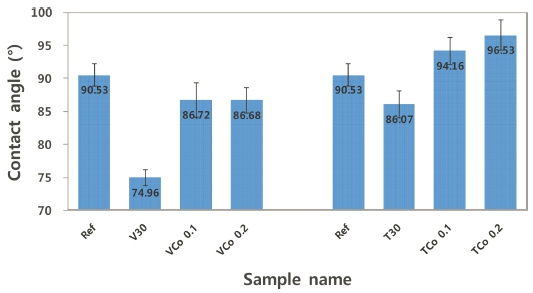
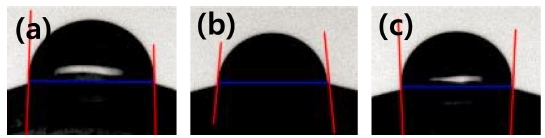
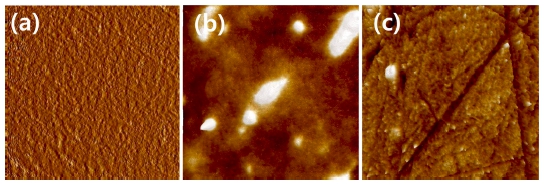
The contact angles of the contact lens samples manufactured through thermal polymerization were measured to evaluate their wetting. The contact angle measurement results, contact angle measurement image, and AFM measurement image are shown in Fig. 8 and 9. The contact angle was 90.53° in the Ref combination without any additive; 74.96 and 86.07° in V30 and T30, respectively; and 86.72, 86.68, 94.16, and 96.53° in VCo0.1, VCo0.2, TCo0.1, and TCo0.2, to which cobalt oxide nanoparticles were added by ratio. Then AFM was conducted to calculate the arithmetic mean roughness for the investigation of the effect of the binding of silane group and cobalt oxide nanoparticles, and it presented in Fig. 10. The obtained values were 0.8125, 1.5536, and 7.2825 nm for the Ref, VCo0.2, and TCo0.2 samples, respectively. The results of this study showed an increasing tendency of wetting by copolymerizing the silane group to a general hydrogel material. Furthermore, the surface measurement of the arithmetic mean roughness via AFM showed decreased wetting in TCo0.2, which had a relatively rough surface. There are several factors that determine wettability, so the surface roughness is not necessarily inversely proportional to wettability. However based on a previous study, it can be said that wetting is inversely proportional to the arithmetic mean roughness of the surface, and the contact angle can be changed accordingly. This study also confirmed that the wetting decreased as the surface roughness of the lens sample increased.26)
4. Conclusion
For the manufacture of functional contact lenses, this study synthesized a silicon material containing silane group and cobalt oxide nanoparticles to evaluate its oxygen permeability and water content, as well as investigated the stability of the lens samples by adding metal oxide nanoparticles to silicon monomers. Adding VTMS and TAVS decreased the contact angle and increased the wetting while adding cobalt oxide nanoparticles showed increased water content and oxygen permeability. In particular, TAVS showed a synergistic effect when used simultaneously with cobalt oxide nanoparticles, and greatly improved the water content rate and oxygen permeability. Therefore, it is considered that VTMS and TAVS can be used as materials for optical lenses with a high water content, high wetting, and high oxygen permeability when added with material nanoparticles at a proper ratio to the lens material.