


1. Instruction
Currently, representative medical devices for vision correction include eyeglasses and hydrogel lenses. In particular, hydrogel contact lenses have a wider field of view than glasses, so they are used in various ways, not only for vision correction and treatment, but also for beauty.1) Hydrogel soft lenses have an excellent fit, but have a problem that oxygen permeability is lower than that of RGP lenses.2,3) Contact lenses directly contact the corneal surface of the eye to correct visual acuity. Thus, the fit condition is the most important, and the wettability and oxygen permeability associated with the fit are major factors.4) For lenses with good wettability, the tear layer acts as a lubricant, reducing foreign body sensation to the lens and allowing faster adaptation. The method to increase the wettability of the RGP contact lens is adding a fluorine atom to the RGP lens. A fluorosilicone acrylatebased contact lens replacing a hydrogen atom in methacrylate has been developed, which not only improved wettability, but also increased oxygen permeability. In the manufacture of RGP contact lenses, a fluorosilicone acrylate-based polymer is mainly used.5) However, as the amount of silicone and fluorine polymer increases, oxygen permeability increases, the surface of the lens becomes hydrophobic and the wetting of tears decreases, resulting in poor fit.6) Currently, in addition to basic physical properties such as high water content, which has a great influence on the fit of contact lenses, and high wettability to reduce foreign body sensation, high oxygen permeability and UV protection to reduce various ophthalmic diseases such as neovascularization are receiving great attention, and research on these is also being actively conducted.7,8) Zinc oxide used as an additive in this study was approved by the FDA as a UV absorber mainly used in ointments and cosmetics. In addition, zinc oxide has excellent optoelectronic properties, antibacterial properties, biocompatibility and low toxicity.9,10) In particular, zinc oxide nanoparticles are known to improve stability and antibacterial activity.11,12) Iron oxide has excellent stability against sunlight, air, moisture, and heat, and has various colors depending on the particle size.13) Among them, iron oxide (III) has a red color and is used as a red pigment, and is mainly used as an abrasive for semiconductors, glass, precious metals, and diamonds.14) In addition, currently, iron oxide nanoparticles are being studied for use in medical applications such as signal enhancement, biocell separation, and anticancer drug delivery.15,16) Therefore, this study evaluated the physical properties after manufacturing a lens by adding a fluorine-based perfluoropolyether containing a hydroxyl group to improve wettability based on a silicone monomer containing a hydroxyl group and DMA, a hydrophilic monomer. In addition, in order to add the functionality of the produced lens, after manufacturing a lens using iron oxide nanoparticles and zinc oxide nanoparticles, the optical, physical properties, and polymerization stability were evaluated to investigate the possibility of application as a functional hydrogel lens material.
2. Experiment
2.1. Reagents and materials
SID-OH, a silicone monomer having a structure with a hydroxyl group (-OH) attached to PDMS in this study, was used, and N,N-dimethylacetamide (DMA), 3-(methacryloxy) propyl tris(trimethylsiloxy)silane(3-TISS), ethylene glycol dimethacrylate (EGDMA, crosslinking agent) and iron oxide and zinc oxide (additives), products of SIGMAALDRICH were used. In addition, for azobisisobutyronitrile (AIBN, initiator), products of JUNSEI were used.
2.2. Polymerization
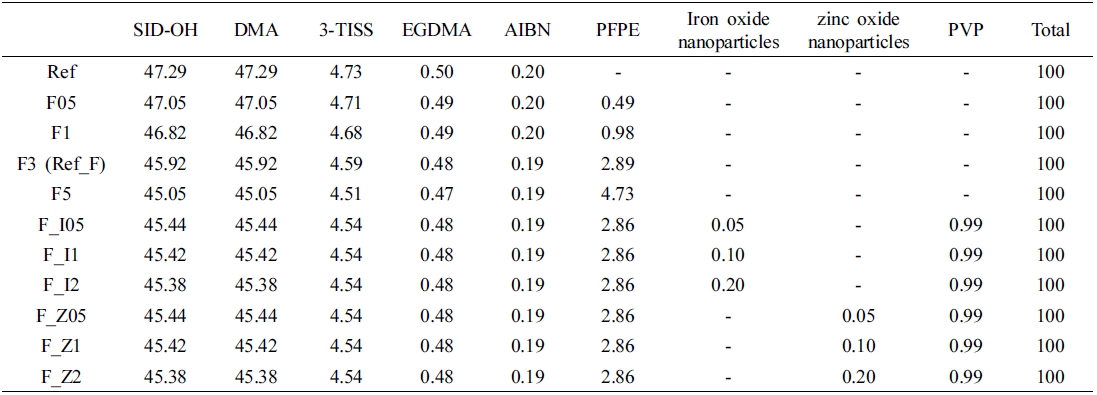
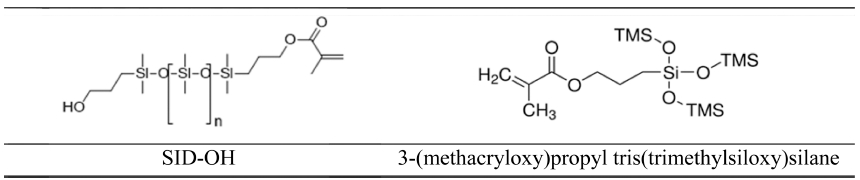
In this experiment, silicon monomers, SID-OH, DMA, and 3-TISS, were used as a basic combination, and perfluoropolyether was added in a ratio of 0.5 to 5.0 %. In addition, after selecting an appropriate ratio of perfluoropolyether to form a separate basic combination, nanoparticles of iron oxide and zinc oxide were added in a ratio of 0.05 to 0.20 %, respectively. Each of the blended monomers was stirred for about 1 h using a vortex, and after adding perfluoropolyether 3 % and nanoparticles as additives, respectively, the mixture was stirred using ultrasonic waves for about 1 h. And it was thermally polymerized at 120 °C for 2 h. The sample of the fabricated lens was named REF for the basic combination without additives, and named F05, F1, F3, and F5 according to the addition ratio of 0.5 to 10 % of perfluoropolyether. Additionally, F3 with fluorolink E10-H 3 % was newly named REF_F. Those with zinc oxide nanoparticles were named F_Z05, F_Z1, and F_Z2 according to the type of nanoparticles and the addition ratio of 0.05 to 0.2 %, and those with iron oxide nanoparticles were named F_I05, F_I1, and F_I2, respectively. The mixing ratios used in the experiment are shown in Table 1, and the chemical structures of the monomers used in the experiment are shown in Fig. 1.
2.3. Experiment
All fabricated lenses were hydrated in 0.9 % sodium chloride physiological saline for 24 h, and then optical and physical properties including spectral transmittance, refractive index, water content, oxygen permeability, and tensile strength were evaluated. To analysis the wettability of the lenses, the contact angle was measured, and the surface was evaluated by measuring AFM. In addition, SEM was measured to confirm the nanoparticles, and polymerization stability was evaluated by an extractable test (absorbance, potassium permanganate-reducing substance test, pH test). All experimental values presented in this study were measured repeatedly five times per sample to increase the accuracy of the experiment, and the averaged values were presented.
3. Results and Discussion
3.1. Silicone Hydrogel Lenses with High Wettability
3.1.1. Physical property
The refractive index, water content and oxygen permeability of the fabricated hydrophilic contact lenses were measured based on ISO 18369-4:2006, water content was measured using the gravimetric method, and oxygen permeability was measured using the polarographic method.
3.1.1.1. Refractive index and water content
As a result of measuring the water content and refractive index of Ref without using an additive, water content was 50.86 % and refractive index was 1.4146. The average water content of the sample in which perfluoropolyether was added to the Ref at each ratio of 0.5 to 5 % was 51.86 to 52.88 %, and refractive index was 1.4136 to 1.4086. It was found that the water content gradually increased according to the amount of additives, and refractive index was found to be inversely proportional to the result of water content.
3.1.1.2. Oxygen permeability
As a result of Dk measurements to evaluate oxygen permeability of silicone hydrogel lenses, it was 27.67 × 10⁻¹¹ (cm2/sec)(mlO2/ml×mmHg) for Ref, and 27.65 ~ 27.84 × 10⁻¹¹ (cm2/sec)(mlO2/mL×mmHg) for the sample with perfluoropolyether. There was no significant change depending on the amount of additives, so it is thought that it does not affect the oxygen permeability.
3.1.2. Surface property
3.1.2.1 Wettability
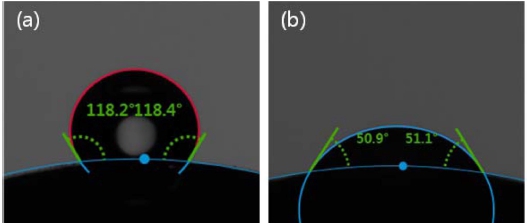
The sessile drop method was used for the contact angle, and wettability was evaluated using DSA30 (Kruss GMBH, Germany). As a result of the measurement, the contact angle of Ref was 118.82°, and it was 94.54 to 50.48° depending on the amount of perfluoropolyether added. The contact angle of Ref was measured relatively high due to the influence of hydrophobic silicone, and it is thought that it gradually has a hydrophilic surface due to the influence of perfluoropolyether. Representatively, the contact angle measurement images of Ref and F5 are shown in Fig. 2.
3.1.2.2. Surface analysis by AFM
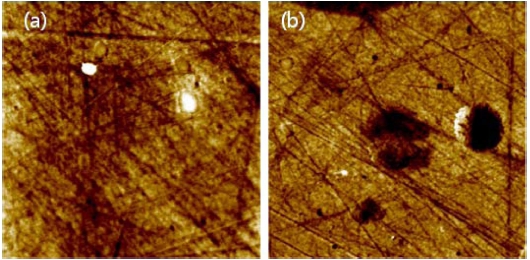
In order to check the roughness of the contact lens surface, Atomic Force Microscopy (AFM) was conducted. The contact lens sample was evaluated for surface roughness according to the amount of perfluoropolyether by measuring Ref without additives and F3 with 3 % perfluoropolyether. As a result of the measurement, the average roughness was 4.27 nm for Ref and 2.26 nm for F3. The roughness of the lens surface is a factor that can affect the wettability, and it is judged that the addition of perfluoropolyether has an effect on the wettability by reducing the surface roughness of the lens surfaces. The images of AFM analysis are shown in Fig. 3.
3.2. Functional Hydrogel Lenses including Nanoparticles
The basic combination was composed with SID-OH, DMA, 3-TISS and 3 % perfluoropolyether. The physical properties of fabricated hydrogel lenses were evaluated after adding 0.05 to 0.2 % iron oxide nanoparticles and zinc oxide nanoparticles respectively based on Ref_F.
3.2.1. Optical property
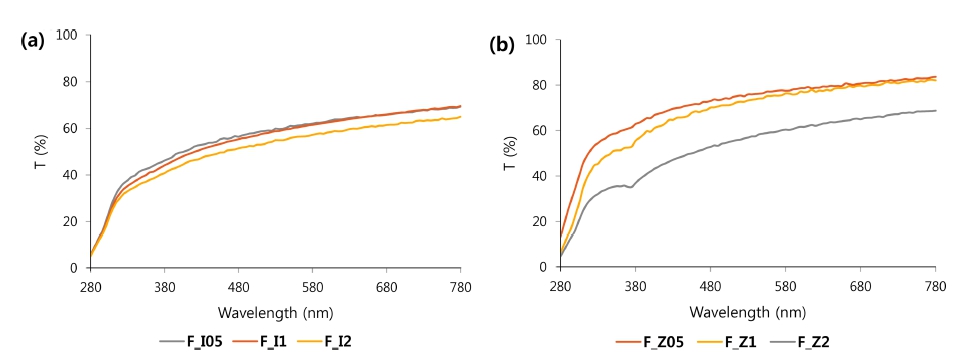
The spectral transmittance was measured in the UV-B, UV-A and visible regions using a spectral transmittance meter (Cary 60 UV-vis., Agilent) based on ISO 8599: 1994. As a result of measuring the spectral transmittance of the fabricated lens, as for Ref, UV-B was 40.79%, UV-A was 78.87 %, and Vis. was 85.87 %. The spectral transmittance of the sample with iron oxide nanoparticles added to Ref-F by ratio was 18.35 to 16.33 % for UV-B, 41.30 to 36.16 % for UV-A, and 61.07 ~ 56.13 % for Vis. The spectral transmittance of the sample with zinc oxide nanoparticles added to Ref-F by ratio was 32.05 to 15.67 % for UV-B, 57.81 to 34.12 % for UV-A, and 76.58 to 58.47 % for Vis. It was found that the addition of zinc oxide nanoparticles slightly reduced the transmittance of the UV-B region, thereby blocking the UV-B region. In addition, iron oxide nanoparticles were also found to have a little protection function. The results of the spectral transmittance measurement according to the addition of nanoparticles are shown in Fig. 4.
3.2.2. Physical property
3.2.2.1. Refractive index and water content
The water content and refractive index were measured to analyze the physical properties of the functional hydrogel lenses to which nanoparticles were added. As a result of the measurement, it was found that iron oxide nanoparticles did not have a significant effect on the water content and refractive index depending on the amount added, and zinc oxide nanoparticles decreased the water content gradually and increased the refractive index depending on the amount added. Table 2 shows the results of water content and refractive index according to the nanoparticles.

3.2.2.2. Oxygen permeability
As a result of oxygen permeability, it was 23.54 ~ 23.24 × 10⁻¹¹ (cm2/sec)(mlO2/mL×mmHg) for the lenses with iron oxide nanoparticles added by ratio, and 22.28 ~ 21.98 × 10⁻¹¹ (cm2/sec)(mlO2/mL×mmHg) for the lenses with zinc oxide nanoparticles added by ratio. Therefore, it was found that the Dk value slightly decreased with the presence of nanoparticles, and that the amount and type of nanoparticles added did not significantly affect when compared to Ref_F.
3.2.2.3. Tensile strength
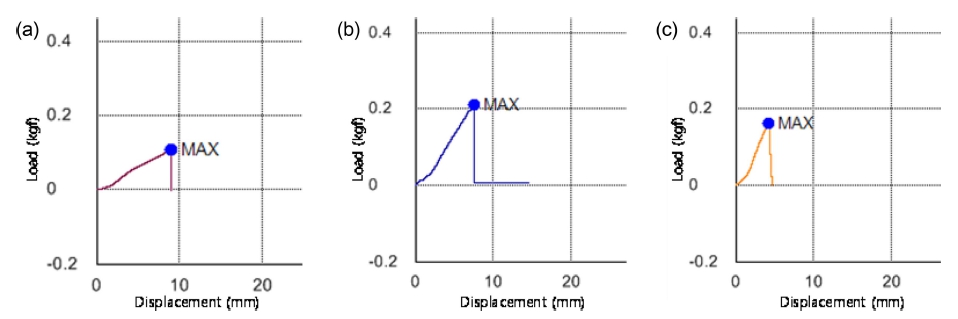
As a result of measuring the tensile strength of the fabricated hydrogel lenses, it was 0.107 kgf/mm2 for Ref_F without nanoparticles, 0.137 ~ 0.205 kgf/mm2 for the lenses with iron oxide nanoparticles, and 0.121 ~ 0.161 kgf/mm2 for the lenses with zinc oxide nanoparticles. It is judged that the tensile strength slightly increased due to the influence of nanoparticles, and it was confirmed that the addition of iron oxide nanoparticles in particular increased the tensile strength of the lenses. The images of the tensile strength are shown in Fig. 5.
3.2.3. Surface property
3.2.3.1. Wettability
As a result of measuring the contact angle to confirm the wettability of the lenses with nanoparticles added, the addition of iron oxide nanoparticles and zinc oxide nanoparticles showed no significant change compared to Ref_F, and the contact angle was about 53 to 56°.
3.2.3.2. SEM analysis
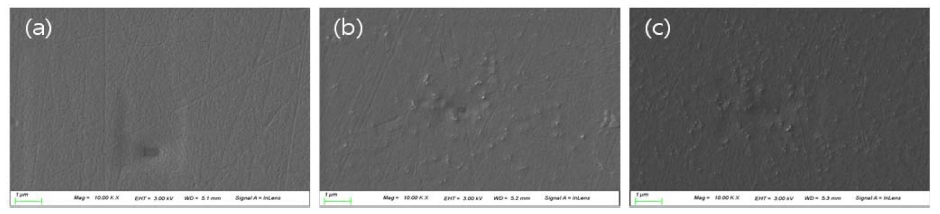
In order to confirm the surface condition and nanoparticles of the lens, the surface of Ref_F without nanoparticles and the surfaces of the lenses with nanoparticles were analyzed by scanning electron microscope (SEM). The images of results are shown in Fig. 6. It was confirmed that particles were not identified in Ref_F, whereas nanoparticles of about 10 to 30 nm were evenly distributed on the lens surface in F_Z2 and F_I2. It is judged that the constant dispersion of the nanoparticles on the lens surface indicates the inherent physical properties of the nanoparticles.
3.2.4 Extractable test for polymerization stability
To evaluate the stability of the fabricated hydrogel lenses, the potassium permanganate-reducing substance, pH, and absorbance were measured, respectively, and the stability according to the presence and type of nanoparticles was evaluated by selecting Ref_F, F_Z2, and F_I2. In addition, distilled water was used for the control group of the potassium permanganate reduction test and the pH test, and the stability was evaluated through the difference of the eluate from the experimental group.
3.2.4.1. Potassium Permanganate-Reducing Substance Test
As a result of potassium permanganate-reducing substance test, the difference in dissolution between the control and experimental groups was 3.46 mL for Ref_F, 2.96 mL for F_Z2, and 4.19 mL for F_I2. Therefore, it was found that zinc oxide nanoparticles have the best polymerization stability for organic and inorganic substances.
3.2.4.2. pH test
As a result of pH measurement, the difference between the control and experimental groups of the sample solution was a value between 0.1 and 0.2 in all the groups, Ref_F, F_Z2, and F_I2. The difference in pH was less than 1.5 in all groups, and the total elution was very small overall, indicating that stability is very good regardless of time.
3.2.4.3. Absorbance measurement
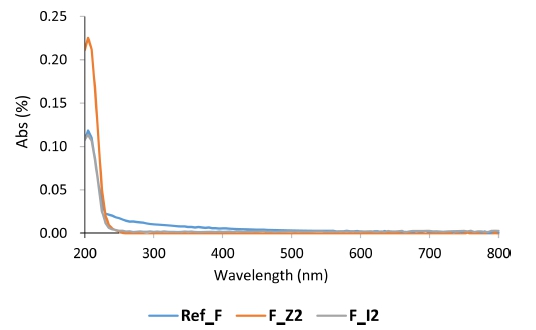
As a result of measuring the absorbance of each hydrated solution over time from 1 to 5 days of hydration, it was 0.113 to 0.118 for Ref_F, 0.184 to 0.225 for F_Z2, and 0.072 to 0.113 for F_I2. Ref_F showed high polymerization stability without a significant change for 1 to 5 days. In the case of lenses with zinc oxide nanoparticles or iron oxide nanoparticles, they were continuously eluted and gradually stabilized on day 3. In particular, the stability of the samples added with iron oxide nanoparticles was the best. The absorbance measurement results on day 5 are shown in Fig. 7.
4. Conclusion
This study used silicone monomer, DMA, crosslinking agent EGDMA, and initiator AIBN as a basic combination to prepare contact lenses using fluorine-based perfluoropolyether containing hydroxyl group and nanoparticles iron oxide and zinc oxide as additives,. As a result of this experiment, it was found that the addition of the wetting additive with fluorine changed the surface energy of the produced lens, thereby improving the wettability. And also, the addition of iron oxide nanoparticles and zinc oxide nanoparticles satisfied the basic hydrogel contact lens properties and slightly increased the UV blocking performance, and increased the tensile strength by improving the durability of the hydrogel lens. In addition, the polymerization stability of the nanoparticles through the eluate test was found to be more excellent. Therefore, the hydrogel lens material containing perfluoropolyether, iron oxide, and zinc oxide nanoparticles based on silicone monomer improves the wearability by improving the excellent oxygen permeability and wettability of hydrogel lens, and at the same time has UV protection, durability and polymerization stability, which is functional hydrophilicity. Therefore, it is judged that these materials can be used in various ways as a high functional lens material.