


1. Introduction
Solar energy represents one of the most abundant renewable natural energy but still least harvest resource.1,2) Recently, photoelectrochemical water splitting by semiconductor photocatalysts has been considered as an effective route to convert solar energy directly into hydrogen for future renewable energy applications.3,4) The water splitting process involves two half-cell reactions, the hydrogen evolution reaction (HER) on photocathodes and oxygen evolution reaction (OER) on photoanodes. The latter is usually more complex and sluggish because it requires the removal of four electrons and two protons from two H2O molecules, which is twice that required for HER. Silver phosphate (Ag3PO4), naturally crystallizing in a P43n body-centered cubic structure, is an n-type semiconductor with a direct bandgap of 2.43 eV and an indirect bandgap of 2.36 eV, ensuring that Ag3PO4 absorbs solar energy of the wavelength shorter than 530 nm.5) This material has received considerable attention because of its versatile photooxidation applications such as OER catalysis and oxidation of organic pollutants,6) which can be traced back to as early as 1988 when Tennakone and co-workers reported the first photocleavage of water using Ag3PO4.7)
It is well known that Ag3PO4 is slightly soluble in aqueous solution, which reduces its structural stability. Moreover, the conduction band potential of Ag3PO4 is more positive than that of the hydrogen potential.8) Thus, Ag3PO4 absorbs a photon to generate an electron and a hole, and then the electron combines with an interstitial silver ion (Ag+) to give a silver atom (Ag), which results in the photocorrosion of Ag3PO4 in the absence of a sacrificial reagent. The appeared black metallic Ag particles would suspend in the photocatalytic reaction systems and attach onto the surface of the Ag3PO4 catalyst, which would inevitably prevent the visible light absorption and decrease the photocatalytic activity.9) One of the effective ways is to build composite structures by assembling Ag3PO4 with other semiconductors such as CeO2,10) Nb2O5,11) GO,12) In2S313) etc. In those systems, the composites exhibited a better photocatalytic performance compared with the pure Ag3PO4 and the enhanced photocatalytic activity is attributed to the synergistic effect including the matched bandgap structures, the improved visible light absorption and the enhanced separation rates of photogenerated electron-hole pairs.
Impressively, In2S3 is an n-type III–VI group chalcogenide semiconductor, which consists of elements with low toxicity. Moreover, In2S3 has been demonstrated to be a very promising optoelectronic material,14) and widely utilized in solar cell,15) photocatalysis,16) and PEC water splitting.17-18) In particular, In2S3 has favorable bandgap (2.0-2.3 eV), moderate charge transport characters, and relatively negative conduction band edge for photoelectrochemical hydrogen generation.19)
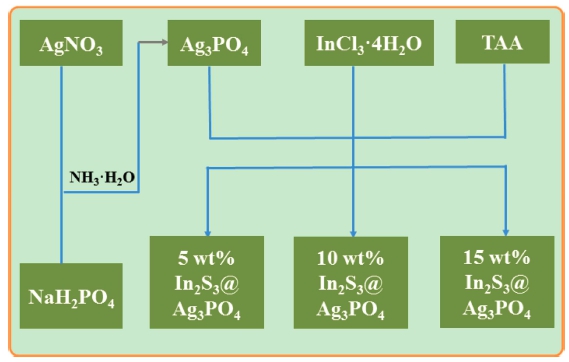
Herein, we demonstrate a successful and general procedure to resolve the above problems by the growth of In2S3 on the surfaces of Ag3PO4 crystals as shown in Fig. 1. The insoluble In2S3 could effectively protect the Ag3PO4 corecrystals from dissolution in aqueous solutions and enhance their stabilities during the photoelectric response process. Moreover, the experimental results confirm that these novel hetero crystals all exhibit much higher photoelectrochemical activities and stabilities than pure Ag3PO4 crystals.
2. Experimental Details
2.1 Materials
All of the reagents used in this experiment were analytical reagent grade and without further purification.
2.2 Sample preparation
Tetrahedral Ag3PO4 mesocrystals were easily prepared via the well-known silver ammonia assisted process. In a typical synthesis, AgNO3 was added into 10 mL of deionized waterto form transparent solution. Subsequently, 3 mL of ammonia water (25 %) was added dropwise into the above solution under stirring.
After stirring for 30 min, 30 mL of NaH2PO4 (0.5 mol/ L) dissolved solution was then added dropwise into the above solution. The mixture was stirred for 4 h and separated by centrifuge followed by washed with ethanol and deionized water for 3 times, then dried in a vacuum oven at 60 °C.
The In2S3 modified Ag3PO4 composites were prepared according to previous report with modification.20) 0.1 g of Ag3PO4 powder and calculated InCl3·4H2O were dispersed in a set volume of ethylene glycol (EG) and ultrasonicated for 0.5 h. A certain amount of thioacetamide (TAA) was then added into the solution under vigorous stirring for 1h and subsequent heated at 140 °C for 0.5 h under argon gas flowing. The resulting solid product was collected by centrifugation, washed with distilled water, and dried in an oven at 60 °C. In this manner, different weight contents (5 ~ 15 wt%) of In2S3 in Ag3PO4/In2S3 composites were obtained, respectively. Pure Ag3PO4 and In2S3 samples were respectively prepared using the same procedures.
2.3 Characterization
The crystal structures of prepared compounds were performed by X-Ray Diffraction (XRD) with Cu Kα irradiation (X'Pert3, PANalytica1), while the morphology and microstructure of the compounds were characterized by Scanning Electron Microscopy (SEM, Nova NanoSEM 450) and Field Emission Transmission Electron Microscopy (FE-TEM, JEM-2100F). X-ray photoelectron spectroscopy (XPS) was conducted to distinguish the chemical state (ThermoScientific, Escalab 250Xi).
2.4 Photoelectric Conversions
The photocurrent and the electrochemical impedance spectra (EIS) of the photocatalysts were obtained using an electrochemical workstation (CHI660E, China). A standard three-electrode system was performed in this photochemical study including counter electrode (Pt foil), reference electrode (saturated Ag/AgCl electrode) and working electrodes (glassy carbon electrode).21) To prepare the working electrode, 4 mg of catalysts and 30 mL of Nafion solution were dispersed in 1 mL of water-ethanol solution by sonicating for 2 h to form a homogeneous mixture. Then 5 ml of this solution was drop-cast onto a glassy carbon electrode (GCE) with a diameter of 3 mm, and was left to dry at room temperature. 0.1 mol/L sodium sulfate aqueous solution was acted as electrolyte. The simulated light source was a 500 W xenon lamp equipped with an AM 1.5 G filter operating at an illumination intensity of 100 mWcm−2. According to the Nernst equation, the potential vs. reversible hydrogen electrode (RHE) could be obtained from the measured potential vs. Ag/ AgCl. The EIS was implemented at 5 mV amplitude and frequency range of 1,000 kHz to 0.1 Hz.
3. Results and Discussion
3.1 Phase and morphology
Fig. 2A shows the X-ray diffraction (XRD) patterns of pure Ag3PO4 nanocrystals and In2S3. For pure Ag3PO4, all the diffraction peaks could be indexed to the cubic Ag3PO4 (JCPDS no.06-0505).22) Diffraction peaks of In2S3 correspond to tetragonal In2S3 (JCPDS cards no. 73- 1366).23) No other miscellaneous peaks appear, suggesting the pure phase nature for the samples. As increasing the original In2S3 concentration from 5 wt% to 15 wt%, the Ag3PO4/In2S3 composites exhibits similar diffraction peaks as the pure In2S3 and Ag3PO4 as shown in Fig. 2B. Moreover, it should be noted that the diffraction peaks of Ag3PO4 in Ag3PO4/In2S3 composites gradually weaken when the In2S3 content increases, reflecting the decoration of more In2S3 particles onto Ag3PO4 surfaces which may prevent photocorrosion of pure Ag3PO4.24)
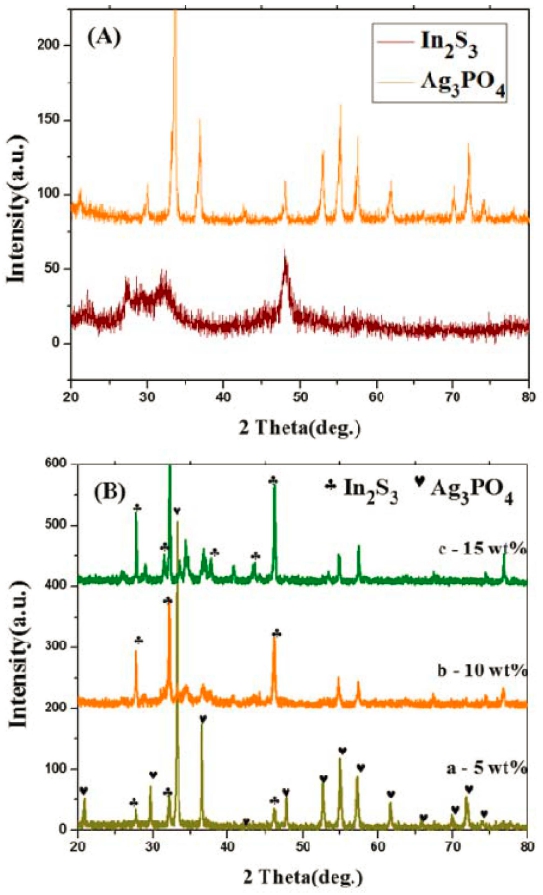
Fig. 2
XRD patterns of as-prepared samples: (A) pure Ag3PO4, pure In2S3 ; (B) (a) Ag3PO4/In2S3 5 wt%, (b) Ag3PO4/In2S3 10 wt%, (c) Ag3PO4/In2S3 15 wt%.
SEM was used to investigate the morphology and particle size of the as–prepared samples. As presented in Fig. 3(a,b), Ag3PO4 particles have an irregular spherical shape, particle size distribution is between 100 to 300 nm. It is also noticed that most Ag3PO4 particles have been growth larger after modification with In2S3 nanoparticles as shown in Fig. 3(c-h), which agreed with the XRD resulsts. After higher temperature treatment, Ag3PO4 particles were growing into larger size which may provide more substrate for distribution of In2S3 nanoparticles. Thus more In2S3 nanoparticles can be easily dispersed on the surface of Ag3PO4. It's worth noting that, while the content of In2S3 was 10 wt%, the shape of In2S3 comprises most small particles and some nanosheets as shown in Fig. 3(e, f). The proper morphology was one of the factors that influenced the photoelectric performance of composites under visible light irradiation. These results imply that nanosheet provides considerable effect for enhancing charge transport and visible-light absorption.25) However, as the content of In2S3 increases to 15 wt% in Fig. 3(g,h), it clear shows that more nanoparticles of In2S3 were aggregated together on the surface of Ag3PO4.
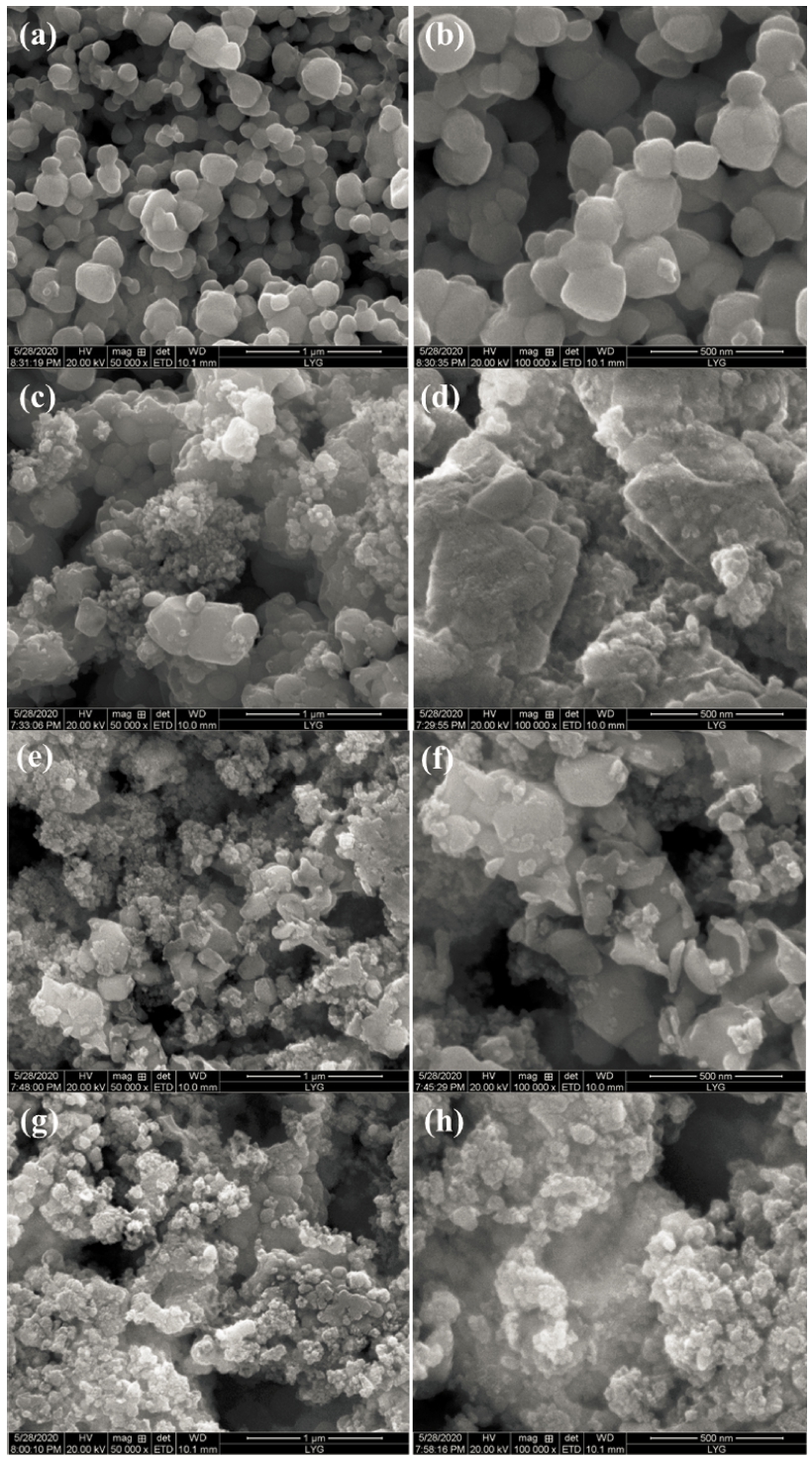
Fig. 3
FE-SEM micrographs of as-prepared samples: (a, b) pure Ag3PO4, (c, d) Ag3PO4/In2S3 5 wt%, (e, f) Ag3PO4/In2S3 10 wt%, (g, h) Ag3PO4/In2S3 15 wt%.
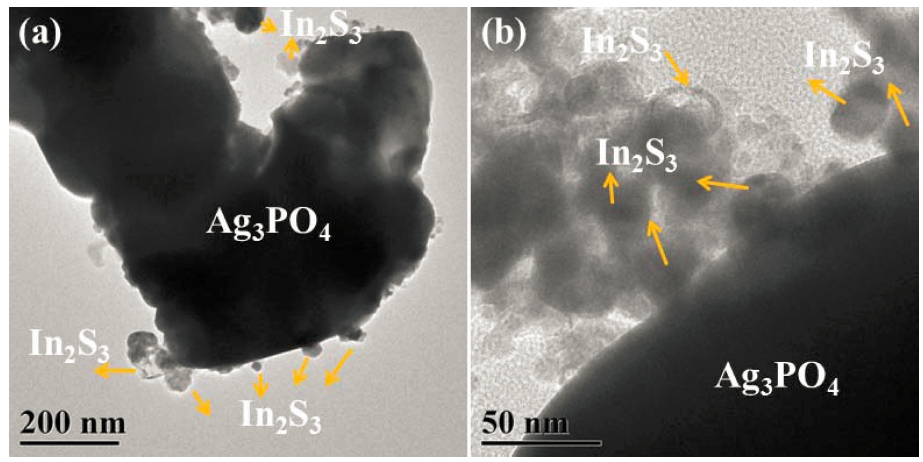
In order to ascertain the detail decoration of In2S3 on the surface of Ag3PO4, a typical Ag3PO4/In2S3 composite (10 wt%) was selected and further investigated by TEM. Fig. 4a shows that the Ag3PO4/In2S3 composite is special morphology consisting of lager size substrate (Ag3PO4), particles and some nanosheets (In2S3), in accordance with the SEM results. As shown in Fig. 4(b), it can be clearly observed that some small nanoparticles with size < 25 nm of In2S3 are highly dispersed on the Ag3PO4 which size is above 200 nm. Clear observation can find that two phases of In2S3 and Ag3PO4 closely contact to form an intimate interface, which favors the charge transfer between In2S3 and Ag3PO4 and may promote the separation of photogenerated electron-hole pairs.
3.2 Chemical state
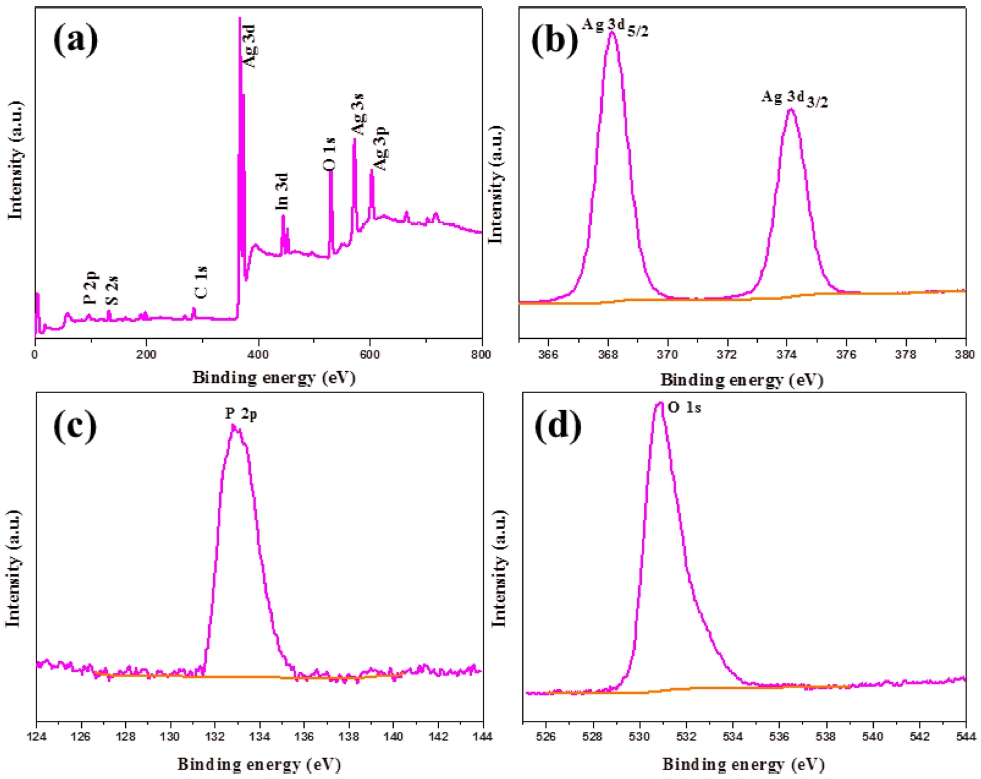
Inder to distinguish the chemical state of Ag3PO4/In2S3 (10 wt%) composite, XPS measurement was performed as shown in Fig. 5. The full XPS spectrum [Fig. 5(a)] indicates that the Ag3PO4/In2S3 composite is mainly composed of In, S, P, O and Ag elements. The XPS peak of C 1 s at 284.8 eV is assigned to residual carbon from the XPS instrument. There were two individual peaks at 374.0 and 368.0 eV in Fig. 5(b), which could be assigned to 3d3/2 and 3d5/2 of Ag+ respectively.26) In Fig. 5(c), the P 2p peak was at 133.0 eV, which corresponds to P5+ coming from Ag3PO4.27) For the O 1s XPS spectra shown in Fig. 5(d), the binding energy of 530.8 eV was attributed to the O2− in the Ag3PO4, while the peak at 532 eV probably corresponded to the hydroxyl group.28) The two strong peaks at 445.2 and 452.7 eV can be attributed to binding energies of In 3d5/2 and In 3d3/2, respectively. The peak at 161.5 eV is assigned to the binding energy of the S2p transition. These values agree well with the reported data for In2S3.20,29)
3.3 Photoelectrochemical performance
It is well known that semiconductors exhibit unique photoelectric properties owing to their intrinsic band-gap structure, which provides a simple and economical lightto electric conversion approach for various energy-related applications. Therefore, the PEC activities of samples were investigated by transient photocurrent responses (Fig. 6) under visible light illuminations at an applied potential of -0.20 V vs Ag/AgCl in 0.1 M Na2SO4 aqueous solutions. As shown in Fig. 6(a,b), the pure In2S3 exhibit a higher and stable photoelectric current than pure Ag3PO4 crystals which possess the lowest photoelectric behavior and obvious photocorrosion characteristics. In addition, the visible light response properties of the asobtained Ag3PO4/In2S3 (5 ~ 15 wt%) composite samples were fairly improved shown in Fig. 6(c-e). Special for Ag3PO4/In2S3 (10 wt%), it exhibits higher and stable photocurrent response characteristics. To perform the transportation of photoelectron, we carried out electrochemical impedance spectrum as shown in Fig. 6(f). In general, the smaller slope of arc represents and Ag3PO4/In2S3 (10 wt%) composite exhibits the lowest charge-transfer resistance about 72.5 W. Therefore, the results of EIS and photocurrent response demonstrated that the introduction of In2S3 was effective to improve the charge separation and the transfer efficiency of Ag3PO4/In2S3, resulting in the enhancement of its photoelectric behavior.
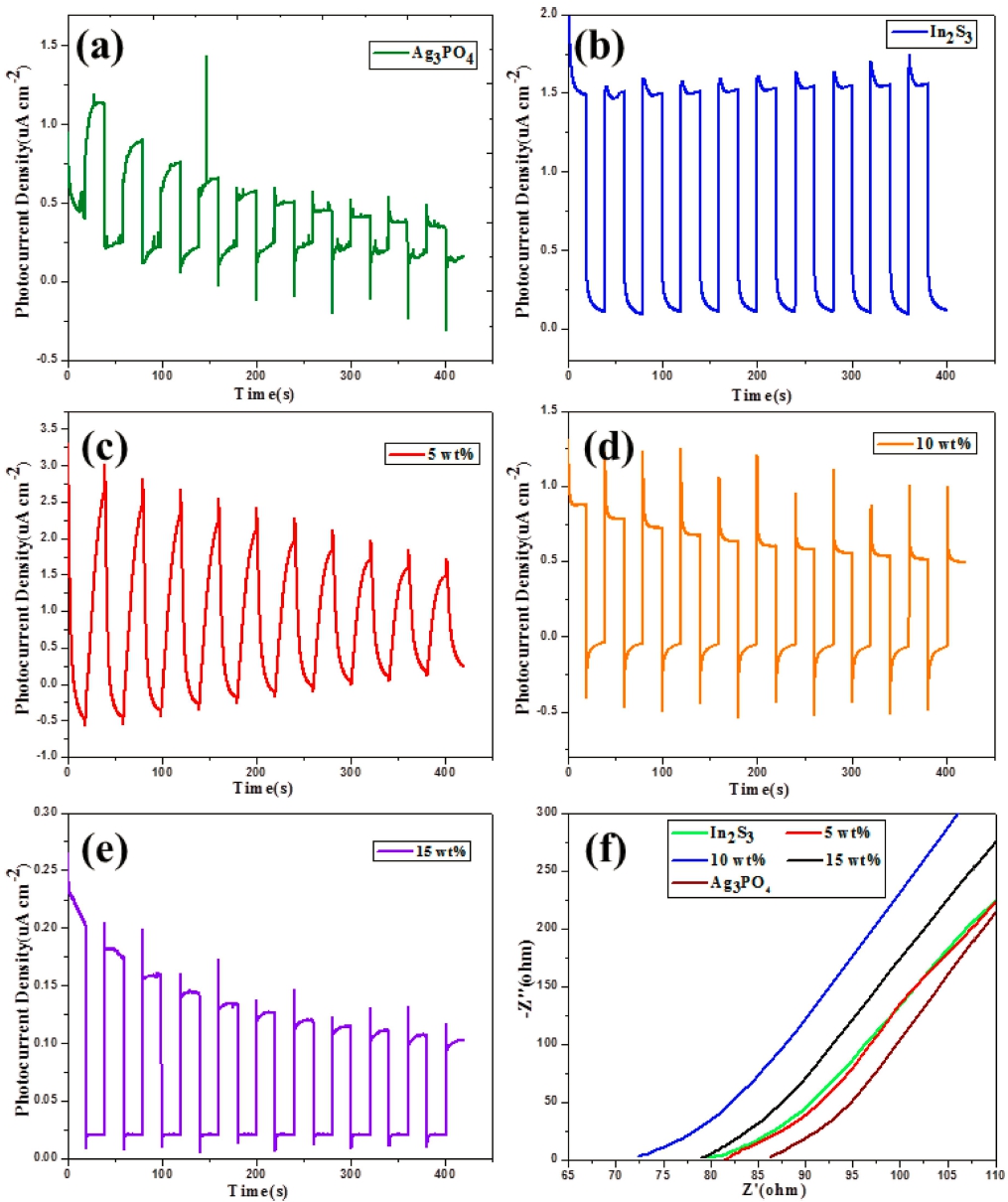
Fig. 6
Transient photocurrent response (a-e) and Electrochemical impedance spectroscopy (f) of as-prepared samples: (a) pure Ag3PO4, (b) pure In2S3, (c) Ag3PO4/In2S3 5 wt%, (d) Ag3PO4/In2S3 10 wt%, (e) Ag3PO4/In2S3 15 wt%.
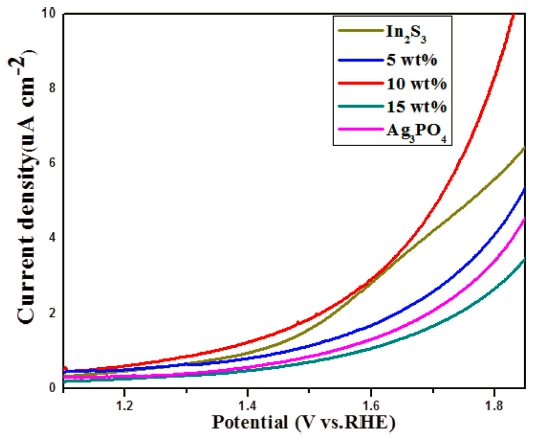
The PEC activities of the as-prepared samples were further investigated by linear sweep voltammetry (LSV) (Fig. 7) under intermittent visible light irradiation with an illumination intensity of 100 mW cm−2. Apparently, the photocurrents of all the hybrid electrode yield improvement compared with the corresponding pure Ag3PO4 in a wide potential range of 0 - 1.9 V vs. RHE under visible light irradiation. Compared with Ag3PO4 nanoparticles, the applied bias photon-tocurrent efficiency of Ag3PO4 increases efficiently, it achieves sequential improvement by introduction of co-catalyst In2S3. On the basis of the above results, we attribute the best PEC performance for Ag3PO4/In2S3 (10 wt%) composite mainly to better electron transport and efficient electron-hole separation. Above all, it can be clearly seen that the In2S3 could serve as excellent co-catalyst for Ag3PO4 to enhance its photoelectrochemical performance.
4. Conclusion
In summary, a series of novel Ag3PO4/In2S3 composites with different In2S3 content were successfully prepared. Most of In2S3 nanoparticles were grown on surface of Ag3PO4 through a modified facile solvothermal method. Ascribed to the good electrical interconnection, exposure of the high-active surface, the Ag3PO4/In2S3 can be directly used as electro and exhibit an excellent response to visible-light, which realized two orders of magnitudes enhancement in PEC activity than pure Ag3PO4. In addition, In2S3 (10 wt%) modified Ag3PO4 composite exhibits a much higher photocurrent density and stable PEC properties may attribute to its special morphology of In2S3 which exhibits mixture of nanoparticle and nanosheet.