


1. Introduction
The existence of several hazardous organic pollutants in water wastes and air results in a serious environmental pollution. Photocatalytic oxidation using semiconducting materials is one of the advanced oxidation processes for the removal of such organic pollutants. However, numerous semiconducting materials such as TiO2, ZnO, WO3, and Fe2O3 have been used for environmental remediation.1) Semiconducting titanium dioxide (TiO2) is a promising candidate for photocatalysis due to its high stability, nontoxicity, low cost, super hydrophilicity, long durability, and excellent photocatalytic activity towards removal of pollutants in water and air.2-5)
During the last decades, numerous researchers have focused on the development of TiO2 photocatalyst in the form of thin films as well as powders.6) The photocatalytic performance of TiO2 nanoparticles has mostly been studied by its immobilization. The application of TiO2 powder is restricted due to incomplete recovery of the photocatalyst during experiments.7,8) The preparation of thin film photocatalyst will overcome this obstacle and also extensively applicable in water and air-cleaning technologies, selfcleaning materials, photocatalytic inhibition of microorganisms, cancer cells and viruses.9)
TiO2 thin films are fabricated by different techniques such as sol-gel,10,11) chemical vapor deposition,12) hydrothermal and sputtering.14) Among these techniques, sol-gel method plays a key role in the stability and photocatalytic activity of the immobilized TiO2. The sol-gel method mostly includes costly and highly reactive metalorganic precursors that quickly reacts with water in atmosphere.15) To overcome these limitations, the peroxo route has been used to prepare TiO2 thin films. Several investigations have been carried out in order to prepare TiO2 thin films by peroxo titanic acid modified sol-gel method.8,15-18) However, in most of the cases, polymeric agents, and complicated synthesis procedures were adopted to prepare peroxotitanic acid sol-based TiO2 thin films.
In this paper, a facile and low cost sol-gel method is demonstrated to prepare TiO2 thin films for coating layer. The peroxo titanic acid sol was prepared using amorphous TiO2 fine particles and hydrogen peroxide solution. The structural and optical properties, self-cleaning performance, and photocatalytic reaction of TiO2 coating films heat treated at low and high temperature were investigated. The main focus of this investigation is to demonstrate selfcleaning and photocatalytic properties of TiO2 coatings on a glass substrate which are prepared at low temperature below 120 °C.
2. Experimental
The TiO2 coating thin films were prepared by a sol-gel method using peroxotitanic acid solution. First, a solution mixture of titanium tetra isopropoxide and isopropyl alcohol was hydrolyzed to get TiO2 fine particles. The molar ratio of TTIP:IPA:H2O was 1:10:4. The obtained TiO2 particles were filtered, washed using deionized water and oven dried at 110 °C for 4 h. Then, 0.2 g of amorphous TiO2 powder was magnetically stirred with 30 % aqueous hydrogen peroxide solution (4 mL) to get a transparent orange gel of peroxotitanic acid. Finally, the gel was diluted with 1 mL aqueous hydrogen peroxide solution followed by 5 mL deionized water to prepare peroxotitanic acid sol. Before spin coating, the glass slides were washed using acetone and ethanol in a sonicator and then rinsed in deionized water. Then, the peroxo titanic acid sol was spin-coated at 2,000 rpm for 10 s. After spin coating, the glass slides were heated at 110 °C for 2 minutes on a preheated hot plate and 400 °C for 1 h in an electric furnace. The TiO2 thin films prepared at low temperature at 110 °C and high temperature at 400 °C were denoted as TiO2-110 and TiO2-400, respectively.
2.1. Characterization
The structure of coated films was analyzed by a Rigaku Dmax 2500/PC X-ray diffractometer with Cu-Kα. Photoinduced hydrophilicity of the samples was analyzed by a X-ray diffractometer(Dmax 2500/PC, Rigaku, Japan) under UV light illumination(Daytime CFL 20W Blacklight, Korea). The observation of surface morphology was carried out with a field-emission scanning electron microscope(FE-SEM, Hitachi S-4300). The energy dispersive spectroscopy(EDS) analysis was carried out by SEM(JSM-6010, JEOL, Japan). Optical transmittance of the samples was obtained by a UV-Vis(S-4100 PDA, Scinco, Korea).
2.2. Photocatalytic activity
The photocatalytic performance of the samples was evaluated by photodegradation of methylene blue(MB) dye solution. In a glass vessel, 5 mL of aqueous methylene blue solution (5.34 × 10⁻⁶ M) was added and the sample of TiO2 coated glass plate (2.5 × 2.5 cm) was immersed completely. To attain the adsorption-desorption equilibrium of MB dye solution, the solution was kept in the dark for 30 min before UV-light illumination. The solution was then exposed to UV light lamp from a distance of 5 cm. At regular interval of time, 1 mL of MB dye solution was withdrawn and analyzed using a UV-Vis spectrophotometer.
3. Results and Discussion
3.1. X-ray diffraction analysis
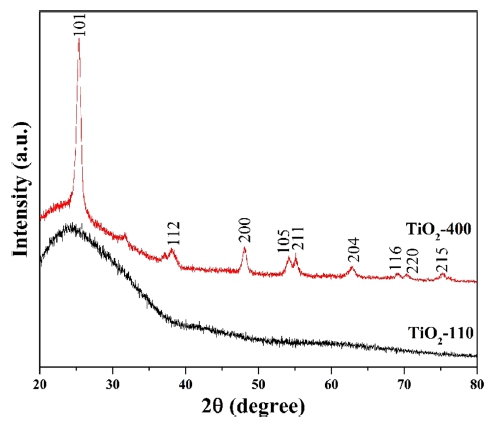
Fig. 1 shows XRD patterns of TiO2-110 and TiO2-400 thin films. The sample prepared heat treated at low temperature exhibit no detectable diffraction peaks. This reveals that the TiO2-110 sample is amorphous. However, TiO2-400 thin film exhibits diffraction peaks at 2θ = 25.39°, 38.1°, 48.04°, 54.17°, 55.10°, 62.77°, 68.95°, 70.34°, 75.04° corresponds to the crystal facets of (1 0 1), (1 1 2), (2 0 0), (1 0 5), (2 1 1), (2 0 4), (1 1 6), (2 2 0), and (2 1 5) anatase phase TiO2 (JCPDS No. 04- 014-5764), respectively. The crystallite sizes of TiO2-400 thin films was calculated using Debye Scherer’s equation. The calculated crystallite size of TiO2-400 thin film was about 12 nm.
3.2. Surface morphology and elemental analysis
Fig. 2(a-b) shows FE-SEM images of TiO2-110 and TiO2-400 thin films. From the FE-SEM image of TiO2- 110 thin film(Fig. 2(a)), amorphous nature of TiO2 nanoparticles has been clearly observed. The FE-SEM image of TiO2-400 thin film reveals slight agglomerations on the surface of thin films. Almost spherical particles were detected from FE-SEM analysis of both thin film samples.
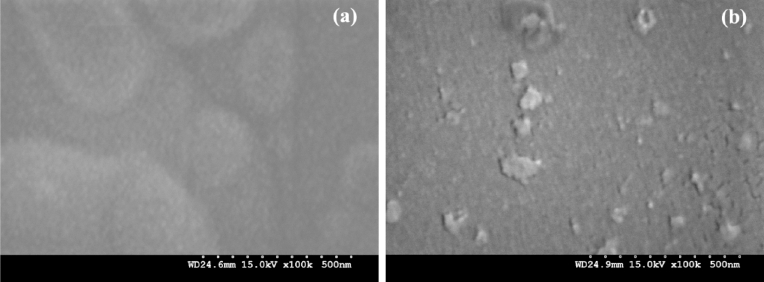
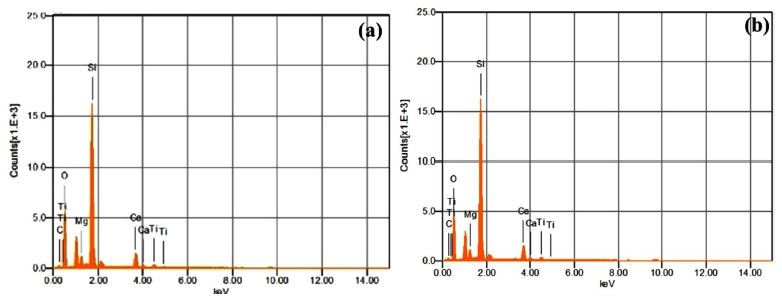
Fig. 3(a-b) shows EDS spectra of TiO2-110 and TiO2- 400 thin films. The EDS spectra of both thin film samples reveal the existence of titanium(Ti) and oxygen(O) on the surface of thin films while remaining elements such as calcium(Ca), magnesium(Mg), and silicon(Si) are from glass substrate. The EDS analysis confirms the formation of TiO2 without any elemental impurities.
3.3. Optical properties
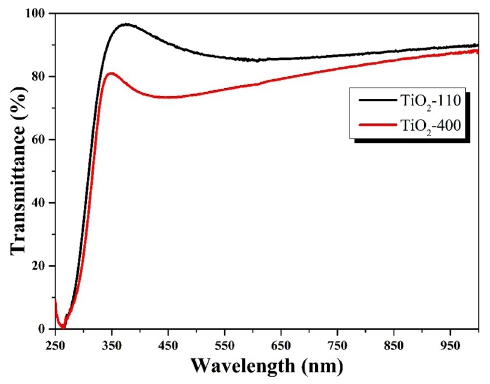
The optical transmittance in the wavelength range of 250-1000 nm was measured for TiO2-110 and TiO2-400 thin films as shown in Fig. 4. The average transmittance of TiO2-110 and TiO2-400 thin films in the visible region was 89 % and 78 %, respectively. The transmittance of the TiO2-400 thin film was lower than that of TiO2-110. The increase in light scattering due to the microstructure change, the transmittance decreased in the case of TiO2- 400 thin films.19) The optical properties of thin films are mainly influenced by thickness and morphology of the thin films.
3.4. Photo-induced hydrophilicity
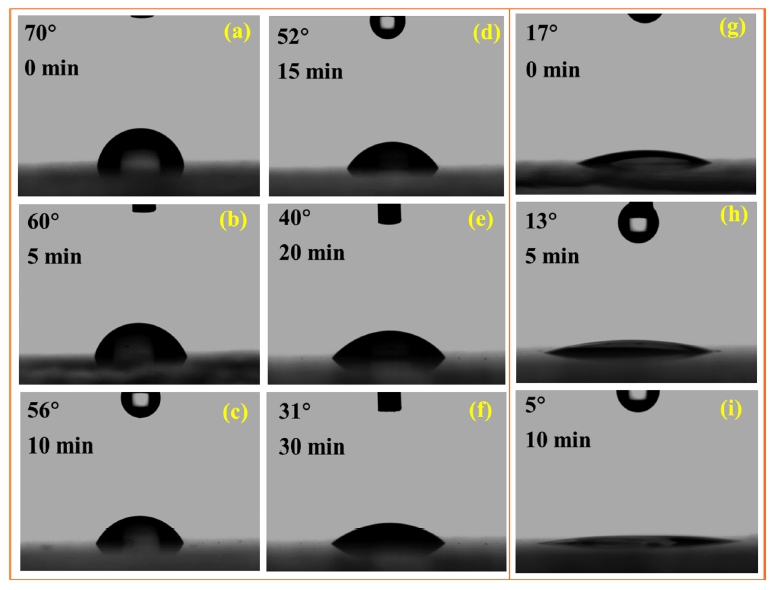
Photo-induced hydrophilicities of TiO2-110 and TiO2- 400 samples were studied by water contact angle measurement in the presence of UV light illumination. Fig. 5 shows water contact angle measurement of TiO2-110 and TiO2-400 samples at different time intervals under UV light illumination. The initial water contact angle of TiO2-110 thin film was 70°. After 30 min of UV light illumination, it was decreased to be 31°. For the TiO2- 400 thin film, the initial water contact angle was about 17°. After 5 min UV illumination, the water contact angle decreased to be 13° and further to be 5° with 10 min UV illumination. The TiO2-400 thin film shows super hydrophilicity under UV light illumination. The decreasing rate of water contact angle for the TiO2-110 thin film was lower than that of the TiO2-400 thin film. Thus, the change of the wettability behaviors for coating surface can be attributed to the surface roughness and effect of thermal treatment.20,21)
3.5. Photocatalytic activity
TiO2 has strong oxidizing power which can completely decomposes organic pollutants under UV light illumination. 3,22) TiO2 photocatalyst generates electron-hole pairs consequent to the absorption of UV light equivalent to the energy band gap.2,23) The photogenerated holes in the valence band migrates towards TiO2 surface and react with adsorbed water molecules, generating hydroxyl radicals (•OH). Similarly, photoexcited electrons in the conduction band generally take part in reduction processes, which are typically combine with molecular oxygen in the air to form superoxide radical anions (O2•−).2) These photogenerated radicals easily decompose nearby organic pollutants. In this way, TiO2 can keep its surface free from organic contaminations under light illumination.24-26)
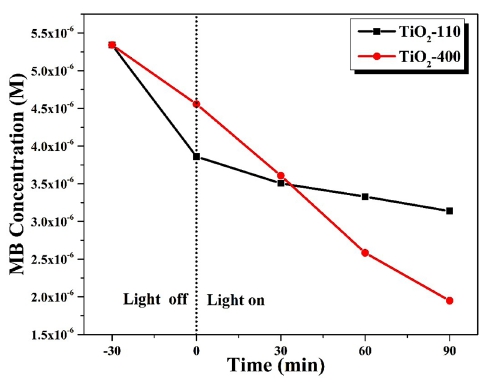
Photocatalytic activities of TiO2-110 and TiO2-400 coating films were evaluated by measuring the degradation of methylene blue. The photocatalytic activity of TiO2 thin films prepared at low temperature was compared with thin films prepared at high temperature. Fig. 6 shows the photodegradation of methylene blue for TiO2- 110 and TiO2-400 films in the presence of UV illumination. The TiO2-400 thin films represent higher activity than TiO2-110. The initial concentration of methylene blue was about 5.34 × 10⁻⁶ M, upon 90 min UV illumination with thin films, the concentration of methylene blue dye reached up to 3.139 × 10⁻⁶ M and 1.937 × 10⁻⁶ M for TiO2-110 and TiO2-400 thin films, respectively. The photocatalytic degradation of methyl blue solution follows a pseudo-first order reaction and its kinetics equation may be expressed as:(1)
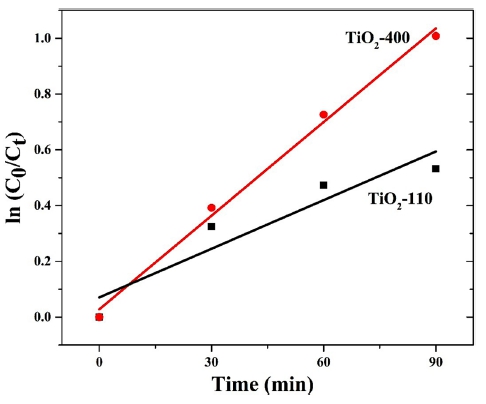
where, k is the apparent reaction rate constant, and C0 is initial concentration and Ct is the concentration of methyl blue dye solution at time t, respectively. The photocatalytic reaction rate constants of methyl blue dye solution over TiO2-110 and TiO2-400 thin films were calculated from the slope of the curve as shown in Fig. 7. The TiO2-400 thin film (k = 0.0112 min−1) exhibited the highest rate of degradation of methyl blue dye solution compared to TiO2-110 thin film (k = 0.00581 min−1). The lower photocatalytic activity of the thin film prepared at low temperature was attributed to the lower crystallinity of the sample. The photocatalytic TiO2 coating layers annealed at low temperature may provide many useful applications such as a coating of TiO2 films on the polymeric substrates for self-cleaning performance which have low melting point.
4. Conclusions
TiO2 thin films were coated on a glass slides using solgel method and peroxo titanic acid as a precursor. The self-cleaning and photocatalytic properties of the thin films were changed with heat treatment. TiO2 thin films prepared at low temperature showed lower photocatalytic activity while higher photocatalytic activity was observed for TiO2 thin films prepared at high temperature. The thin films heat treated at low temperature had maintained high transparency, hydrophilicity, and adequate photocatalytic activity. The coating process of self-cleaning and photocatalytic TiO2 thin films on the glass substrates was quite simple, low-cost, and a low temperature route. Therefore, this work may provide a promising way to coat self-cleaning and photocatalytic TiO2 thin films for various applications.