


1. Introduction
It is well established that the flow stresses in Ni3Al and Ni3Al-base compounds with L12 structure increase with increasing temperature, reaching a peak value at a certain temperature.1-3) Many investigations have been carried out to rationalize this anomalous increase of flow stress and, as a result, the understanding of the deformation mechanism at lower temperatures than the peak temperature has advanced. It is well accepted that the heteroclite increase of flow stress can be described by the cross-slip pinning model.4) For all practical purposes, however, the nickel-base superalloys including the Ni3Al phase are exposed at temperatures above the peak temperature. In this temperature range, the flow stresses in Ni3Al gradually decreases with temperature. There is little information available on the deformation mechanism at these high temperatures. The deformation mechanism may be very complex because of the contribution of the diffusion of atoms. However, it is important to understand the high temperature deformation mechanism because most heat resisting materials are practically used at high temperatures.
The investigations reported for L12 intermetallic compounds in this temperature range are not sufficient. The following results have been reported from the creep experiments and the conventional constant strain rate tests. In polycrystalline materials, the creep rate can be explained by the power law relation with stress, the value of stress exponent are about 3, and the deformation is controlled by the viscous motion of dislocations.5-7) In single crystals, the octahedral viscous glide is a rate controlling mechanism for the crystals with the <001> orientation, and the deformation mechanism is the Peierls mechanism in the <110>{001} slip system for the crystals with off <001> orientations.8-11)
The purpose of the present investigation is to understand the deformation mechanism of Ni3Al and Ni3(Al,Mo) single crystals with the orientation near <112> at high temperatures above the peak temperature. Especially, the deformation behavior at low strain rates is investigated in detail. The results of strain rate dependence of the flow stress, the observation of active slip system and the dislocation structures will be discussed in this study.
2. Experimental Procedure
The alloys used in this investigation melted by electric arc using a non-consumable tungsten electrode from starting materials of nominal composition Ni-24.0 at%Al- 0.1 at%B and Ni-18.5 at%Al-5.0 at%Mo. Using these alloys, the Ni3Al and Ni3(Al,Mo) single crystals with the orientation near <112> were grown by the Bridgman method in a vacuum pressure of 10–4 Pa controlling the temperature gradient in a furnace and the growth velocity of crystallization. The growth rates of crystals are 6 mm/ h for Ni3Al and 3 mm/h for Ni3(Al,Mo). The reason for the addition of B element to Ni3Al is to make easy the growth of single crystals and give only a small influence on the deformation behavior at high temperatures.10)
The orientations of specimens were determined by Xray Laue back refraction. All crystals grown were annealed for one week at 1273 K at a vacuum pressure of 10–3 Pa. After annealing, specimens with the orientation near <112> were cut by mechanical cutting and spark erosion to a gage size 3 × 0.3 × 10 mm. Specimens were mechanically polished with abrasive papers and buffs with alumina suspension. And then all specimens are annealed again for 3 hours at 1273 K to eliminate the strain by polishing.
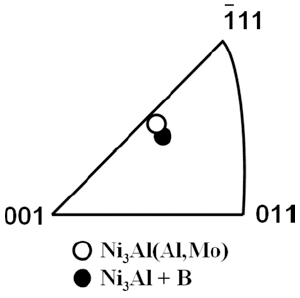
The deformation behavior of these crystals was intensively investigated over a temperature range from 1073 to 1273 K at a vacuum pressure of 10–1 Pa and a strain rate range from 8 × 10⁻⁶ to 8 × 10⁻⁴ s–1. Fig. 1 and Table 1 show the tensile axis and the Schmid factors for Ni3Al and Ni3(Al,Mo) single crystals used respectively. Slip line observations were made by optical microscopy with a Nomarski interferometer to determine the active slip system. The dislocation structures after deformation were observed by a transmission electron microscope (TEM).
3. Results
3.1 Stress-strain curves
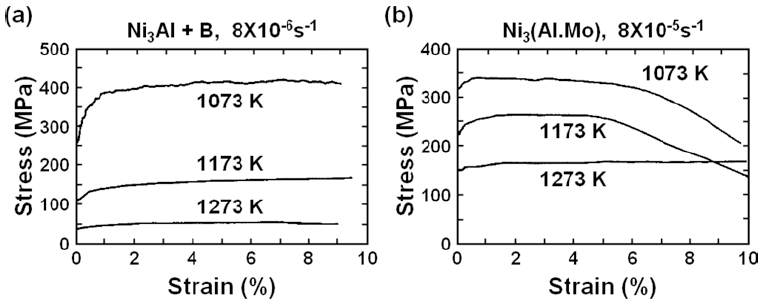
The typical stress strain curves at various temperatures in Ni3Al and Ni3(Al,Mo) are shown in Fig. 2(a) and (b). The flow stress reached a steady state level after a few percent (0 < 2 %) strain during deformation. The flow stress at the steady state deformation decreases with temperature. High temperature yielding and serrated flow were found at some deformation conditions.
3.2 Temperature and strain rate dependence of the 0.2% flow stress
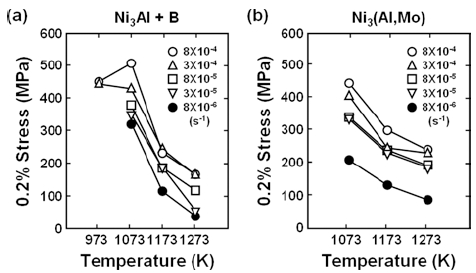
Fig. 3(a) and (b) show the temperature dependence of the 0.2 % flow stress for several strain rates. The yield stress in Ni3Al reached the maximum at the temperature between 1000 and 1100 K. The yield stress monotonously decreases with the increase of temperature and with the decrease of strain rate above the peak temperature. The degree of the temperature dependence of the yield stress in Ni3(Al,Mo) is slightly different from that in Ni3Al. The flow stress in Ni3(Al,Mo) tends to become constant at higher temperatures.
3.3 Strain rate dependence of flow stress
The steady state deformation during which the flow stress maintains a constant level is the same phenomenon as the steady state creep in creep test. In the present experiments the deformation rate will be described by the power law creep equation referring to the deformation mechanism map in Ni-base superalloys.12) Therefore, the strain rate, έ, can be given by the following Dorn equation,
where A, D, b, σ, μ, k, n and T are a constant, the diffusion coefficient, the Burgers vector, the flow stress, the shear modulus, Boltzmann’s constant, the stress exponent and the absolute temperature, respectively.
Fig. 4(a) and (b) indicate the relationship between the normalized strain rate, (kT / Dμb)έ, and the normalized steady state flow stress, σ / μ, for Ni3Al and Ni3(Al,Mo). The values of stress exponent, n, varied at a critical stress in both Ni3Al and Ni3(Al,Mo). The value of n was almost infinite in the high stress (high strain rate) region, and n = 2.7 for Ni3Al and n = 4.8 for Ni3(Al,Mo) in the low stress (low strain rate) region.
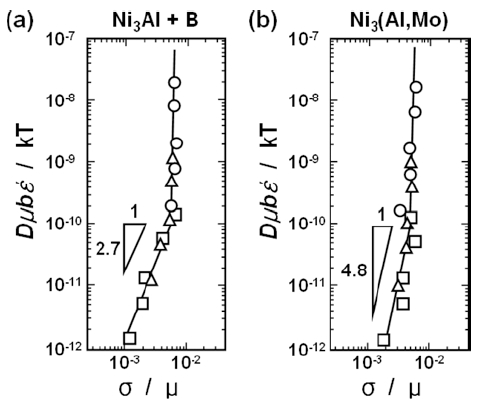
Fig. 4
The relationship between the normalized strain rate and the normalized stress in (a) Ni3Al and (b) Ni3(Al,Mo).
The above results show that the strain rate dependence of flow stress is negligibly small at the high strain rates, while the dependence became large at low strain rates. The deformation behavior of metals and alloys in high temperature creep is divided into two types, they are an alloy type (n = 3) and a pure metal type (n = 5). Judging from the values of stress exponent in the low strain rate region, the deformation behavior of Ni3Al is the alloy type (type A) and that of Ni3(Al,Mo) is the pure metal type (type M).
3.4 Apparent activation energy for deformation
The apparent activation energies for deformation in Ni3Al and Ni3(Al,Mo) were obtained in the low strain rate region. The values of the apparent activation energy are 360 kJ/mol for Ni3Al and 300 kJ/mol for Ni3(Al,Mo). These values are in agreement with the activation energies for the self diffusion of Ni and Al or the interdiffusion in Ni3Al shown in Table 2.13-15) The deformation in this region is controlled by the diffusion of atoms.
3.5 Active slip system
Fig. 5(a) and (b) are the optical micrographs showing the slip lines on the specimen surfaces of Ni3Al and Ni3(Al,Mo) deformed at 1273 K. The results of the slip line observations are summarized in Table 3(a) and (b). The active slip systems in Ni3Al are divided into two types by the strain rate and the test temperature.
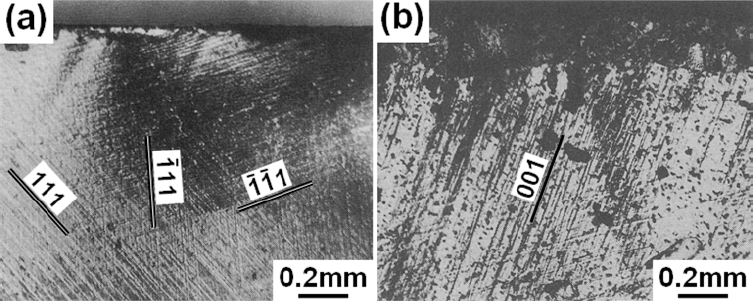
Fig. 5
Optical micrographs showing slip lines in (a) Ni3Al and (b) Ni3(Al,Mo) deformed at 1273 K and at a strain rate of 8 × 10⁻⁴ s–1.
Table 3.
Active slip planes in (a) Ni3Al and (b) Ni3(Al,Mo). *mark shows the most active slip plane.
In the low temperature and high strain rate region, both {001} slip and {111} slip were observed, but in the high temperature and low strain rate region only {111} slip observed. The border line with the change of the slip system is corresponding to the change of stress exponents from the infinite values in the high strain rate region to about 3 in the low strain rate region in Fig. 4(a). While, the only {001} slip is active at all the test conditions above the peak temperature.
3.6 Microstructures of deformed crystals
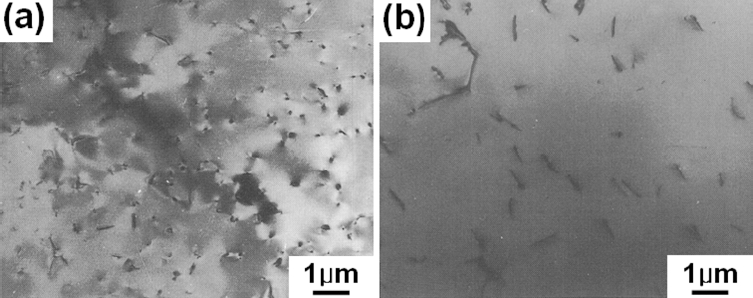
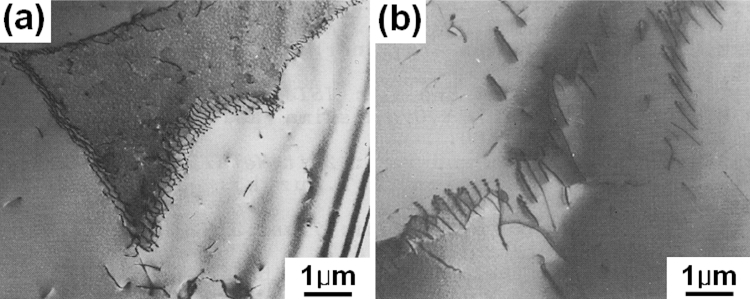
The dislocation structures of Ni3Al and Ni3(Al,Mo) observed by TEM are shown in Fig. 6(a) and (b) and in Fig. 7(a) and (b) for the specimens deformed: (a) in the low temperature and high strain rate region and (b) in the high temperature and low strain rate region, respectively. The distribution of dislocations was uniform in Ni3Al but inhomogenous in Ni3(Al,Mo). The subgrains were formed in Ni3(Al,Mo).
4. Discussion
Three types of deformation behavior were found in Ni3Al and Ni3(Al,Mo) single crystals depending on the strain rate, the test temperature and the solute element.
At high strain rates the deformation behaviors in both of Ni3Al and Ni3(Al,Mo) were similar. When the values of stress exponent was high, the strain rate sensitivity was slight and the cube glide ({001} slip) was active. In this region the deformation in both crystals may be controlled by the dislocation glide according to the Peierls mechanism in the <110>(001) slip system.
At lower strain rates, the apparent activation energies for deformation in both crystals were in agreement with that for diffusion in Ni3Al. The result indicates that the deformation in this region is controlled by the same diffusion process as the high temperature creep. The characteristics of the deformation behavior in Ni3Al are as follows; the value of stress exponent is about 3, the distribution of dislocations is uniform and the octahedral glide is active. These results suggest that the deformation of Ni3Al in this region is controlled by the viscous glide of dislocations on the {111} slip planes such as the A type behavior in the high temperature creep of solid solutions.
It should be noticed that the Ni3Al single crystal with the orientation near <112> is deformed by the octahedral glide ({111} slip). It is well accepted that the octahedral glide above the peak temperature operates only in the crystals with the <001> orientation in which the Schmid factor of cube glide is zero.6,10,11)
However, in the case of the crystals having the orientations without the <001>, it has been considered that the deformation is controlled by the octahedral glide below the peak temperature, by the cube glide above it and again by the octahedral glide at higher temperatures.7,11) In the present investigation, although the tensile axis is near <112>, the octahedral glide is active in Ni3Al in all the temperature range at low strain rates.
The deformation behavior of Ni3(Al,Mo) single crystals at low strain rates can be characterized as follows; the value of stress exponent is about 5, the dislocation distribution is inhomogeneous (the formation of subgrains), the cube glide is active. The results suggest that the deformation is controlled by the dislocation climb process such as the type M behavior in creep. In Ni3(Al,Mo), the {001} slip was active above the peak temperature even at low strain rates as reported in the literatures.7,11) It seems that the addition of Mo atoms to Ni3Al tends to change the slip system from the <110> {111} to the <110>{001}.
5. Conclusions
The high temperature deformation behaviors of Ni3Al and Ni3(Al,Mo) single crystals that were oriented near <112> was investigated at low strain rates in the temperature range above the peak temperature.
Three types of behavior were found under the present experimental conditions. In the relative high strain rate region, the strain rate dependence of the flow stress is small, and the deformation may be controlled by the dislocation glide mainly on the {001} slip plane in both crystals.
At lower strain rates, the octahedral glide is still active in Ni3Al above the peak temperature, but the active slip system in Ni3(Al,Mo) changes from octahedral glide to cube glide at the peak temperature. The results suggest that the deformation rate controlling mechanism of Ni3Al is the viscous glide of dislocations by the <110>{111} slip, whereas that of Ni3(Al,Mo) is a recovery process of dislocation climb in the substructures formed by the <110>{001} slip. The results of TEM observation show that the characteristics of dislocation structures are the uniform distribution in Ni3Al and the subboundary formation in Ni3(Al,Mo).