


1. Introduction
Recent investigations reveal that mechanical properties of TiAl intermetallics are greatly influenced by aluminum content.1-5) Many factors responsible for the change in mechanical properties with aluminum content have been pointed out, such as the decreasing of interstitials in the gamma phase with a decrease in aluminum content because of a high degree of absorption of interstitials in the increased α2 phase.1,6) It is also reported that morphology of lamellar grain boundaries changes with aluminum content, that is the boundaries of the Ti-44 at.%Al (hereafter all compositions are at.%) alloy are straight while those of the Ti-48%Al alloy are serrated, and the morphology strongly affects the fracture behavior of the alloys from low to high temperatures.3,4) In this study, the formation process of lamellar grain boundaries of binary TiAl alloys are investigated. Special emphasis has been placed on differences in the process at levels of Ti- 44%Al and Ti-48%Al.
2. Experimental Procedure
Button ingots of binary TiAl alloys containing aluminum ranging from 44 to 48 % were prepared using an arc melting furnace. Cylindrical specimens, 6 mm in diameter and 6 mm in height, were machined from these ingots, and were induction-heated to 1723 K and held for 2 minutes. At 1723 K, the Ti-44%Al alloy is considered to be in the beta single phase field, while the Ti-48%Al is in the alpha single phase field according to recently published phase diagrams of the Ti-Al system.7-10) Then specimens were cooled at a constant rate of 30 K/min to quenching temperatures of 1473 K, 1273 K for Ti-44%Al, and 1623 K, 1573 K, 1473 K for Ti-48%Al, followed by helium-gas-quenching from the temperatures. The average cooling rate from quenching temperatures to 723 K was approximately 100 K/sec. Microstructural observation for quenched specimens by means of optical microscopy(OM; GX-51 OLYMPUS) and transmission electron microscopy (TEM; JEM-3010 JEOL), and X-ray diffraction(XRD; JDX-35HS JEOL) experiments were performed. Thin plates of about 0.3 mm thickness were cut from the specimens and thin foils for TEM observation were prepared by standard twin-jet electro-polishing using a 35 % butanol +59 % methanol +6 % perchloric acid electrolyte at 273 K, and electro-polishing condition is 12-14 V, 0.5- 0.6 A, about 300 sec.
3. Results and Discussion
Microstructures and X-ray diffraction spectra of quenched Ti-44%Al and Ti-48%Al alloys are shown in Fig. 1 and Fig. 2, respectively.
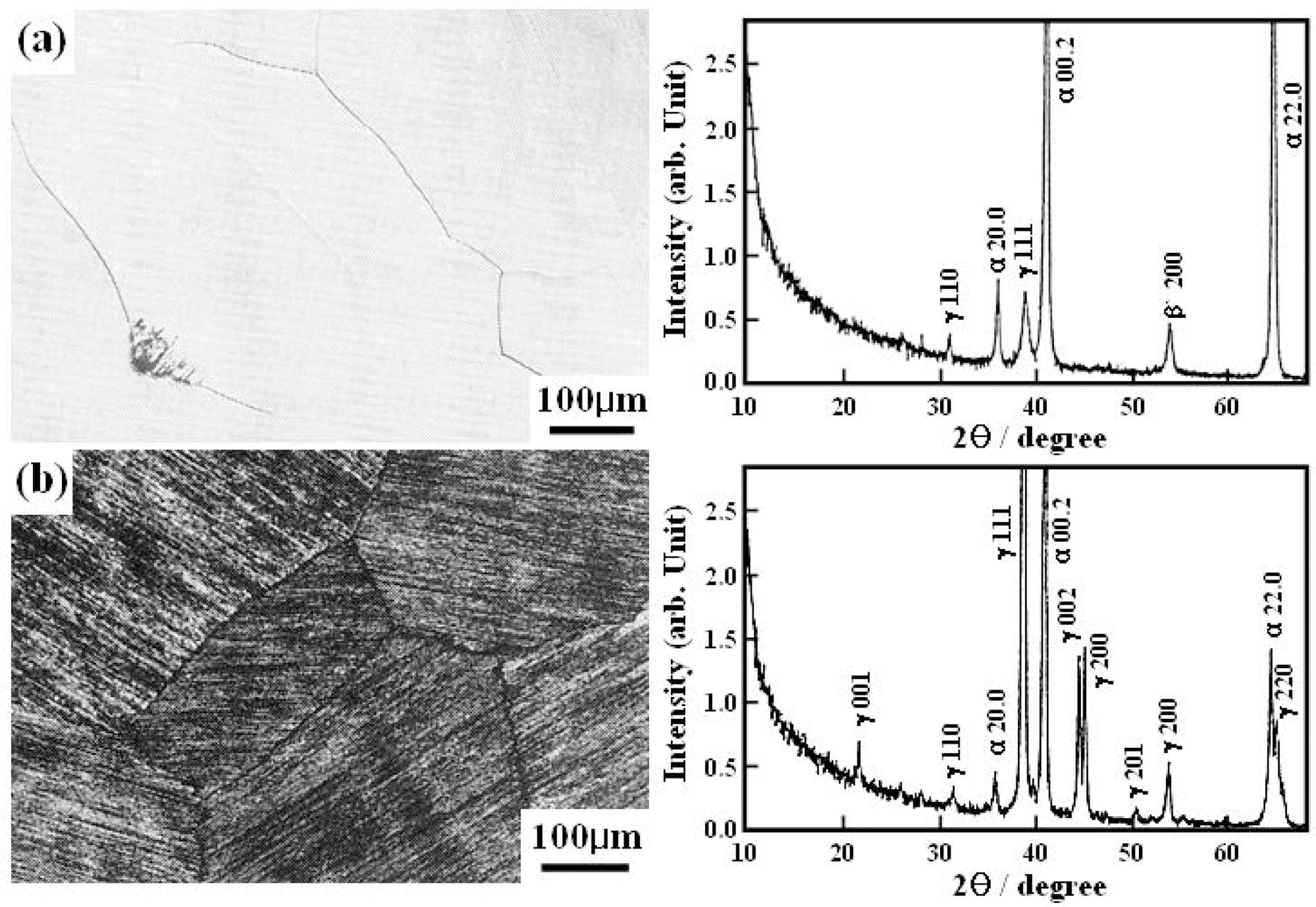
Fig. 1.
Microstructures and X-ray diffraction spectra of heat treated Ti-44%Al. Held at 1723 K for 2 minutes followed by helium gas quenching from (a) 1473 K and (b) 1273 K.
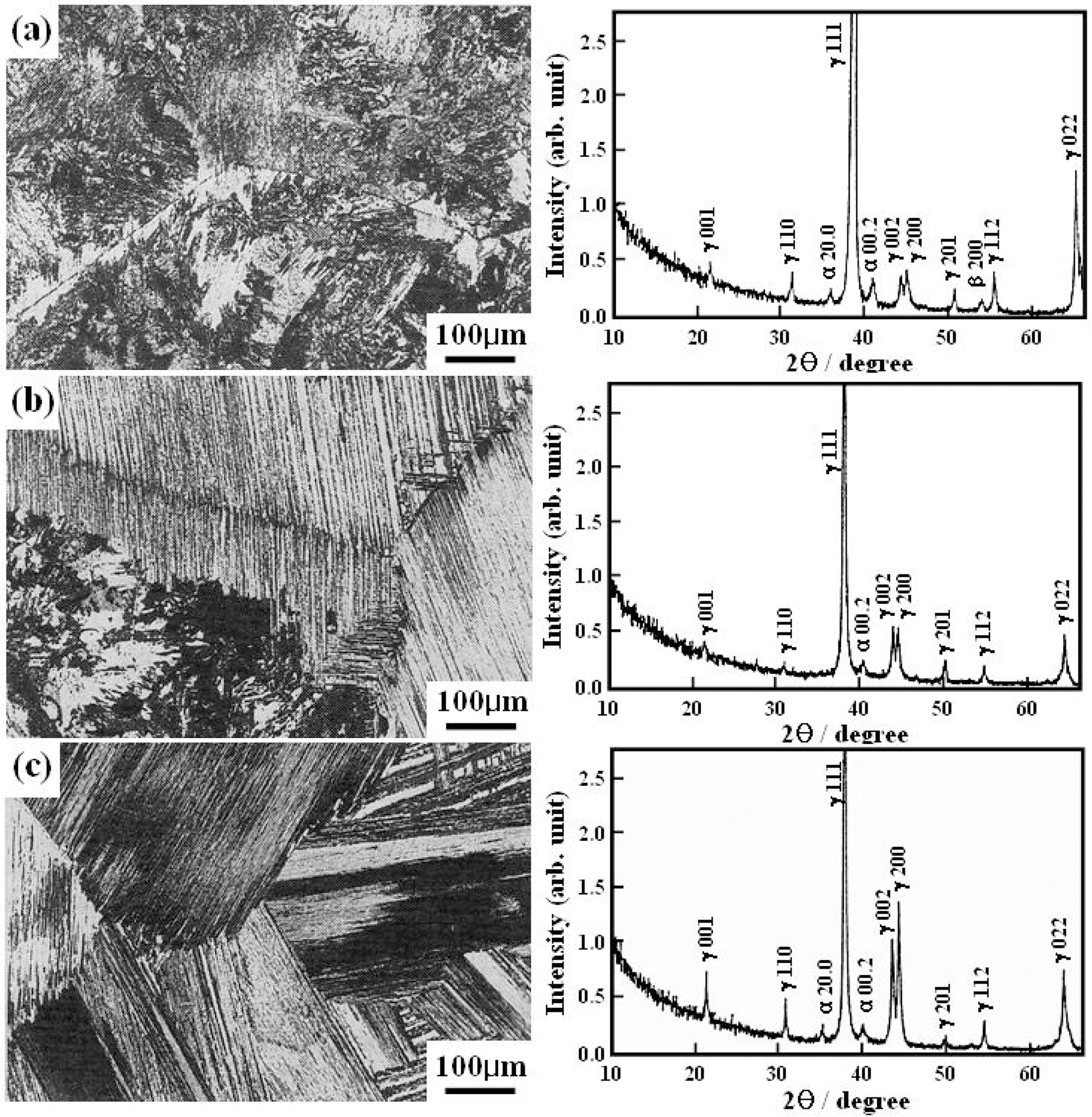
Fig. 2.
Microstructures and X-ray diffraction spectra of heat treated Ti-48%Al. Held at 1723 K for 2 minutes followed by helium gas quenching from (a) 1623 K, (b) 1573 K and (c) 1473 K.
For the Ti-44%Al, few lamellae were observed in samples quenched from higher than 1473 K(Fig. 1(a)). Although small peaks of beta phase were detected using X-ray diffraction, only the ordered hexagonal phase (α2) with clear APB contrast was observed in TEM observation( Fig. 3). This suggests that the sample mainly consisted of disordered alpha phase at high temperatures in a series of heat treatments, and that the disordered phase transformed to the ordered phase during quenching. The sample quenched from 1273 K consisted of the α2/γ lamellar structure with the straight feature of lamellar grain boundaries(Fig. 1(b)). The formation of the lamellar structure is considered to take place during slow cooling through the eutectoid temperature at around 1390 K.7-11)
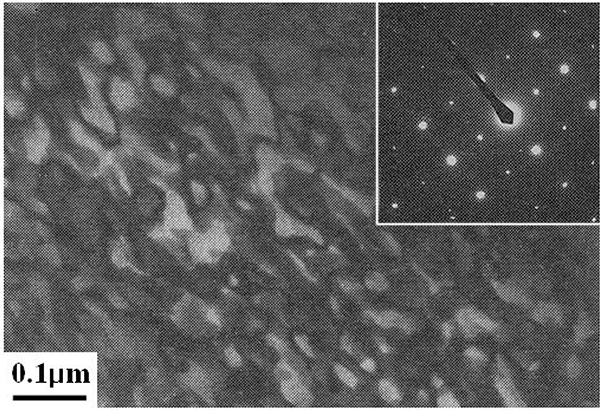
Fig. 3.
Superlattice dark field image of the Ti-44%Al alloy corresponding to Fig. 1(a). Anti-phase boundaries are observed. The zone axis patterns: [1210]α2.
For the Ti-48%Al alloy, almost no lamellar structure, and straight grain boundaries were observed in samples quenched from higher than 1623 K(Fig. 2(a)). The formation of lamellae along grain boundaries was observed in the sample quenched from 1573 K(Fig. 2(b)). The fully lamellar structures with serrated boundaries were observed in samples quenched from lower than 1473 K(Fig. 2(c)).
According to the equilibrium phase diagram,7-9) the α →α+ γ transformation temperatures in Ti-44%Al and Ti-48%Al alloys are approximately 1530 K and 1640 K, respectively, so super-cooling of the gamma formation is considered to be over 130 K for Ti-44%Al, and 70 K for Ti-48%Al at cooling at a rate of 30 K/min. It is reported that the gamma phase has sluggish growth kinetics because of the ordered structure,12) and this seems to be one of the reasons for the high levels of super-cooling obtained even at a relatively slow cooling rate as in this work.
An enlarged view of the lamellar grain boundaries in the Ti-44%Al alloy corresponding to Fig. 1(b) is shown in Fig. 4. It is interesting to note that slightly serrated characteristics are observed despite the fact that the morphology of the boundaries is regarded as straight in a low magnified observation. A TEM micrograph of the serrated lamellar grain boundaries of the Ti-45%Al alloy consisting of full α2/γ lamellae is shown in Fig. 5. Since the angle between neighboring lamellar grains is 54 degree Fig. 1. (which is given by the diffraction patterns obtained in both grains), there is no orientation relationships between the bulged area and the matrix.
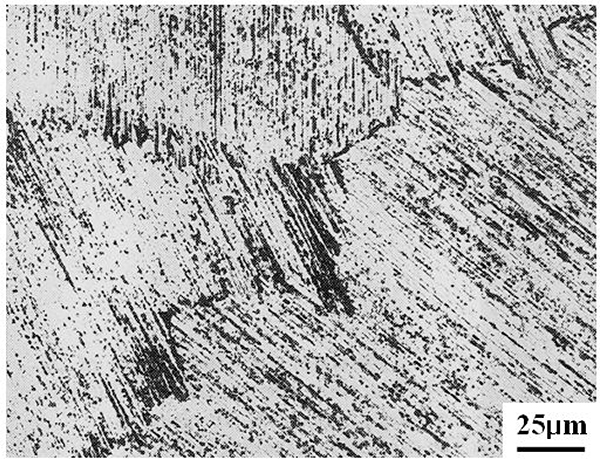
Fig. 4.
Enlarged views of lamellar grain boundaries of the Ti- 44%Al alloy corresponding to Fig. 1(b).
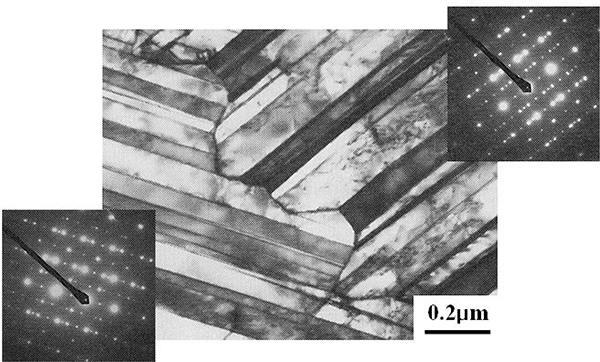
Fig. 5.
TEM micrograph of serrated lamellar grain boundaries observed in Ti-45%Al. The zone axis patterns for each lamellar grain: and twin corresponding to 180° rotation about [111]γ.
The α→α2 + γ eutectoid reaction exists in the phase diagram of Ti-Al system, however, it is reported that the formation of γ in the supersaturated α is actually the pre- cipitation of γ in the supersaturated ordered α2 matrix.13,14) Since in both cases, the formation of γ is basically precipitation in the supersaturated hexagonal matrix, and crystallographic relationships between α and γ are the same as those of α2 and γ, namely and , it is considered that the differences are not significant in the transformation processes at levels of Ti-44%Al or Ti-48%Al. The nuclei of γ at grain boundaries will be coherent to the matrix of at least one grain which is adjacent to the boundaries. The nuclei can grow not only into the coherent grain but also into the incoherent grain. In general, the growth rate of the nuclei in a coherent grain is faster than that in an incoherent one because of the low surface energy of the coherent plane(Widmanstatten growth). However, when the driving force of the transformation is very large, the nuclei actually grow into the incoherent grain very fast accompanied with the grain boundary migration. Assuming that the driving force for the transformation is constant, the extent of the precipitation-induced grain boundary migration will become larger at higher transformation temperatures due to higher diffusivity. Additionally, the low interfacial energy of the α2/γ interface compared with that of the α/γ interface appears to promote the Widmanstatten growth as the major mode in Ti-44%Al.15) Consequently, it is considered that the large serration of lamellar grain boundaries in Ti-48%Al is due mainly to the remarkable grain boundary migration induced by precipitation and growth of γ into adjacent grains at the high transformation temperature.
4. Conclusions
The process of the α→α+ γ transformation in Ti- 48%Al is basically similar to that of the α→α2 + γ in Ti-44%Al. The large serration of lamellar grain boundaries in Ti-48%Al is considered to be due to noticeable grain boundary migration induced by precipitation and growth of γ into adjacent grains at the higher transformation temperature.