


1. Introduction
Due to human activities (such as fossil fuel combustion), the growing amount of CO2 emitted into the atmosphere that have exceeded the natural carbon cycle. The sustained increase in the density of CO2 has led to the melting of glaciers as well as the increase of disastrous weather year by year.1-3) Therefore, reducing carbon dioxide emissions has become a global concern. Whether it is tackling climate change or resolving human dependence on fossil energy, the conversion of carbon dioxide (CO2) into high-value fuels and chemicals has brought important challenges and possibilities to people today.4,5) As an inexhaustible green energy source, solar energy has been widely favored by scientific researchers. In particular, photocatalytic reduction of CO2 to high value chemical substances,6,7) such as CH4,8) HCOOH,9,10) CO,11) CH3OH,12) etc. has become a research hotspot.
g-C3N4 is a kind of pollution-free and metal-free green catalyst, and because of its non-toxic, low cost, narrow band gap, excellent chemical stability and wide applicability, it has attracted much attention.13-19) The structure of g-C3N4 has two-dimensional layered, with N as a heteroatom in a conjugated bond between the internal layers of the molecule, and a covalent bond between the carbon and nitrogen atom, which is a weak interaction between molecules.20) On account of the particularity of its organizational and electronic structure, it can maintain high stability even under acid-base conditions.21) But, g-C3N4 also has some shortcomings, such as easy recombination of photo-generated carriers, low surface area and quantum efficiency, etc.22,23)
The starting point of this article is the photocatalytic reduction of CO2 with g-C3N4 based catalysts. It mainly introduces the g-C3N4 morphology control, doping method, oxide-sulfide composite and other methods to improve the electron-hole separation efficiency of g-C3N4, thereby improving CO2 conversion rate. And combined with the literature, the photocatalytic CO2 reduction with g-C3N4-based catalyst prepared by different methods was compared.
2. Experimental Procedure
According to reports, the main synthesis methods of g- C3N4 include solvothermal, electrochemical deposition and thermal polymerization method. In recent years, researchers have used different methods to synthesize g- C3N4 with different morphologies. Here are a few methods as follow.
2.1 Solvothermal method
Solvothermal preparation of g-C3N4 generally uses melamine, melamine chloride, etc. as raw materials, NH2NH2, Et3N, etc. as solvents, and crystallize synthesis at a certain temperature. The solvothermal synthesis process is simple, easy control of the composition and good system uniformity. And this reaction is carried out under the closed condition of the autoclave, the harmful gas produced will not be directly volatilized into the air, reducing environmental pollution.
2.2 Thermal polymerization method
The thermal polymerization method forms g-C3N4 by thermally inducing the polycondensation reaction of the precursor. First, melamine was ground in mortar, and then transferred to alumina crucible. After high temperature reaction in a semi-closed environment for a period of time, a light yellow block material g-C3N4 was obtained. Then, grind the block g-C3N4 in a mortar, add methanol solution, sonicate, wash, and dry to obtain g-C3N4 nanosheets. this is a direct and simple method for preparing materials, and in recent years it has gradually become a commonly used and important synthetic method for preparing g-C3N4, the thermal polymerization method uses a variety of nitrogen-rich precursors, low cost, low equipment and control requirements, simple operation, and easy to scale up. It has become the first choice for large-scale preparation of g-C3N4.
2.3 Electrochemical deposition method
Electrochemical deposition method has been mainly used in the preparation of g-C3N4 thin film in recent years. The method requires expensive equipment and complex reaction process, but the equipment is simple and easy to control, which can reduce the temperature of the reaction system.
3. Results and Discussion
3.1 g-C3N4 morphology control and reduction of CO2
By calcining different ammonia-containing precursors such as urea, C3H6N6, C2H4N4, etc., a massive g-C3N4 can be obtained by intermolecular self-polymerization. The bulky g-C3N4 has a low specific surface area, which greatly limits its application. By introducing nano-tunable pore structure (soft template, hard template) or changing the preparation process, a series of g-C3N4 catalysts with high-up specific face region have been synthesized. Ma24) et al. successfully prepared a new type of nitrogendeficient photocatalyst porous structure g-C3N4 through in-situ doping and freeze-drying way, which has improved photoreduction of CO2 performance. The catalytic mechanism was shown in Fig. 1. The results showed that the method has obtained satisfactory yields of CO and CH4, about 19.7 μmol/g and 37.1 μmol/g, respectively.
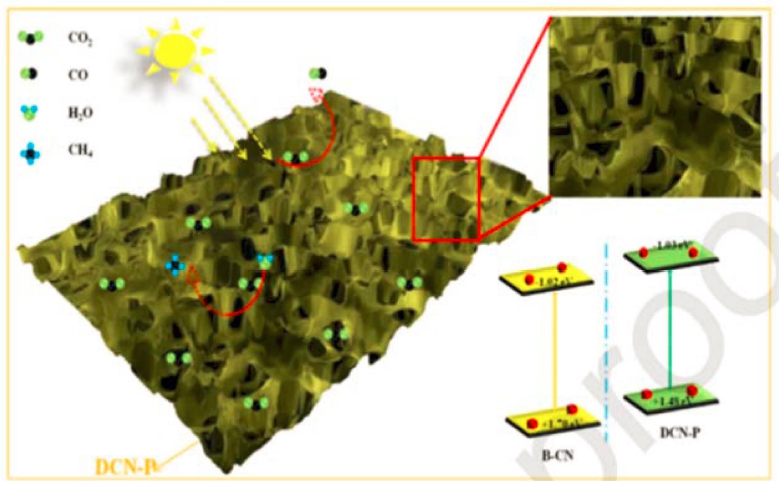
Supramolecular assembly methods are widely used, especially in the synthesis of one-dimensional materials with unique advantages. It is a molecular aggregate in which molecules and molecules are spontaneously connected to non-covalently bonded molecules, and then under certain conditions form a structurally stable molecular aggregates. Through molecular self-assembly, we can obtain selfassembly materials with novel functions and characteristics, which have been widely valued and studied by researchers.25) Mo et al.26) successfully prepared porous N-rich g-C3N4 nanotubes through supramolecular self-assembly, and g- C3N4 has Lewis basicity and large face region. Therefore, the photocatalytic carbon dioxide reduction activity is enhanced. The CO2-CO conversion rate of the composite nanotube catalyst was 17 times and 15 times higher than that of the bulk g-C3N4 and P25-TiO2, respectively, as shown in Fig. 2.
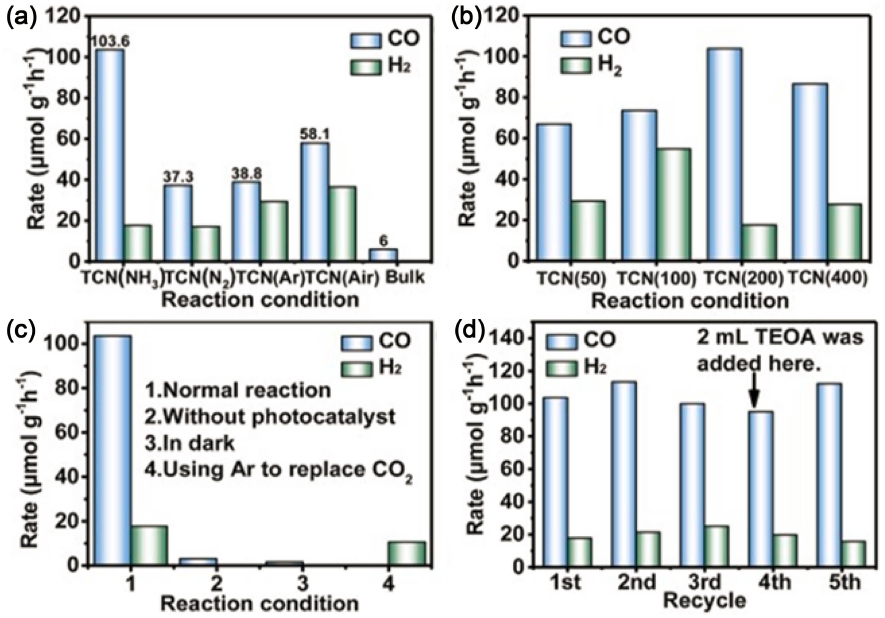
Fig. 2
(a, b) CO2 photoreduction activity of different samples, (c) CO2 reduction performance under various conditions, and (d) CO/H2 formation in stability test.26)
3.2 Non-metal doped g-C3N4 to reduce CO2
Non-metallic,27-32) such as: doping of B, S, O, P, F, C, etc., can replace C, N, and 3-s-triazine structural units the element H replaces lattice defects, effectively suppresses electron-hole recombination. Among them, black phosphorous (BP) is a multifunctional non-metal semiconductor, which was widely used as doping in g-C3N4 to reduce CO2 emissions. Zhou et al.33) prepared a 2D/2D BP/g-C3N4 composite material at exceedingly low temperatures for CO2 reduction. With the addition of 2D BP, the separation of photogenerated electron-hole pairs by photoelectricity was greatly promoted. At the same time, the composite material can maintain high CO generation selectivity. The related mechanism was shown in Fig. 3. Liu et al.34) composited S-substituted g-C3N4 by handle g-C3N4 powder in high-purity H2S gas at 723 K. This method will generate a large amount of toxic and odorous gases, causing serious harm to the surrounding environment. However, Wang et al.35) synthesized S-doped g-C3N4 by calcining thiourea. The method is relatively simple and releases less harmful pollutants. The results showed that the CH3OH yields of TCN and MCN were 1.12 and 0.81 mol/g, respectively, as shown in Fig. 4.
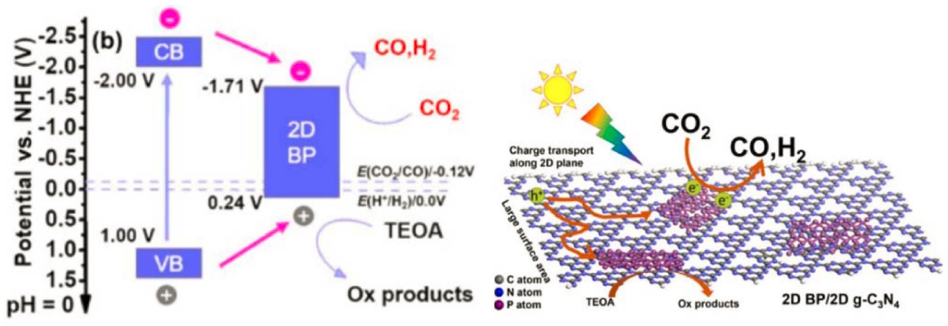
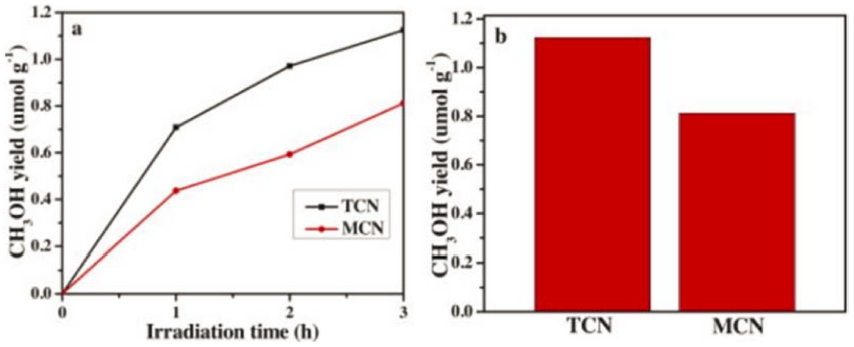
Fig. 4
(a) Time course of photocatalytic generation of CH3OH (b) Comparison of photocatalytic generation of CH3OH on TCN and MCN for 3 h under ultraviolet and visible light irradiation.35)
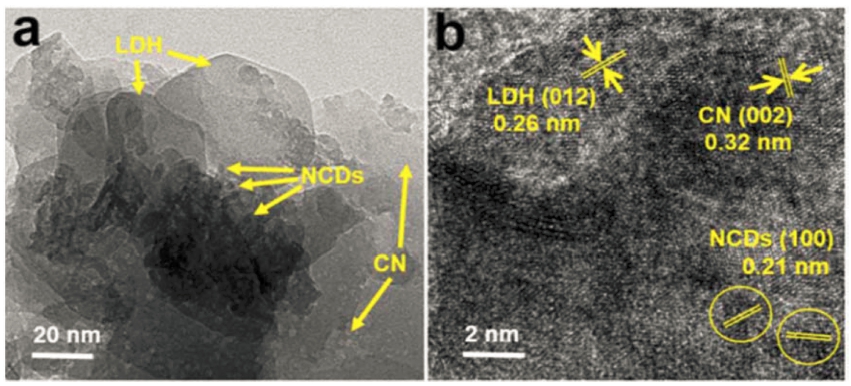
Conforming two distinct semiconductors into a twodimensional stratumed architecture with adaptation CB and VB fringe potentials is considered to be an effective means to improve the productivity of photoexcited carrier separation.36) Wan et al.37) prepared N-doped C-dot/CoAl layered double hydroxide/g-C3N4 heterojunction photocatalyst under simulated sunlight. High-resolution TEM images is shown in Fig. 5. It can be seen from TEM that the NLC- 10 hybrid photocatalyst has been successfully combined. This method can effectively and selectively reduce CO2 and water to CH4, and the best reduction rate was 25.69 mol/g/h. Liu et al.38) successfully prepared the P element and cyano group (CN) merged into the g-C3N4 framing. Compared with the original g-C3N4, the photocatalytic CO2 reduction activity of composite sample was increased by 1.58 times. Samanta et al.39) successfully prepared surface-modified g-C3N4 by co-condensation reaction of urea and thiourea with 2-methylimidazole. Physicochemical characteristics show that O and C are co-doped. Without using any cocatalyst, the photocatalyst was used for the reduction of CO2 and H2O2.
3.3 Metal doped g-C3N4 to reduce CO2
Metal doping is widely used to improve its photocatalytic performance (such as Fe,40) K,41) Cu,42) Zn43) and Mo44)), Due to the diversity of metal ions, it also has different effects on the photocatalytic activity of the catalyst.
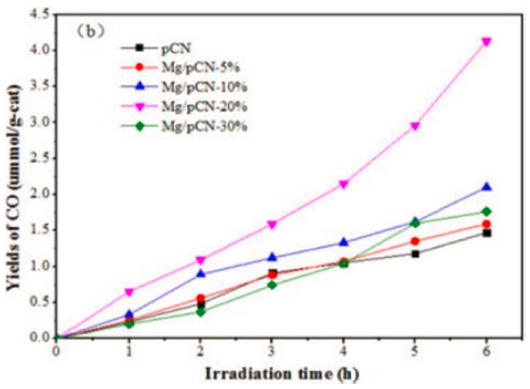
The electron migration path of the Z-type heterojunction between semiconductors is connected in series with the English letter “Z”, so it is called the Z-type photocatalytic system. This unique electron migration path causes the Z-heterojunction electrons to increase the separation of a large number of electrons and holes, while still maintaining high redox capabilities.45) Wang et al.46) successfully prepared nanocrystals with Z-type photocatalyst [Au/ATiO2)@ g-C3N4]. The nanocrystal has abundant surface photoelectrons and exhibits high-up photocatalytic activity for CO2. The production rates of CH4 and CO were 37.4 and 21.7 μmol/g/h, respectively. In addition, Wang et al.47) successfully constructed g-C3N4/Ag/m-CeO2 composites through a simple calcination method. With the addition of Ag/m-CeO2, Ag not only helps the transfer of photogenerated electrons, surmounts the photoetching of nano particles. The SEM images is shown in Fig. 6. Sun et al.48) constructed this by constructing an 0D/3D Cu- NPs/g-C3N4 foam (Cu/CF) composite materials. The material has 3D micrometer-sized pores, and CO2 exhibits high photocatalytic activity and diffusion performance. At the same time, a nano-scale Schottky barrier is formed between Cu/CF, which accumulates photogenerated e- on the surface of Cu-NPs, thereby inhibiting the compound of photogenerated e- and h+. Li et al.49) used CO2 as a soft oxidant on a sequence of Zn-doped g-C3N4 composite materials to effectively convert photocatalytic methane to C2-hydrocarbons. Shi et al.50) synthesized a battery of g- C3N4 nanoplates modified with Cu nanoparticles with different Cu contents. Compared with the original g- C3N4, the CO yield of the best specimen was increased by 3 times. Li et al.51) prepared AuCu alloy NPs modified ultra-thin porous g-C3N4 nanoplates for photothermal catalytic reduction of CO2 to ethanol. At 393 K, the yield and selectivity were 0.89 mmol/g/h and 93.1%, respectively. Tang et al.52) successfully prepared a set of flake Mg/g- C3N4 catalysts by in-situ hydrothermal deposition method. Experiments show that the g-C3N4 catalyst doped with Mg shows higher photocatalytic performance, and the yields of CO generated is shown in the Fig. 7.
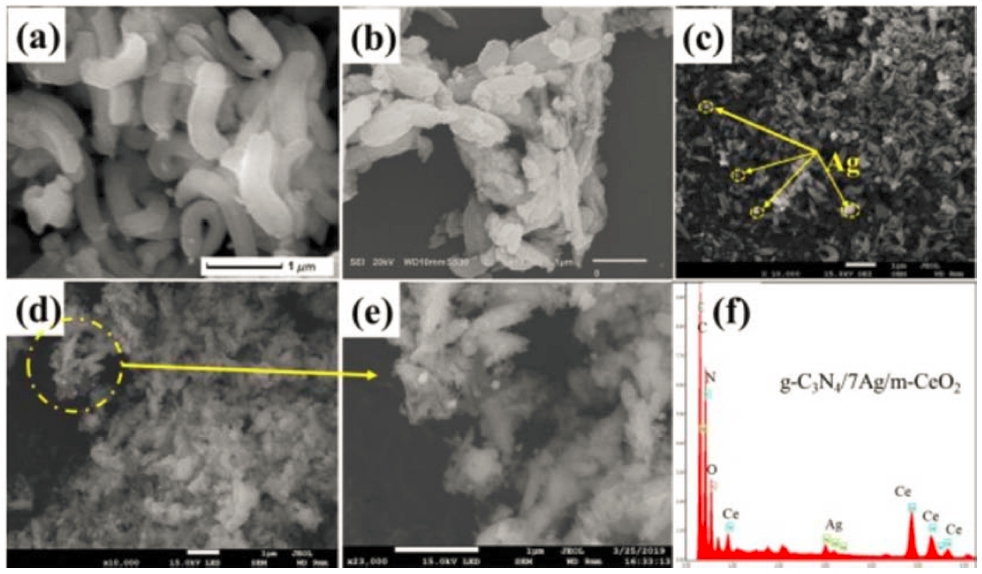
Fig. 6
SEM images of (a) SBA-15, (b) m-CeO2, (c) 7Ag/m-CeO2, (d, e) g-C3N4/7Ag/m-CeO2. The SEM-EDS of g-C3N4/7Ag/m-CeO2.37)
3.4 Oxide composites/g-C3N4 reduction to CO2
By forming a heterostructure between the oxide and g- C3N4 to reduce CO2, the new photocatalyst improves the visible light absorption rate and inhibits light-induced carrier recombination.
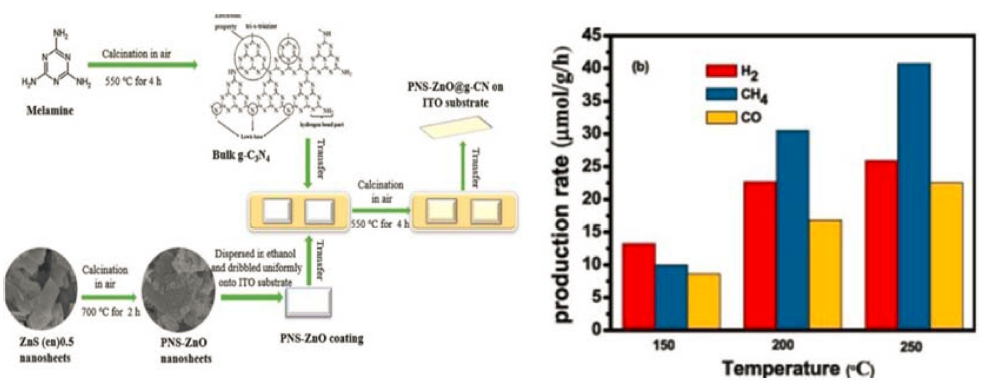
Porous ZnO nanosheets have distinct semiconductor characteristics, open crystal pore walls and abundant defect sites, with rich absorption and activation sites for CO2.53) Guo et al.54) coated the g-C3N4 (g-CN) nanofilm on the face of porous ZnO nanoplates (PNS-ZnO), the synthesis process is as shown in the Fig. 8. The forceful interplay between porous ZnO and g-C3N4 showed the better photocatalytic performance. The experimental results showed that the yields of H2, CH4 and CO were 22.7, 30.5 and 16.8μmol/g/h, respectively, as shown in Fig. 8.
The transition metal manganese is widely concerned,55) because of its good catalytic ability and low toxicity. Zhang et al.56) in-situ ways to co-modify extremely scattered Mn and Cu oxides into g-C3N4 nanoplates to effectively reduce CO2. The photocatalysis activity of optimized nanoplates was increased by 3 times. The schematic diagram of the mechanism of photogenerated charge transfer as shown in Fig. 9. Guo et al.57) synthesized a set of α-Fe2O3/g-C3N4 (FCN) catalysts by hydrothermal method to reduce CO2. FCN hybrids show greater visible light absorption than pure g-C3N4. Sun et al.58) prepared g-C3N4 foam/Cu2O QD photocatalyst by a simple light deposition method. The introduction of g-C3N4 foam can not only serve as an excellent carrier for Cu2O quantum dots, but improve CO2 adsorption and gas transfer. Meanwhile, it also shows a remarkable augmentation of photocatalytic performance.
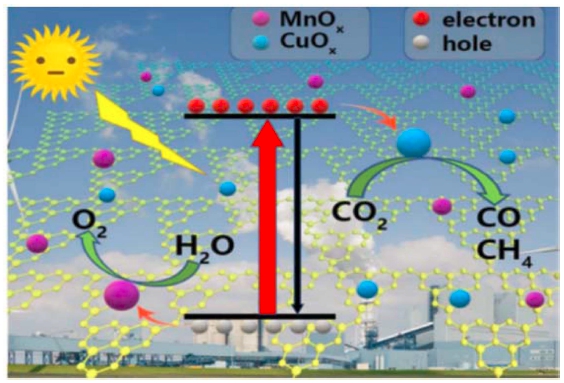
Fig. 9
Schematic diagram of the mechanism of photo-generated charge transfer on g-C3N4 nanosheets co-modified with CuOx and MnOx.56)
Table 1
Comparison of reaction conditions and photocatalytic performance of photocatalysts based on g-C3N4 for CO2 reduction
Combined with the above review, the experimental methods and photocatalytic reduction rates of some documents are listed below. In recent years, hydrothermal synthesis technology has developed rapidly, due to its relatively simple process, easy control of reaction conditions, and high photocatalytic reduction rate. With the application of various new technologies and new equipment in hydrothermal method, it is foreseeable that hydrothermal technology will continue to innovate and usher in a brand-new development period.
4. Conclusion
g-C3N4 is a non-metallic green catalyst, but due to the limitations of g-C3N4 itself, it is difficult to reduce CO2. so it can be improved by increasing the specific surface area of g-C3N4, doping with metal/nonmetal, oxide compounds and other methods to improve the shortcomings of poor conductivity, adjust the energy level structure to improve the redox performance. However, the reaction mechanism in the reaction of g-C3N4-based photocatalytic reduction of CO2 is not yet clear. The high activation energy and low selectivity required in the reaction have been the barriers restricting industrial applications. With the continuous development of theoretical calculation and experimental research, it is of great research significance to continue to develop g-C3N4-based catalysts in the field of photocatalysis.