


1 Introduction
TiAl intermetallic compound has drawn much attention as a high temperature material due to its excellent strength to weight ratio. However, its ductility at room temperature and oxidation resistance at high temperatures are not yet sufficient and many studies to improve those properties have been conducted.1-3)
Oxidation behavior of TiAl has been studied by many investigators.4,5) It was also reported that binary TiAl intermetallics oxidized at above 1,100 K did not form protective Al2O3 film and protective Al2O3 film forming was only possible on Ti-63.0 mass%Al alloy.6) Also their oxidation behavior was known to be affected significantly by the addition of ternary elements. Addition of ternary elements, such as Si,7-11) Nb,12-15) and Mo16,17) was known to improve oxidation behavior. In the present paper, breakaway oxidation behavior of Ti-Al binary and ternary alloys with Mo and Mn have been investigated. Once breakaway oxidation occurs, the oxidation proceeds linearly resulting in a very fast oxidation. It is very important to delay the breakaway in order to keep the material under protective condition.
2 Experimental Procedure
Ti-Al binary alloys and, Mo and Mn added TiAl ternary alloys were prepared. In order to analyze the effect of Al, Al content was varied from 20.0 to 63.0 mass% in the Ti-Al binary alloys. For the ternary alloys, base TiAl composition was constant to be 34.5 mass%, which is the best to obtain ductility at room temperature. Amount of Mo that is known to improve ductility of TiAl, was varied widely from 1.5 to 6.0 mass% Mn which is known to profit ductility of TiAl, was added at 1.5 mass%.
Small ingots of 120 g in mass were melted by means of a non-consumable Ar arc furnace. After heat treatment at 1,473 K for 86.4 ks in vacuo, they were sliced into rectangular specimens of 10 × 30 × 1mm in size. The specimens were polished on SiC abrasive papers and weighed prior to oxidation tests.
Isothermal oxidation tests in air were performed at temperatures between 1,073 K and 1,173 K. The specimens were placed in alumina crucible and were inserted in oxidizing furnace. Mass change was measured including spalled oxide scale.
3 Results
Fig. l shows mass gain-time relations of binary TiAl alloys comparing with ternary alloys under isothermal oxidation condition at 1,173 K. Breakaway oxidation was observed in every alloy, except for Ti-63.1 mass%Al. After breakaway, oxidation rates of the binary TiAl alloys below 34.5 mass%Al obeyed almost linear kinetics. The corrosion rate of Ti-63.1 mass%Al appeared to be almost parabolic. Al content greater than 63.0 mass% was found to be necessary to form a protective alumina film.
Oxidation rate was affected significantly by the addition of ternary element. Ductility of TiAl containing Mn or Mo is known to be improved.18-20) Nevertheless, oxidation behavior was quite different with each other. At shorter oxidation period, mass gain of 1.5 mass%Mn added TiAl was small, and increased linearly as shown in Fig. 1. Mo added TiAl showed also breakaway behaviors with slightly greater increase than parabollc. Fig. 1
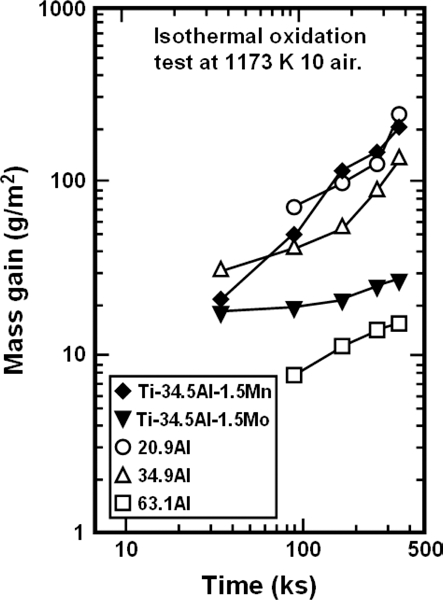
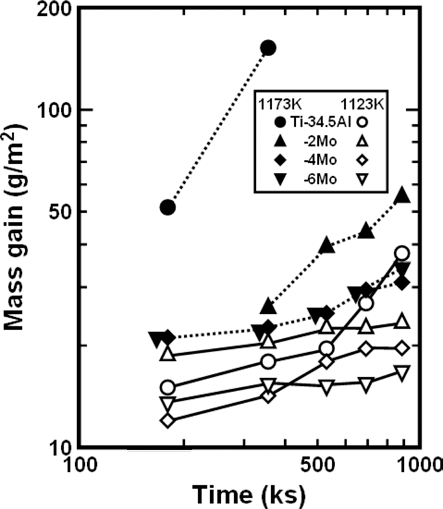
Fig. 2 shows the effects of various amounts of Mo on isothermal oxidation behavior at 1,123 K and 1,173 K. At 1,123 K, no breakaway, i.e. a parabolic increase in mass gain, were observed in the Mo added TiAl alloys. The binary Ti-34.5 mass%Al exhibited transferring from parabolic to linear kinetics. At 1,173 K, the binary alloys showed vary fast linear oxidation and even the Mo added alloys exhibited breakaway oxidation. The 2.0 mass%Mo added TiAl exhibited a slope between linear and parabolic. In 4.0 and 6.0 mass% added TiAl alloys, slightly larger rates were observed than a parabolic rate law even after breakaway.
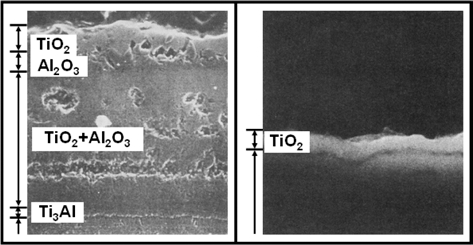
Cross sections of the scale were observed by SEM. For binary alloys, typical scales are depicted in Fig. 3. A multi-layered oxide film was observed on the Ti-34.5 mass%Al forming TiO2/Al2O3/TiO2+Al2O3/internal oxides from the outer surface. However mono-layered film of TiO2 probably forming a protective Al2O3 underneath was observed on the Ti-63.1 mass%Al.6)
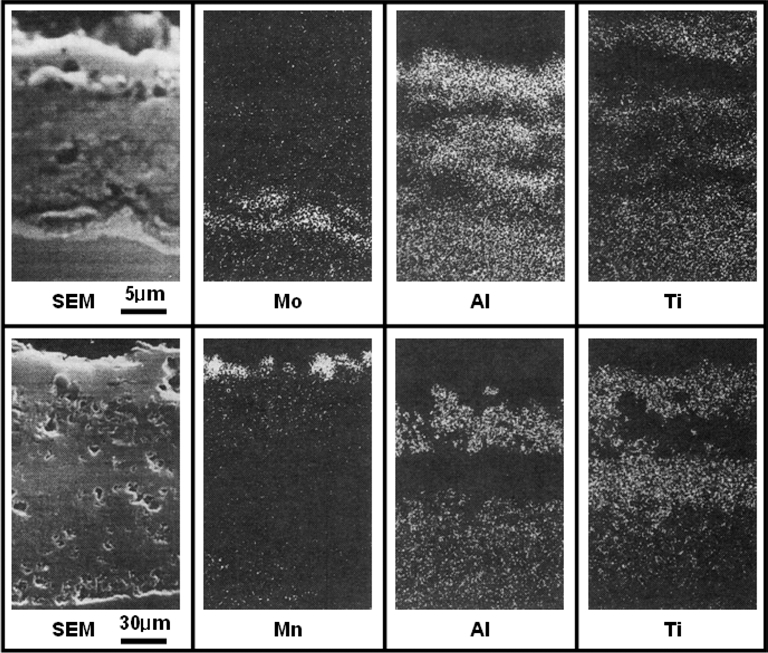
The scale structures of the oxide on the ternary TiAl alloys were almost same as the Ti-34.5 mass%Al except for thickness, as shown in Fig. 4. In the case of Mo added alloys, enrichment of Mo in the metal side at the scale/metal interface and scale thickness was much less. The Mn added TiAl alloy appeared to loose continuity in the second Al2O3 layer, probably resulting in a rapid deterioration.
4 Discussion
The multi-layered scale structures were not significantly changed by the breakaway. However, protectiveness of the second Al2O3 layer appeared to change. Thickness change with oxidation time of each layer of the multilayered oxide scale is depicted in Fig. 5. Before breakaway, each layer appeared to have grown obeying under parabolic rate law. After the breakaway, the rate law transferred to linear and thickness of the inner (Al2O3 and TiO2 mixed) layer increased extremely rapidly, however the second Al2O3 layer from its surface did not grow so much. This suggests that the second oxide layer, before breakaway, might provide certain protectiveness, and, after breakaway, its protectiveness might be diminished and oxygen might penetrate to react with the directly to Ti3Al.
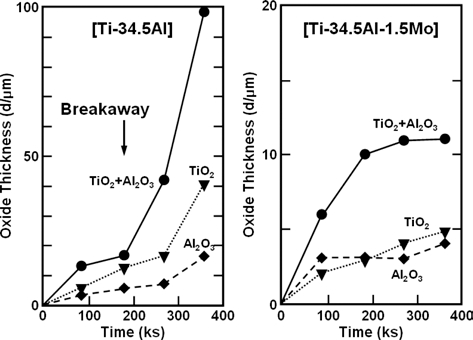
Fig. 5.
Thickness of multi-layered oxide film, comparing binary and Mo added TiAl oxidized at 1173 K in air.
In the Mo added TiAl alloys, enrichment of Mo in the metal side of the interface of metal and persistent second Al2O3 layer was observed. Every layer thickness appeared to grow parabolically as shown in Fig. 5. In the case of the Mo added alloy, the second Al2O3 layer appeared to be continuous even after breakaway, this being the cause for the slow scale growth on those alloys. In the case of the Mn added TiAl, the second Al2O3 was more discontinuous than that of the binary TiAl. Mn might have an effect to prevent the Al2O3 layer from being continuous.
5 Conclusion
Breakaway oxidation behavior was investigated in binary and Mo and Mn added TiAl alloys at 1,073 K and 1,173 K in air and following conclusions were obtained.
1) Binary Ti-Al alloys below 51.0 mass%Al content exhibited a breakaway, transferring from parabolic to linear rate law. The second Al2O3 layer might have some protectiveness before breakaway. Ti-63.1 mass%Al oxidized at 1,173 K under parabolic law.
2) Addition of Mo improved the oxidation resistance dramatically. No breakaway was observed at 1,123 K, and breakaway was delayed by Mo addition at 1,173 K. On those alloys, the second Al2O3 layer appeared to be persistently continuous.
3) Oxidation resistance was considerably degraded by the addition of Mn. Mn appeared to have an effect to break the continuity of the second Al2O3 layer.