


1. Instruction
Recently, various attempts have been made to study ophthalmic functional hydrogel lenses, including their ultraviolet barrier properties, high oxygen permeability, and antimicrobial effect.1-3) In particular, the lenses’ antimicrobial effect has been attracting much attention recently because it can reduce the incidences of various infectious diseases originating from the eyeball, which can be easily exposed. Wearing contact lenses can cause many ophthalmic diseases and has many side effects. In particular, Escherichia coli (E. coli) infection, Staphylococcus aureus infection, Pseudomonas aeruginosa infection, fungal infection, and bacterial keratitis are known to be the main infectious diseases that may reduce the visual acuity.4) Many studies have been conducted recently by diversely using nanomaterials as antimicrobial substances. Nanomaterials, including gold, silver, and copper, and carbon nanotubes, have been used as antimicrobial substances.5,6) Also, studies on multifunctional contact lenses that applied various functions, as well as those on the antimicrobial effect of nanomaterials on contact lenses, have been actively conducted recently.7,8) Carbon nanotubes were discovered by S. Iijima of NEC (Japan Electric Company) in 1991 and are regarded as the most promising materials.9) Carbon nanotubes are cylindrical structures with carbon atoms connected to one another, like a network. As they have various properties, many excellent characteristics have been reported, and they are being used in a wide range of fields, including tissue engineering, biosensing, and drug delivery.10) In particular, carbon nanotubes have an antimicrobial effect, and studies related to this have been actively conducted. As the immune mechanism, it is known that carbon nanotubes directly contact bacteria to damage their cell membrane, thereby exerting an antimicrobial effect.11,12) They are 10-100 times stronger than steel, strong against physical impact, and have a modulus value similar to that of diamond, showing excellent mechanical properties.13) Therefore, it is judged that the polymer made of carbon nanotubes can be applied to various medical devices by applying biomaterials. In this study, multifunctional hydrogel lenses with mechanical strength and a strong antimicrobial effect were fabricated using carbon nanotubes as an ophthalmic hydrogel contact lens material. The functions of the two carbon nanotubes were also compared, using a single-walled, carboxylicacid- functionalized carbon nanotube, to which carboxylic acid (-COOH) groups were attached, as well as a singlewalled carbon nanotube. To analyze the physical properties of the fabricated lens polymer, the optical and physical characteristics, including the water content, refractive index, optical transmittance, and breaking strength, were measured. To evaluate the stability of the lens, the absorbance and extractables were measured. Lastly, the antimicrobial effect of the fabricated lens was evaluated to analyze the functionality of the carbon nanotubes.
2. Experiment
2.1 Reagents and materials
In this experiment, for HEMA (2-hydroxyethyl methacrylate), which is mainly used as a hydrogel lens material, and AIBN (azobisisobutyronitrile), a radical initiator, the products of JUNSEI were used. For the crosslinking agent, EGDMA (ethylene glycol dimethacrylate) was used, and for the additives, a single-walled carbon nanotube (SWCNT) and a single-walled, carboxylic-acid-functionalized carbon nanotube (SWCCNT), both products of SIGMA-ALDRICH, were used.
2.2 Polymerization
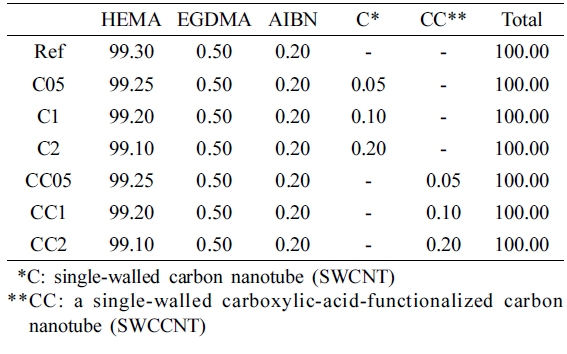
For polymerization, HEMA, EGDMA, and AIBN were used as a basic combination, and mixtures were prepared by adding the SWCNT and the SWCCNT at each ratio to the basic combination. After vortexing for about 30 minutes, the mixture was evenly dispersed using an ultrasonic disperser (Branson 2510) for about 60 minutes. Each mixed monomer was thermally polymerized in an oven at 100 °C for 1 hour. The fabricated lenses were hydrated in 0.9 % sodium chloride for 24 hours. Then the optical and physical characteristics, such as the optical transmittance, refractive index, and water content, were evaluated, and the stability was evaluated based on the absorbance and through an extractable test and pH measurement. Lastly, the antimicrobial effect of the fabricated lens was evaluated. For the fabricated lens samples, the basic combination without any additive was set as the Ref. Based on the ratio of SWCNT that were added, the samples were named C05, C1, and C2. Based on the ratio of SWCCNT that were added, the samples were named CC05, CC1, and CC2. The mixing ratios of the samples that were used for the experiment are shown in Table 1.
3. Results and Discussion
3.1 Optical and physical characteristics
3.1.1 Spectral Transmittance
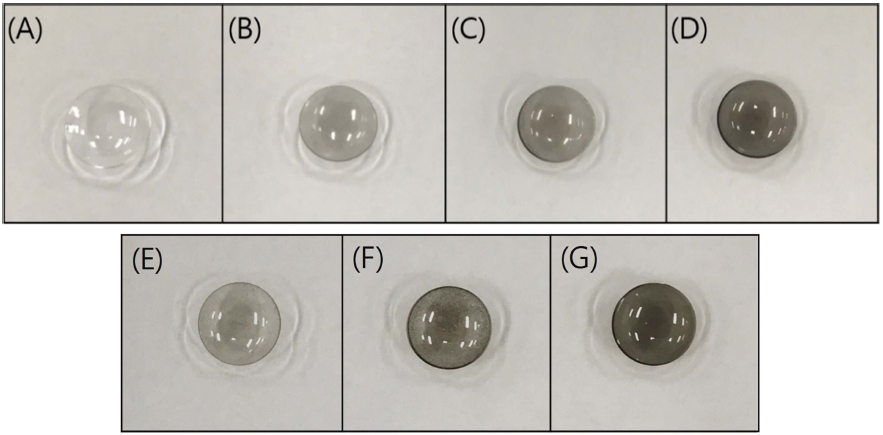
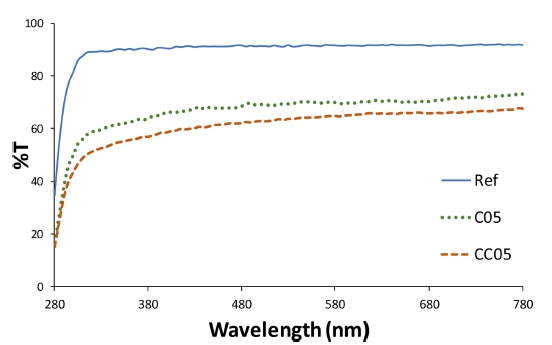
For the spectral transmittance of the lens, the transmittance values of UV-B (280-315 nm), UV-A (315-380 nm), and visible light (380-780 nm) were measured using the Agilent Cary 60 UV-vis. As a result, the average transmittance of Ref with no carbon nanotubes added was about 91.3 % for visible light, 89.7 % for UV-A, and 72.3 % for UV-B. In combination C, where a SWCNT was added at each ratio, the average transmittance was 50-69.8 % for visible light, 18.6-61.6 % for UV-A, and 10.6-43.21 % for UV-B. In combination CC, where a SWCCNT was added at each ratio, the average transmittance was 41.3-64.0 % for visible light, 26.6-54.5 % for UV-A, and 15.2-37.4 % for UV-B. As the amount of carbon nanotubes increased in both groups, the overall transmittance decreased. It is considered that the color of the carbon nanotubes affects the transmittance. Fig. 1 shows the fabricated lens for each sample. In addition, the spectral transmittance measurement graph of each combination is shown in Fig. 2.
3.1.2 Water Content and Refractive Index
The water content was measured through the gravimetric method, based on ISO 18369-4:2006, and the refractive index was measured using an ABBE refractometer (ATAGO NAR 1T, Japan). For the results of the measurement of the fabricated samples, the water content of Ref (with no carbon nanotubes added) was 37.04 %. For combinations C and CC, the water content increased according to the addition ratio of nanoparticles, and decreased at 0.2% ratio of nanoparticles. In particular, CC2 showed a somewhat abrupt decrease rate. The refractive index was measured at 1.4351 for Ref, and those of all the other combinations were inversely proportional to the water content. Table 2 shows the refractive indices and water contents of the fabricated lens samples.

3.1.3 Breaking Strength
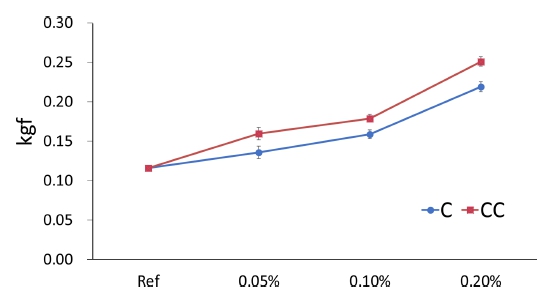
To measure the breaking strength of the fabricated lens, the Universal Testing Machine (UTM; AGS-X 20N, Japan) of SHIMADZU was used. The maximum value at which the lens was broken when a force of 0-2.00 kgf was applied at a speed of 10 mm/1 min in the state of removing the surface moisture of the sample was expressed as a breaking strength value. For the measurement results, the breaking strength was 0.1161 kgf for Ref, 0.1358-0.2191 kgf for combination C, and 0.1597-0.2509 kgf for combination CC. Considering that the breaking strength gradually increased with the increasing ratio of carbon nanotubes, the increase of the lens strength seems to have been an effect of the additive. Also, the strength of combination CC with the carboxyl group(-OH) was somewhat higher than that of combination C. Fig. 3 shows the breaking strength results.
3.1.4 Oxygen Permeability
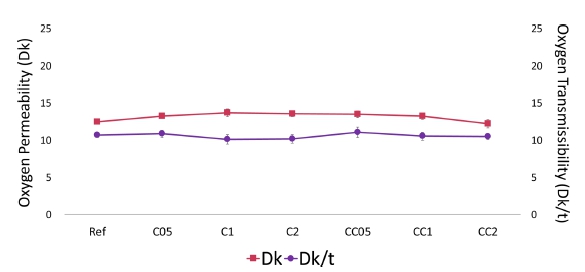
The oxygen transmissibility was measured through the polarographic method, based on ISO 18369-4:2006, while the oxygen permeability (Dk) was measured using the oxygen permeation analyzer (201T, USA) of Rehder. The Dk of the fabricated sample was within the 12.19- 13.69 × 10⁻¹¹ (cm2/sec)(mlO2/ml×mmHg) range, not showing a large difference. The oxygen transmissibility (Dk/t) was also within the 10.09-11.07 × 10⁻⁹ (cm/sec) (mlO2/ml×mmHg) range, not showing a large difference. Therefore, it is considered that carbon nanotube particles do not significantly affect Dk and Dk/t. Fig. 4 shows the Dk and Dk/t results.
3.1.5 SEM Analysis
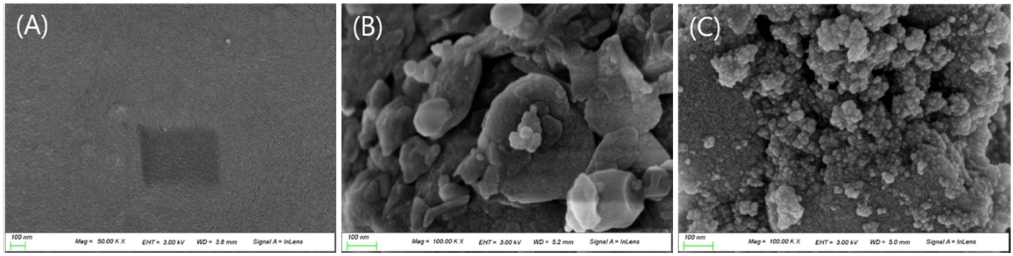
The lenses were fabricated after copolymerization by adding carbon nanotubes to the conventional hydrogel materials, and were analyzed with a scanning electron microscope (SEM) to check the surface status and nanoparticles. The particle size of SWCNT ranges from 80 to 100 nm and the particle size of SWCCNT ranges from 10 to 30 nm, confirming the presence of nanoparticles on the surface. The results of the analysis are shown in Fig. 5.
3.2 Stability Analysis
3.2.1 Absorbance Measurement
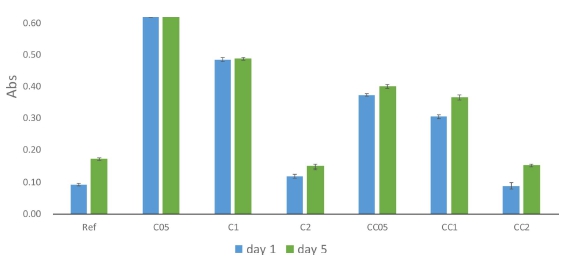
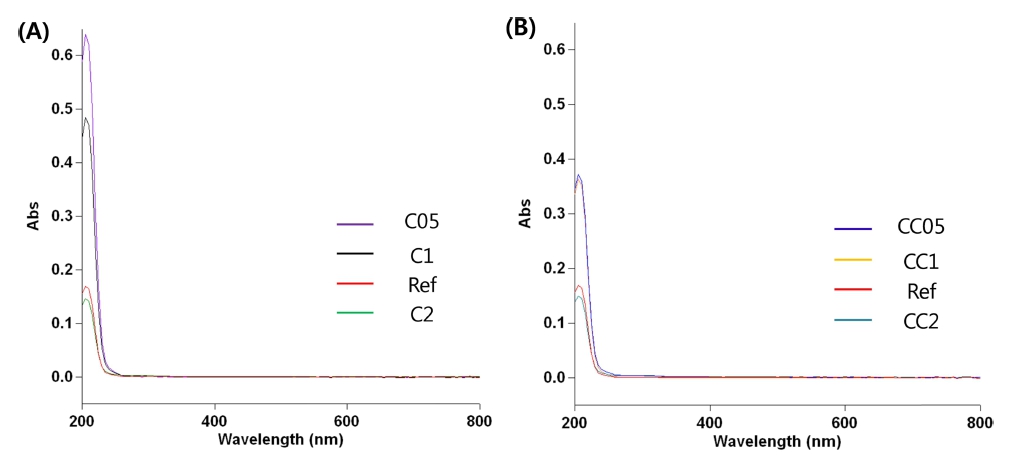
To evaluate the stability of the fabricated lens, the absorbance values were measured using the Agilent Cary 60 UV-vis equipment. The specific wavelength peak was measured at 200-800 nm. The lens hydration solution was used by diluting 30 times, and absorbance values of the hydration solution was measured and compared after 1 and 5 days of hydration. The highest peak was observed at a 205 nm wavelength in all the combinations, and the amount of extractables slightly increased over time. The values of the C05 and CC05 groups were somewhat higher but gradually decreased according to the addition ratio, and similar values as that of Ref were shown in the C2 and CC2 groups. Thus, the extraction of carbon nanotubes was found to have decreased from 0.2 %, indicating excellent stability. Fig. 6 and 7 show the absorbance measurement results. Regardless of the type of carbon nanotube, a similar value as that of Ref was shown at 0.2 %. As such, 0.2 % is considered the most stable mixing ratio.
3.3 Measurement of the Antimicrobial Effect
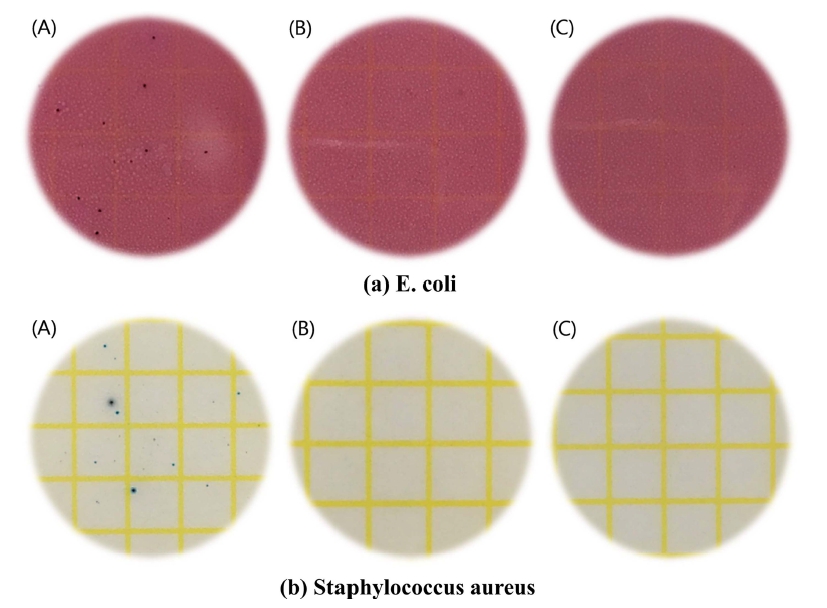
The microorganisms were analyzed through the dryrehydratable- film method to measure the antimicrobial effect. 1 ml of the sample solution hydrated in 0.9 % sodium chloride saline solution was injected into the dried culture medium of dry-rehydratable-film, and the medium was allowed to absorb the sample solution. It was then incubated in a thermostat for about 24 hours to maintain the temperature at 35 ± 1 °C, and Staphylococcus aureus and E. coli were identified. By setting the combination with no carbon nanotubes added to HEMA (the basic hydrogel hydrophilic lens material) as the Ref, and C2 and CC2 as the control and experimental groups, respectively, the antimicrobial effects against Staphylococcus aureus and E. coli were examined. The results are shown in Fig. 8. The antimicrobial results showed that there were somewhat more microorganisms in Ref than in the C2 and CC2 groups in both the Staphylococcus aureus and E. coli media, indicating that the bacterial distribution was different between Ref and the groups with carbon nanotubes. Carbon nanotubes are known to be excellent in the antimicrobial properties due to the strong sterilization effect of direct damage to the cell membrane of microorganisms.12,14) Therefore, in this experiment, the polymer produced with carbon nanotubes is considered to have the same effect.
4. Conclusion
To increase the antimicrobial effect and strength of the hydrogel lens, two types of carbon nanotubes (the SWCNT and the SWCCNT) were added to the conventional hydrogel lens materials at each ratio for copolymerization, and then the physical properties, stability, and antimicrobial effect of the lenses were evaluated. As a result of the addition of 0.05-0.2 % carbon nanotubes, the water content gradually increased and then decreased at 0.2 % compared with Ref. The refractive index was inversely proportional to the water content, and the breaking strength was found to have gradually increased with the increasing ratio of carbon nanotubes. Moreover, in terms of the stability of the lens polymer fabricated with carbon nanotubes, the extraction of organic and inorganic materials was found to be most stable when 0.2 % carbon nanotubes was added, showing a similar value as that of Ref. The polymerization stability to the hydrogen ion was shown to be excellent in all the groups. The antimicrobial effect of the lenses was improved compared to Ref with regard to both E. coli and Staphylococcus aureus, regardless of the type of carbon nanotube. Based on the experiment results, it can be said that hydrogel lenses containing carbon nanotubes have a high antimicrobial effect and can be used as an ophthalmic functional contact lens material, in accordance with the physical properties of the conventional hydrogel lens.