


1. Introduction
Currently, the energy demand is one of the main issues throughout the world. Many researchers were focused to find a way to alternative energy for fossil fuel, which were basically environmentally friendly. Thermoelectric materials are receiving greater attention compare to other renewable energy sources due to exhibiting excellent characteristic features such as no moving parts, silent, reliable, environment freely and minimum maintenance.1) The efficiency of thermoelectric energy conversion is a straight forward result of thermoelectric materials, which can be defined by the dimensionless factor, figure of merit; ZT = (α2/ρκ)T, where α is the thermo power or Seebeck coefficient, ρ is the electrical resistivity, κ is the thermal conductivity and T is the absolute temperature.2) In order to built a best thermoelectric solid state device, the material should exhibit a high Seebeck coefficient values like insulators, lower electrical conductivity materials like metals and low thermal conductivity like a glass. All of these properties are not independent and that would be main cause to the lack of high efficiency thermoelectric materials yet.3,4) Meanwhile, these properties were significantly affected by the microstructure of a host material. So far, the figure of merit, ZT values of over 1.0 have been reported in nanostructured superlattices, low dimensional systems and including nanocomposites. Venkatasubramanian et al. prepared Bi2Te3/ Sb2Te3 superlattices via metalorganic chemical vapor deposition (MOCVD) and obtained state-of-art figure merit 2.4 at 300 K.5) M. S. Dresselhaus et al. introduced new method for enhancing thermoelectric properties via low dimensional systems.3) Another way of enhancing approach is to fabricate 2D nanostructured bulk materials with fine grains. Recently, Zhang et.al reported a hydrothermal coating method to produce Pb-Te based TE materials.6)
The alloys which include silver antimony telluride, AgSbTe2 with germanium telluride, GeTe yields a pseudobinary semiconductor (GeTe)1-x(AgSbTe2)y termed as (TAGS-x), where x designates that GeTe percentage. TAGSx has been studied for many years and successfully developed for niche applications inclusding RTG (Radioisotope Thermoelectric Generator) for deep space and remote applications in NASA.7) The composition (GeTe)0.85 (AgSbTe)0.15 was knows for exhibiting best combination of low thermal and high electric transport properties with good mechanical stability. Extensive twinning in crystal as well as phase and anti-phase regions have been found in transmission electron microscope of TAGS-85 that much seriously reduce the lattice thermal conductivity.7,8) Recent works in AgSbTe2 points out strong anhormonicity of phonon-phonon interactions contributes to reduction in lattice thermal conductivity. More recently, Yang et al discussed the nanocrystalline inclusions in TAGS-80 & TAGS-85, which acts like nanoscale domains and contribution to the reduction in lattice thermal conductivity due to the enhanced mid-frequency phonon scattering.9) In addition, preparation methods are also plays important role for increasing ZT. Recently, Chen et al investigated TAGS-85 by rapidly solidified (Melt Spinning) method with ZT of 1.48 due to reduction in thermal conductivity 10) and, also Yang et al observed inhomogeneity and nanocrystals in the matrix of liquid nitrogen quenched TAGS-x materials.9) Mechanical alloying is also one the eminent method to produce the alloy powders however contamination was easily accumulated over the powders during the milling process. Recently, researchers are performed thermoelectric materials by ingot crushing, and then making powder form to enhance thermoelectric materials.11) As another novel method, gas atomization (GA) is distinct category of rapid solidification method for fabrication of homogeneous and fine grain structured of TE materials to enhancing TE efficiency as well as mechanical properties. The most advantage of GA compare to others is an eminent mass production process.12)
In this work, we have successfully fabricated TAGS-85 thermoelectric materials by gas atomization. It is well known that the temperature plays a typical role on microstructural changes during high temperature powder consolidation methods such as hot extrusion and hot pressing. In addition, powder fabrication methods often contaminate the powder by adsorbing oxygen as a film on its surface. The formation of oxide layers on the surface of powders might be interrupt the electrical properties, which are significantly affects the thermoelectric figure of merit. So, it is much important to eliminate the oxide layers on the surface of powder. The hydrogen reduction is one of the best reduction treatment for oxygen among other methods because most of the oxygen existing as moisture that was easily evaporated by heating during the hydrogen reduction. So, in this research the alloy powders were hydrogen reduced under different temperature with appropriate holding times. The hydrogen reduced GA powders were consolidated using spark plasma sintering at 450 °C. Effect of hydrogen reduction in microstructure and TE transport properties of TAGS- 85 were studied.
2. Experimental procedure
Comemrcial elements of Ge, Te, Ag and Sb with 5N purity were weighed according to the chemical stoichiometry of (GeTe)85(AgSbTe2)15. The TAGS-85 alloy powders were fabricated by high frequency induction in graphite crucible at temperature of 100-200 °C above the melting point.7)
Describe more detailed experimental procedure about atomizing process. In order to inverstigate the oxygen contamination, the hydogren reduction treatment was carried. The as-atomized powders were reduced at 350, 400 and 450 °C temperatures for 4 h under hydrogenargon atmosphere (H2 : Ar = 1 : 9). After reduction, the reduced and as-atomized powders were consolidated by spark plasma sintering at 450 °C for 8 min in vacuum. The oxygen content of both powders and bulks samples were determined by Eltra ONH-2000 Oxygen/Nitrogen/ Hydrogen determinator. The phase of the atomized powders and SPS-ed samples were characterized by X-ray diffraction (XRD) using Cu Ka radiation. The Vickers hardness was measured by using micro Vickers hardness tester. Temperature dependence of thermoelectric properties such as Seebeck coefficient, electrical resistivity, and power factor were measured using the thermoelectric measurement system (Seepel: TEP 1000) at room temperature.
3. Results and discussion
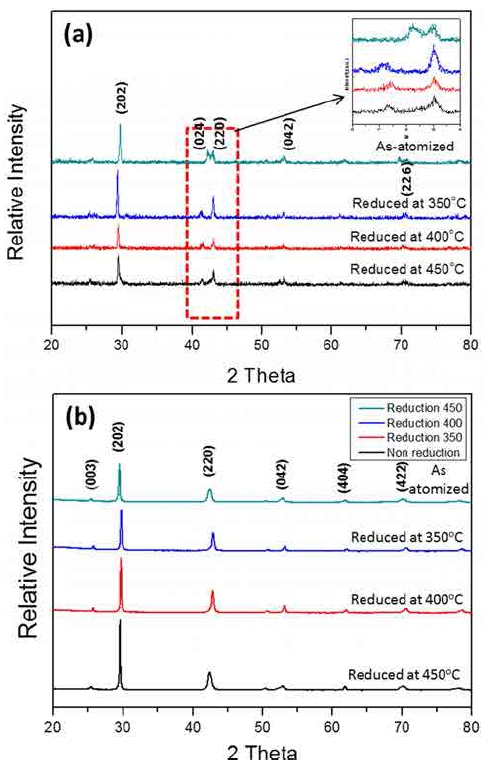
Fig. 1 illustrates the powder morphology of as-atomized and reduced TAGS-85 powders at different temperatures. Fig. 1(a) shows the powder morphology of initial TAGS- 85 gas atomized powder. The initial GA powders were in spherical shape with smooth surface and expanded in wide powder size distribution with an average size of 15 μm. Fig. 1(b) shows the hydrogen reduced GA powders at 350 °C. It was clearly observed that the tiny powders were adhesive with together. The reduced powders were further crushed by agate mortar & pestle for consolidation by SPS. Fig. 1(c) and (d) show the hand crushed GA reduced powders at 400 and 450 °C by agate mortar & pestle for investigating grain size behavior. It was evident that the reduced powders were more brittle to initiate the cracks and broken rapidly when crushed by pestle. It might be expected that bond between the particleparticle was very weak after heat treatment due to releasing its internal stress, so that ease to initiate cracks inside the powder. In order to investigate the reduction heat treatment effect on microstructure, the cross-sectional surfaces of TAGS-85 powders were characterized and shown in Fig. 2. It was revealed that the grains of initial (GA powder) and hydrogen reduced (at different temperature) powders were homogeneously distributed (shown in Fig. 2) and grain size was increased with reducing temperature. The grain shape was much different and size was increased when elevating reduction temperature from 350 to 450 °C shown in Fig. 2(b), (c) and (d) respectively. The XRD pattern of TAGS-85 initial and hydrogen reduced powders as well as sintered bulks were shown in Fig. 3. All samples were exhibited single- phase of GeTe, which is a rhombohedral structure with a space group of R3m. The GeTe phase in XRD traces of TAGS- 85 powders can be identified by the presense of (024) and (220) peaks.13) The inset in Fig. 3(a) illustrates the enlarged part of two theta from 40° to 44°. In initial TAGS-85 GA powder, the (024) and (022) peaks does not separated completely, however the complete separation of peaks were occurred after powders reduced at different temperature conditions. The intensity of the (024) and (220) peaks were decreased with increasing reduction temperature from 350 to 450 °C. In the case of SPS-ed bulks in Fig. 3(b), only one peak (220) regarding to GeTe phase was observed. The intensity of all peaks in the bulk samples were decreasing with reduction temperature from 350 to 450 °C. In addition, there was no peaks existence corresponding to other phases except rhombohedral phase of TAGS.
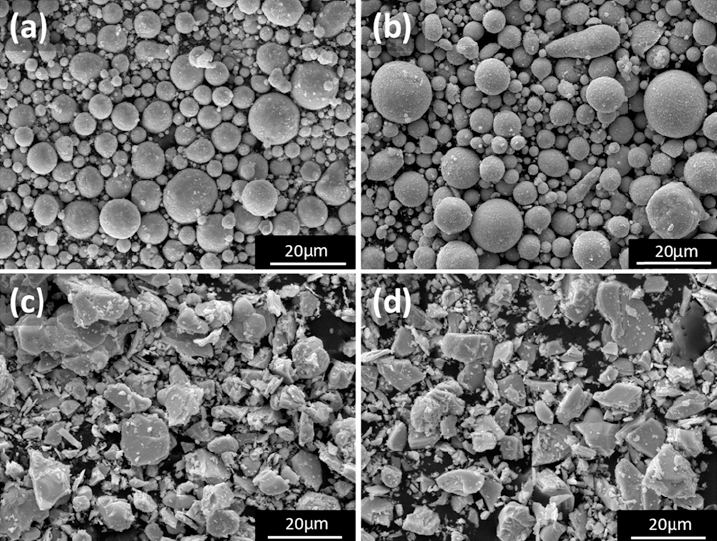
Fig. 1
Morphology of as-atomized and reduced powders at different temperatures. (a) as-atomized powder, (b) reduced powder at 350 ºC, (C) reduced powder at 400 ºC and (d) reduced powder at 450 ºC.
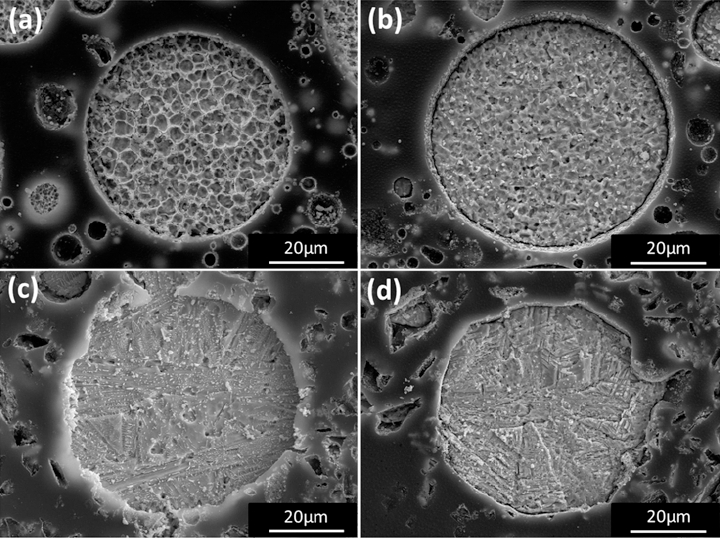
Fig. 2
Cross-sectional micrographs of (a) as-atomized powder, (b) reduced powder at 350 ºC, (C) reduced powder at 400 ºC and (d) reduced powder at 450 ºC.
The contamination of oxidation is one of the major issues during the powder fabrication process. In gerneal, the contamination of oxygen can substantially alters the electrical properties of thermoelectric materials. It is necessary to diminish the oxygen content in host materials. The contaminated oxygen might have removed from the powder surface, since most of the oxygen existing as moisture that can easily evaporated through heating by hydrogen reduction process. Fig. 4 illustrates the oxygen content of TAGS-85 initial and hydrogen reduced powder as well as SPS-ed bulk samples. It is evident from the Fig. 4 that the amount of oxygen content was decreased with increasing reduction temperature from 350 to 450 °C. The bulk samples show lighter oxygen content when compared to corresponding reduced powder. It might be due to eliminating of oxygen content again during the SPS process in bulks. Cook et al14) argued that the alloy containing more oxygen can exhibit low carrier mobility, could favor to increases in electrical resistivity. It is expected that the oxide layers on the powder surface can substantially increase the electrical resistivity, since the carriers can restricted by oxide layers.
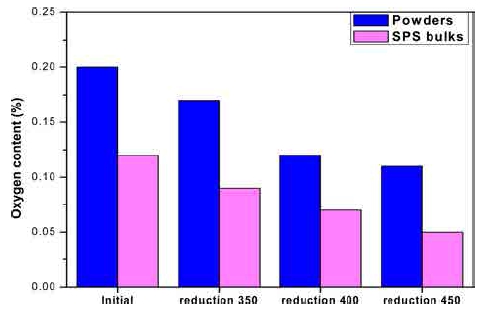
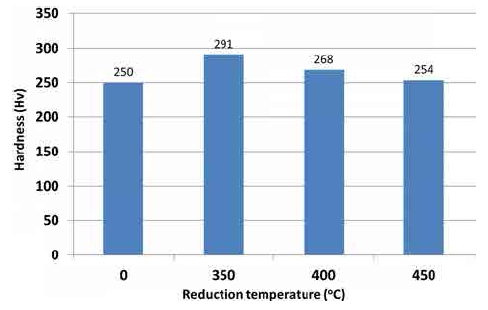
Fig. 5 shows the fracture surface of SPS-ed bulks sintered at 450 °C. It was observed that the initial GA bulk (Fig. 5(a)) exhibit clean surface with grain average size about ~15 μm. The grain size of hydrogen reduced bulks was increased with temperature from 350 to 450 °C (Fig. 5(b-d)). During reduction of powders, the bond between the particle-particle got weaken due to releasing its internal stress, then its ease to initiate crack inside the powder that can be clearly observed in Fig. 5(b-d). It is well known that the microstructure was seriously affect mechanical properties as well as thermoelectric transport properties. The Vickers hardness properties of sintered TAGS-85 bulks were demonstrated as a function of reduction temperature in Fig. 6. It is observed that the Vickers hardness of SPS-ed bulks were decreased with increases in reduction temperature, since the grain size was increased with increasing reduction temperature. However, the un-reduced samples, and reduced sample at 450 °C is almost similar. This might be due to the same consolidation temperature conditions for both the samples, since we consolidated at 400 °C. The peak Vickers hardness was measured 291 Hv for the bulk reduced at low reduction temperature (350 °C temperature).
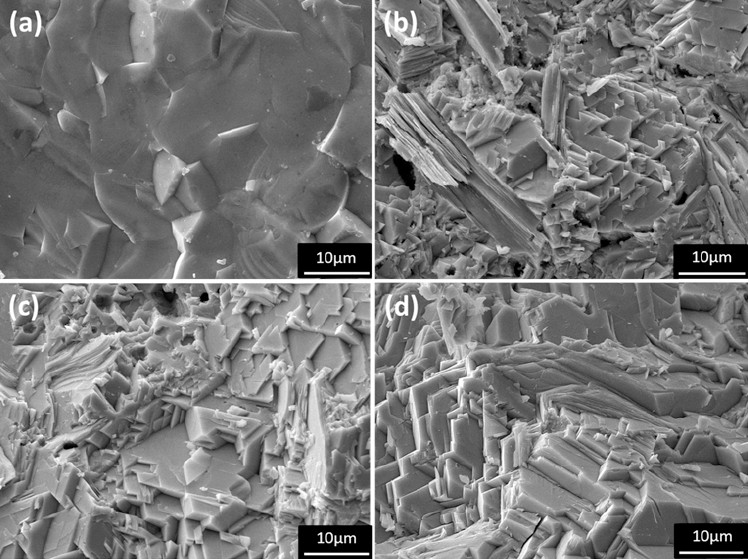
Fig. 5
Fracture surface of SPS-ed bulks of (a) as-atomized sample, (b) reduced at 350 ºC, (C) reduced at 400 ºC and (d) reduced at 450 ºC samples.
The temperature dependence of electrical resistivity of reduced TAGS-85 bulks were shown in Fig. 7. The electrical resistivity of all samples were increased with temperature, since it is a typical degenerate semiconductor, which the electrical resistivity increases with increase in temperature due to high carrier scattering. In general, electrical resistivity is inversely proportional to the carrier concentration(nc) and mobility(μ), expressed as follows; ρ = 1/nceμ.15) The carrier concentration and mobility of TAGS-85 were represented in Fig. 8. The carrier concentration was decreased with increasing absolute temperature, since strong scattering among the carrier-carrier might have reduced the carrier concentration at elevated temperatures. In addition, the contaminated oxide layers might restrict the transport of charge carriers which in low carrier concentration. In other parts, the value of nc was decreased with increase in reduction temperature, since the oxygen content was decreased (seen in Fig. 6). The mobility of the TAGS-85 bulks were slightly increases with increasing temperature as clearly observed in Fig. 8b. However, carrier concentration was dominates than mobility, results in increasing electrical resistivity with absolute temperature. The results of carrier concentration and carrier mobility of TAGS-85 samples (shown in Fig. 8 well coincide with the electrical resistivity.
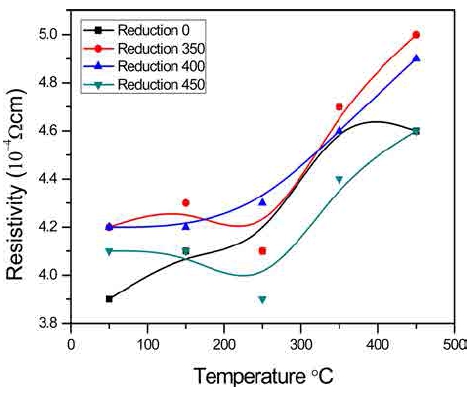
Fig. 7
Temperature dependence of electrical resistivity of TAGS- 85 alloys at different reduction temperatures.
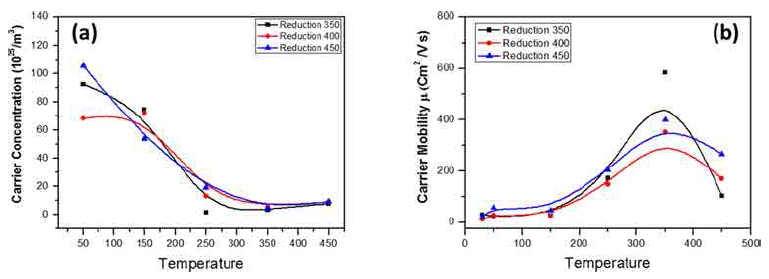
Fig. 8
Temperature dependence of (a) carrier concentration and (b) carrier mobility of TAGS-85 samples.
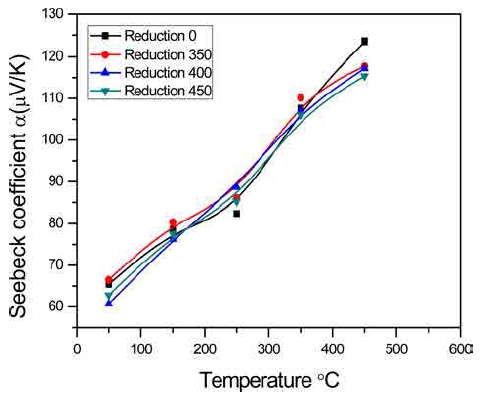
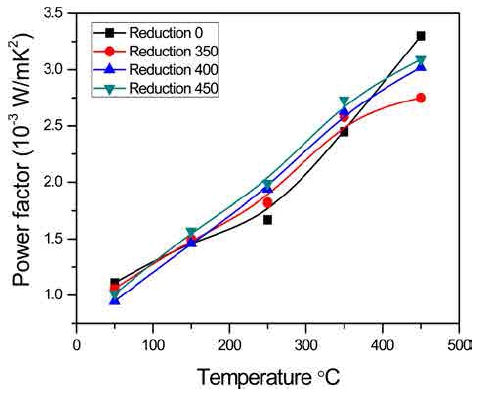
Fig. 9 shows the temperature dependence of Seebeck coefficient of SPS-ed TAGS-85 bulk samples. The sign of Seebeck coefficient of all specimens is positive through the measured temperature range, means that the TAGS- 85 bulks are p-type semiconductors and holes acts as a major carrier. It was evident that the Seebeck coefficient was decreased with increasing reduction temperature (see magnifie area in Fig. 9) since the mobility was increased due to the increasing grain growth with temperature. The value of the Seebeck coefficient was measured about 60 to 124 μV/K for all samples. However, the Seebeck coefficient was increased with measurement temperature since the scattering between the carrier and carrier was very strong at elevated temperatures. The power factor was calculated from the Seebeck coefficient and electrical resistivity, and presented in Fig. 10. The values of the power factor were increases with measurement temperature similar to those electrical resistivity and Seebeck coefficient. The non-reduction bulk shows the higher power factor values than hydrogen reduction bulks due to exhibit both lower electrical resistivity and higher Seebeck coefficient.
4. Conclusion
(GeTe)0.85(AgSbTe2)0.15 (TAGS-85) alloy powder have been successfully prepared by gas atomization process, and subsequently consolidated by spark plasma sintering at 450 °C. The effect of hydrogen reduction on the microstructure and thermoelectric properties of TAGS-85 was studied. The grain size of the powder and SPS-ed bulk samples were gradually increased with reduction temperature and that was greatly alters the transport properties was studied. The oxygen content of powders were decreased from 0.20 % to 0.11 % and, and 0.12 % to 0.05 % for bulks with increasing reduction temperature. The electrical resistivity and Seebeck coefficient were increased of all TAGS-85 with increase in reduction temperature and well agreement with carrier concentration and carrier mobility. The maximum powerfactor values were measured 3.3 and 3.09 × 10⁻³W/mK2) for non-reduction bulk TAGS- 85 and reduced sample at 450 °C. In conclusion, the contamination of oxygen on thermoelectric properties was not obvious due to slight reduction in the oxygen content when compared to initial sample and hydrogen reduction samples.