


1 Introduction
Interest in eye health and high-performance hydrogel lenses has been increasing for both consumers and suppliers with the rapid increase in the number of contact lens wearers and the incidence of eye diseases. In addition to the diseases caused by wearing lenses, there are various other factors that threaten eye health. The influence of ultraviolet rays, in particular, cannot be avoided because the human eyes are exposed to the outside environment. Ultraviolet rays adversely affect the lens and retina, thus causing various eye diseases such as cataract and macular degeneration. The UV-B(ultraviolet- B) ray corresponding to 280~315 nm promotes inflammation and skin aging, reduces corneal epithelium thickness, and causes corneal opacity and inflammation.1) The UV-A ray corresponding to 315 to 380 nm causes skin discoloration and immune system damage.2) Moreover, due to the rapidly increasing use of LED(light emitting diode) display devices and mobile phones, the harmfulness of blue light corresponding to 380~480 nm is being emphasized.3-5) According to a survey on the wearing status of contact lens wearers, about 50 % of lens wearers experience dry eye symptoms6-7), and some people stop wearing lenses due to dryness, redness, or foreign body sensation.8) The materials used for hydrogel lenses have a significant effect on the water content and wettability of the lens. Thus, the drying symptoms can be alleviated by combining a moisturizing agent on the lens surface or using a new monomer to improve wettability. Studies have also been actively carried out to improve various properties such as refractive index, water content, contact angle, tensile strength, and light transmittance.9-10) To minimize the effect of ultraviolet light on ophthalmic lens, various materials using additives are being developed.11-14) In particular, the unique properties of nanomaterials have been utilized to incorporate new electrical, magnetic, and optical properties into hydrogel lenses.15-17)
The first carbon nanoparticles were discovered by Professor Smalley’s team in the U.S. in 1985, and consisted of a unique spherical structure.18) This material has excellent strength and elasticity and is widely used in industries utilizing polymer composites such as the energy, semiconductor, clothing, and medical sectors. In particular, carbon nanoparticles have hydrophobic properties and are mostly insoluble in water, but the wettability of porous carbons vary depending on the chemical composition and geometry of the surface.19) The wettability has also been shown to be greatly influenced by the roughness, pore size, and oxygen content of the carbon surface.20-21)
Polyethylene glycol(PEG), used as an additive in this experiment, is well known as a substance that has good water solubility, excellent biocompatibility, and low toxicity and skin irritation. For this reason, it is mainly used in materials for drug delivery or to convert a hydrophobic substance into a hydrophilic substance.22-23)
In this study, carbon nanoparticles and PEGMEMA were used as additives and were copolymerized with HEMA(2-hydroxyethyl methacrylate) and EGDMA(ethylene glycol dimethacrylate), which are widely used as contact lens materials and AIBN(azobisisobutyronitrile), which is an initiator. The basic properties of the contact lenses such as refractive index, light transmittance, tensile strength, breaking strength, water content and wettability were subsequently evaluated. To verify the mixing state of the nanoparticles, the surface was analyzed using scanning electron microscopy(SEM). The addition ratios of carbon nanoparticles and PEGMEMA, a hydrophilic substance, were varied as 0.1~0.2 % and 1~20 %, respectively, to investigate their usability as materials for high-performance contact lenses.
2 Experimental procedure
2.1 Reagents and Materials
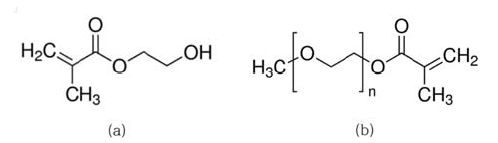
In this experiment, the 2-hydroxyethyl methacrylate (HEMA) monomer was used to make a hydrophilic hydrogel lens. In addition, methacrylic acid(MA), a hydrophilic material, was used to improve the performance of the soft hydrogel lenses, and methyl methacrylate (MMA) was used to improve strength although it was hydrophobic. For crosslinking agents, ethylene glycol dimethacrylate(EGDMA) and azobisisobutyronitrile(AIBN), an initiator, were used. The 2-hydroxyethyl methacrylate and AIBN used in the experiments were products of JUNSEI. Ethylene glycol dimethacrylate, poly(ethylene glycol methyl ether methacrylate, average Mw = 300) (PEGMEMA) and carbon nanoparticles from Sigma- Aldrich were used for polymerization. The structures of the samples used in this experiment are shown in Fig. 1.
2.2 Experimental Method
2.2.1 Polymerization
HEMA, MA, and MMA were mixed with EGDMA as a crosslinking agent while AIBN was used as an initiator as a basic combination for manufacturing contact lens. For additives, carbon nanoparticles and PEGMEMA were added at a ratio of 0.1~0.2 %, and 1~20 %, respectively, for copolymerization. The lenses used in the experiment were molded using the cast-mold method through thermal polymerization. For the polymerization temperature and time, the hydrogel lens samples were heated at 100 °C for 1 hour, and then were hydrated in a physiological saline solution containing 0.9 % sodium chloride for 24 hours at room temperature. Afterwards, the physical properties including refractive index, water content, contact angle, strength and light transmittance were evaluated.
2.2.2 Analysis and evaluation of properties
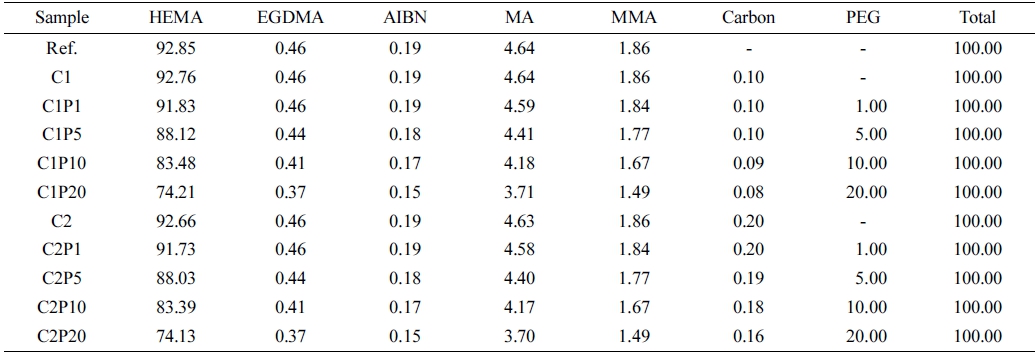
The sample prepared with HEMA, MA, MMA and EGDMA as the base combination were named Ref. The amount of carbon nanoparticles added to the composition of Ref. was increased in two ratios and the samples were named C1 and C2. The samples prepared by increasing the amount of PEGMEMA added to C1 were named C1P1, C1P5, C1P10 and C1P20. The samples prepared by increasing the amount of PEGMEMA added to C2 were named C2P1, C2P5 and C2P10 and C2P20. Table 1 lists the mixing ratios of the samples used in the experiment.
2.3 Measuring Instruments and Analysis
The refractive index was measured using ABBE Refractometer(ATAGO DR-A1, Japan) based on ISO 18396-4:2006(Ophthalmicoptics-Contact lenses-Part 4: Physicochemical properties of contact lens materials, 4.5. Refractive index). The water content was measured using the gravimetric method of ISO 1869-4: 2006(Physicochemical properties of contact lens materials). Wettability was evaluated by measuring the contact angle using Goniometer OCA20(Data Physics Instruments Ltd. Germany) with the sessile drop method. The tensile strength and breaking strength were measured using Universal Testing Machine AGS-X from Shimadzu Corporation. The light transmittance was measured using Cary 60 UVvis of Agilent, and Cary Win UV was used as the software for the analysis. Furthermore, the nanoparticle distribution on the surface of the lens was analyzed using a scanning electron microscope(SEM, JSM 6335F, Oxford).
3 Results and Discussion
3.1 Polymerization
3.1.1 Lens Surface Analysis(SEM)
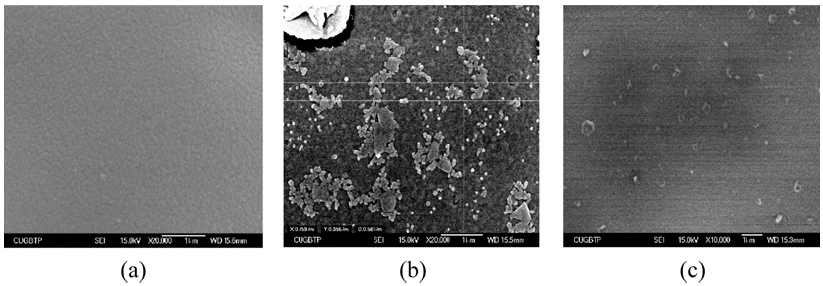
To evaluate the state of the lens surface, the surface state of each combination was observed by SEM. When carbon was added at 0.2 %, the diameter of the nanoparticles ranged approximately from 300 to 900 nm. It was found that the particles were not uniformly distributed and were clustered on the lens surface. However, when PEGMEMA was added at 10 %, it was found that carbon nanoparticles of 300-400 nm were uniformly distributed on the lens surface. Lee et al.24) reported that the addition of PEGMEMA to the nanoparticles had the effect of distributing the nanoparticles evenly. The addition of PEGMEMA seems to affect the uniform distribution of the sample particles. The surface state measurement results of each sample combination are shown in Fig. 2.
3.2 Results of Properties Measurement
3.2.1 Refractive index
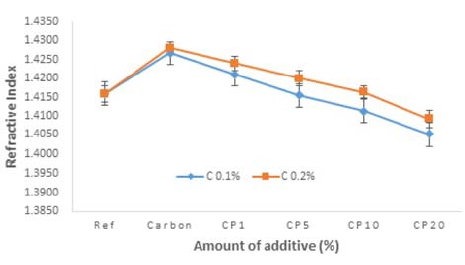
Results of the refractive index measurement of the fabricated hydrogel lenses are as follows. The mean refractive index of Ref. with no additive was 1.4159. The mean refractive indices of C1 and C2, which were prepared by adding carbon nanoparticles to Ref. at different ratios, were 1.4267 and 1.4281, respectively. In the case of C1P combinations prepared by adding PEGMEMA to the C1 combinations at different ratios, the mean refractive indices were 1.4210 for C1P1, 1.4154 for C1P5, 1.4113 for C1P10, and 1.4051 for C1P20. In the case of C2P combinations prepared by adding PEGMEMA to the combination of C2 at different ratios, the mean refractive indices were 1.4240 for C2P1, 1.4200 for C2P5, 1.4163 for C2P10, and 1.4092 for C2P20. As the addition ratio of carbon nanoparticles increased, the refractive index increased. Also, the refractive index tended to decrease as more PEGMEMA was added. According to Lee et al.25), the refractive index is inversely proportional to the water content. Because PEGMEMA is a hydrophilic material, it plays a role in increasing the water content and decreasing the refractive index. The results of this study indicate that mixing PEGMEMA with carbon nanoparticles induces a competing reaction between these two substances according to the content of PEGMEMA, thus decreasing the refractive index. The refractive index measurement results of the sample combinations are shown in Fig. 3.
3.2.2 Water content
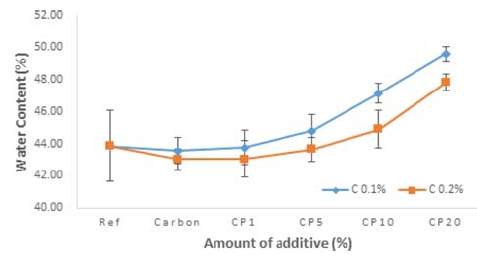
Results of the water content measurement of the manufactured lenses are as follows. The mean water content of Ref. with no additive was 43.85 %. The mean water contents of C1 and C2, which were prepared by adding carbon nanoparticles to Ref. at different ratios, were 43.58 % and 43.05 %, respectively. In the case of C1P combinations prepared by adding PEGMEMA to the C1 combination at different ratios, the mean water contents were 43.77 % for C1P1, 44.82 % for C1P5, 47.16 % for C1P5, and 49.61 % for C1P20. In the case of C2P combinations prepared by adding PEGMEMA to the C2 combination, the mean water contents were 43.07 % for C2P1, 43.67 % for C2P5, 44.91 % for C2P10 and 47.84 % for C2P20. These experimental results showed that the water content was lower in combinations with a lower ratio of carbon nanoparticles, and the water content tended to increase when more PEGMEMA is added. In particular, the water content difference between C1 and C2 was the largest when PEGMEMA was added at 10 %. The water content measurements of the sample combinations are shown in Fig. 4.
3.2.3 Wettability
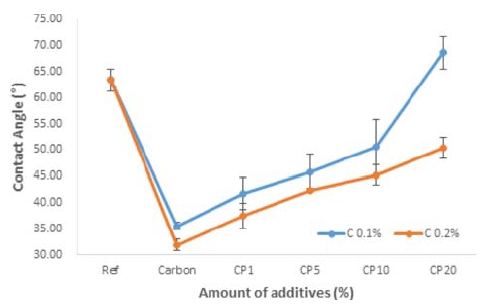
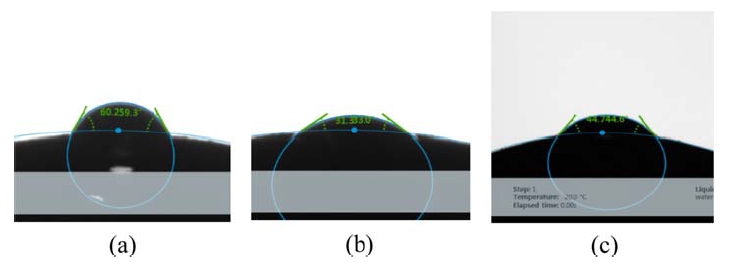
The contact angle was measured to evaluate the wettability of the prepared hydrogel lens. The mean contact angle of Ref. with no additive was measured at 63.38°. The contact angles of Cl and C2, which were prepared by adding carbon nanoparticles to Ref. at different ratios, were 35.59° and 31.95°, respectively. In the case of the C1P combinations prepared by adding PEGMEMA to the C1 combination, the contact angle was 41.74° for C1P1, 45.70° for C1P5, 50.51° for C1P10, and 68.61° for C1P20. In the case of the C2P combinations prepared by adding PEGMEMA to the C2 combination at different ratios, the contact angle was 37.54° for C2P1, 42.39° for C2P5, 45.23° for C2P10, and 50.39° for C2P20. It is generally known that due to the nature of contact lenses, wettability increases when water content increases.25) In this study, however, wettability increased inversely with decreasing water content. This is also different from the wettability improvement result in the previous study by Kim et al.26) It seems that the higher the ratio of carbon nanoparticles, the lower the contact angle and the higher the wettability become. This results from inducing low surface tension and improving wettability depending on the distribution of carbon particles. As more PEGMEMA is added, the wettability decreases as PEGMEMA binds to carbon nanoparticles and interferes with the inherent properties of carbon nanoparticles. In particular, when the added ratio of PEGMEMA was more than 10 %, the contact angle difference between C1 and C2 increased somewhat significantly, suggesting that PEGMEMA above a certain concentration has a greater effect. The contact angle measurement results of the sample combinations are shown in Fig. 5 and 6.
3.2.4 Tensile strength and breaking strength
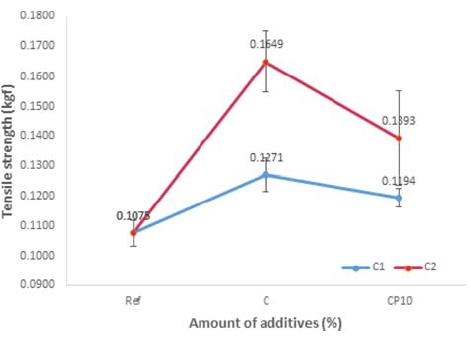
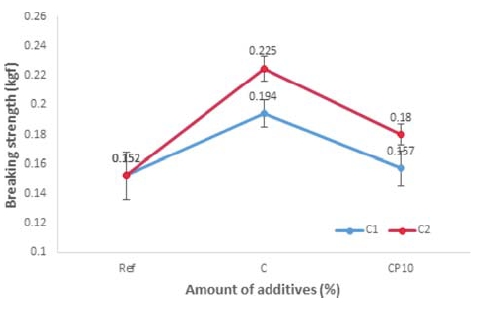
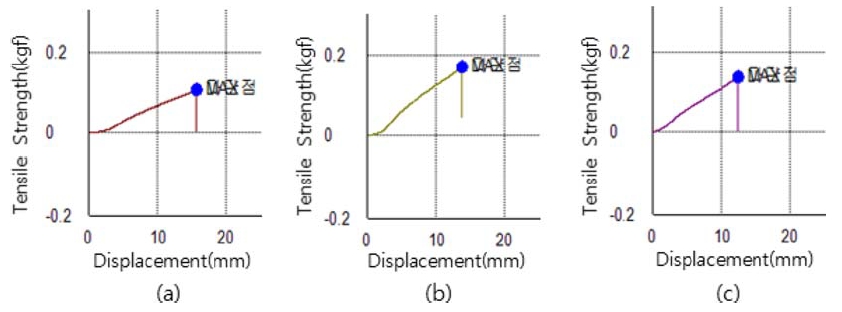
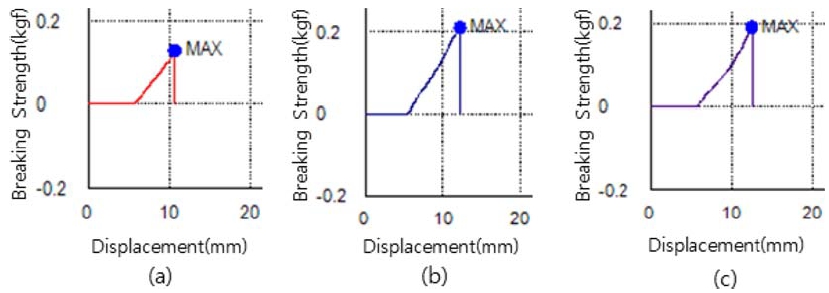
Results of the tensile strength measurement of the manufactured lenses are as follows. The mean tensile strength of Ref. with no additive was measured at 0.1075 kgf. The tensile strengths of C1 and C2, which were prepared by adding carbon nanoparticle to Ref. at different ratios, were 0.1271 kgf and 0.1649 kgf, respectively, The tensile strength of C1P10 prepared by adding PEGMEMA to the C1 combination at a ratio of 10 % was 0.1194 kgf, while the tensile strength of C2P10 prepared by adding PEGMEMA to the C2 combination at a ratio of 10 % was 0.1393 kgf. The mean breaking strength of Ref. with no additive was measured at 0.1520 kgf. The breaking strengths of C1 and C2, which were prepared by adding carbon nanoparticle to Ref. at different ratios, were 0.1940 kgf and 0.2250 kgf, respectively. The breaking strength of C1P10 prepared by adding PEGMEMA to the C1 combination at a ratio of 10 % was 0.1570 kgf, while the breaking strength of C2P10 prepared by PEGMEMA to the C2 combination at a ratio of 10 % was 0.1800 kgf. These experimental results showed that the tensile strength and breaking strength of carbon nanoparticles increased with incremental addition ratio of carbon nanoparticles. Furthermore, tensile strength and breaking strength decreased with increasing PEGMEMA content, which is attributed to increased water content. These results suggest that the carbon nanoparticles can make up for the disadvantage of various additives used to increase the water content, which reduce the strength of the lens. The tensile strength and breaking strength measurements of the sample combinations are shown in Fig. 7 to 10. Fig. 8, 9
3.2.5 Light transmittance
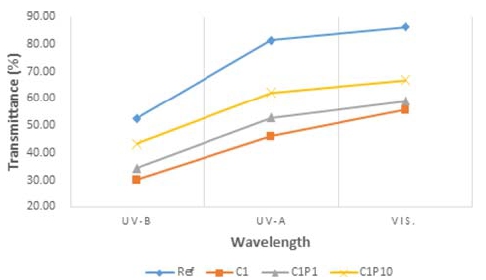
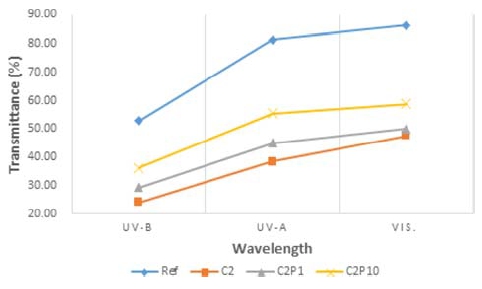
The results of the light transmittance measurement for the hydrogel lenses are as follows. The light transmittance of Ref. with no additive was 52.73 % for UV-B, 81.39 % for UV-A and 86.20 % for visible light. The mean light transmittances in the UV-B, UV-A and visible light rays of the C1 combinations prepared by adding carbon nanoparticles at different ratios were 30.16 %, 46.17 %, and 55.84 %, respectively, for C1, and 23.99 %, 38.37 % and 47.60 %, respectively, for C2. Furthermore, the mean light transmittances of the C1P combinations prepared by adding PEGMEMA to the C1 combination at different ratios were 34.49 %, 52.83 %, and 59.03 % for C1P1, 37.77 %, 55.84 %, and 60.62 % for C1P5, 43.36 %, 62.23 %, and 66.77 % for C1P10, and 36.63 %, 53.62 % and 61.46 % for C1P20. The light transmittances of C2P combinations prepared by adding PEGMEMA to the C2 combination at different ratios are 29.29 %, 44.95 %, and 49.98 % for C2P1, 28.88 %, 45.38 % and 49.98 % for C2P5, 36.15 %, 55.41 % and 58.87 % for C2P10, and 21.69 %, 35.59 % and 45.85 % for C2P20. These results showed that the light transmittance tended to decrease as the amount of carbon nanoparticle increased, and increase again when PEGMEMA was added. For the combinations prepared by adding carbon nanoparticles to HEMA, the visible light transmittance decreased to 45.85~66.77 %. This is because when the carbon nanoparticles are added, the lens is colored in gray and this lowers the visible light transmittance. The addition of PEGMEMA at 10 % resulted in the highest light transmittance, which suggests that the uniform distribution of the particles improves the transparency of the sample. The light transmittances of sample combinations are shown in Fig. 11 and 12.
4 Conclusion
This study was conducted to develop hydrogel ophthalmic lenses from high functional materials by adding carbon nanoparticles and PEGMEMA at different ratios using HEMA, MA, MMA and EGMDA, which are used in hydrogel lenses. PEGMEMA was added at different ratios to increase the water content and light transmittance of the prepared lens. The physical properties including water content, refractive index, light transmittance, contact angle, tensile strength and breaking strength were then measured. Tensile strength, breaking strength and wettability improved when carbon nanoparticles were added. When PEGMEMA was added, the water content and light transmittance increased. Therefore, these two additives can be used in hydrogel lenses designed for specific functions if they are used at an appropriate ratio. Furthermore, because carbon nanoparticles have the function of coloring the entire lens in gray due to the inherent color of the particles, they can substitute the function of the tinted lens in addition to providing the UV blocking function. Therefore, these additives can be used in a variety of applications.