


1. Introduction
Although carbon atoms are currently the most widely used energy carriers because of their practicality, they have the serious drawback that carbon-based fuels contribute to global warming due to the greenhouse effect.1) As an alternative, researchers have investigated hydrogen atoms as promising energy carriers because water molecules rather than the greenhouse gases of carbon dioxide and methane are produced by combustion of hydrogen. In other words, hydrogen reacts with oxygen to from water and release energy; accordingly, hydrogen is considered a zero-carbon-emission fuel.2-7)
Hydrogen is the lightest element(atomic number = 1) on the periodic table, thus it has a high energy density by mass. However, hydrogen has very low energy density by volume, because it exists as a gas at ambient conditions. Therefore, hydrogen gas needs to be pressurized or liquefied for efficient utilization, especially in fuel cell vehicles.8-9) However, increasing hydrogen gas pressure and liquefying hydrogen to improve energy density by volume have both cost and safety issues. Therefore, hydrogen storage and supply are key aspects that need to be considered when utilizing and delivering energy using hydrogen atoms. To this end, many researchers and companies are working hard to develop technologies to efficiently store and supply hydrogen energy.10-11)
Various methods of hydrogen storage and supply, including high pressure, cryogenics, and chemical compounds, have been investigated in the last decade. Considering safety when using hydrogen energy, many researchers agree that chemical compounds are promising candidates for onboard storage and supply of hydrogen. In this study, we investigated an onboard hydrogen storage and supply system using decalin, which is a liquid organic hydride(LOH).12-17) Decalin has various advantages as an onboard storage medium for hydrogen. Firstly, decalin is liquid at ambient conditions, which allow the use of existing infrastructure such as oil tanks and tank lorries for long-term storage and transport. Secondly, decalin has an extremely high hydrogen content on a mass and volume basis (7.3 wt.% and 64.8 kg-H2/m3).17) Thirdly, loss of decalin by evaporation during storage and transport is negligible due to its high boiling point. Finally, the commercial process of naphthalene hydrogenation has already been developed, and thus, naphthalene produced by decalin dehydrogenation can be easily recycled to decalin. Therefore, catalyst-promoted decalin dehydrogenation is considered to be a good way to supply hydrogen in fuel cell vehicles.18-20)
The most widely used catalysts for decalin dehydrogenation are based on platinum.21-23) Although platinum is known to be an efficient catalyst for this reaction, many efforts have been made to reduce the content of platinum in catalysts while maintaining the intrinsic catalytic activity of platinum. To overcome this problem, we prepared Pt@Cu/C core-shell catalysts for dehydrogenation of decalin to produce hydrogen. Pt@Cu/C coreshell catalysts, which had a core of copper with a platinum surface, were prepared through a two-step process. The carbon support was first impregnated with copper (impregnation), and subsequently, the surfaces of the copper particles were exchanged with platinum using the difference in ionization tendency between copper and platinum(transmetallation).24-25) The prepared catalysts were characterized by XRD and TEM analyses. Catalytic activity of the Pt@Cu/C core-shell catalysts for decalin dehydrogenation was tested in a batch-type reactor.
2. Experimental Procedure
Pt@Cu/C core-shell catalysts were prepared through two processes, namely impregnation and transmetallation. Palm-activated carbon(Samchum Inc.) was employed as a carbon support. First, we impregnated the carbon support with copper precursor (Cu(NO3)2, Wako Pure Chemical) by an incipient wetness impregnation method. After drying the impregnated sample at 120 °C for 12 h, reduction of the sample was conducted at 350 °C for 3 h with a mixed stream of nitrogen and hydrogen to yield Cu/C catalyst. Loading amount of copper was controlled from 1.5 to 7 wt.%.
Transmetallation reaction was carried out in a nitrogen atmosphere using the prepared Cu/C catalyst and platinum precursor.25) Aqueous solution of platinum precursor (H2PtCl6, Wako Pure Chemical) was added dropwise into aqueous solution containing a known amount of Cu/C catalyst. Amount of platinum in all Pt@Cu/C catalysts was varied from 1.5 to 5 wt.%. The mixed solution was stirred vigorously at room temperature for 2 h to facilitate the transmetallation reaction between metallic copper and platinum cations. In this reaction, copper on the surface of the Cu/C catalyst was exchanged for platinum due to the difference in ionization tendency between copper and platinum. After the transmetallation reaction was completed, the resulting solution was filtered and washed with distilled water. The obtained solid was dried overnight at 80 °C. The prepared core-shell catalysts were denoted Pt@Cu/C_X_Y, where X and Y represent the weight percent of copper and platinum in the catalyst, respectively.
Physical properties of the carbon support were characterized using N2 adsorption/desorption isotherms obtained using an ASAP 2020(Micromeritics) instrument. XRD patterns of the prepared catalysts were recorded with a Shimadzu XRD-7000 instrument (40 kV, 40 mA) using Cu-Kα radiation (λ = 1.54056 Å). Metal particle size in the catalyst was examined by transmission electron microscopy (TEM; JEOL, JEM-2100F) analysis.
The catalytic activity of Pt@Cu/C_X_Y with regard to the catalytic dehydrogenation of decalin was investigated using a batch-type dehydrogenation reactor. The catalytic reaction was conducted under a nitrogen atmosphere. Details of the procedure are similar to those we described previously.26-27) A reaction containing 0.3 g of catalyst was heated to 210 °C using an oil bath. The catalytic reaction was started by addition of 1 mL of decalin to the catalyst using a syringe. Decalin(cis- and trans-mixture) was obtained from Sigma-Aldrich. Amount of hydrogen evolved over a 30-min period was measured periodically using a gas burette. The evolved gas composition was also analyzed using a gas chromatograph(Young Lin instrument, YL6500) equipped with a thermal conductivity detector(TCD).
3. Results and Discussion
N2 adsorption/desorption isotherm analysis revealed that the palm-activated carbon, which was used as a support in this work, retained the typical characteristics of microporous carbon(surface area: 1,304 m2/g). Microporous carbon, with its very large surface area, is known to be an efficient support for noble metal catalysts. In addition, palm-activated carbon is a low cost material, which is why we chose to use it as a support material.
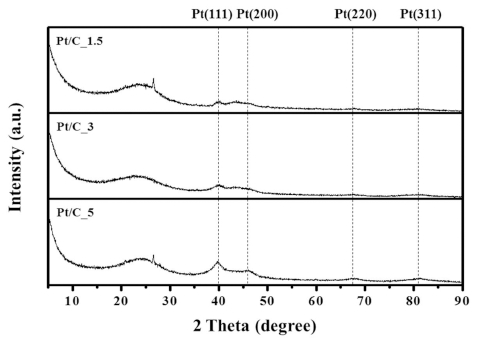
Prior to investigating the catalytic activity of Pt@Cu/C core-shell catalysts, we studied the catalytic activity of Pt/C catalysts only. For this purpose, a series of Pt/C_X catalysts with various platinum weight percentages(X) in the catalyst (X = 1.5, 3, and 5) were prepared using an incipient wetness impregnation method. XRD patterns of the prepared Pt/C_X catalysts are shown in Fig. 1. As expected, the XRD reflection peaks for metallic platinum at 2θ = 39.9°, 46.4°, 68.2°, and 81.9° became lower and broader with decreasing platinum content in the Pt/C_X catalysts. This indicated that low loading of platinum favored fine dispersion of platinum particles. Therefore, we expected that the Pt/C_1.5 catalyst with small platinum particles would show good catalytic activity in the catalytic dehydrogenation of decalin.
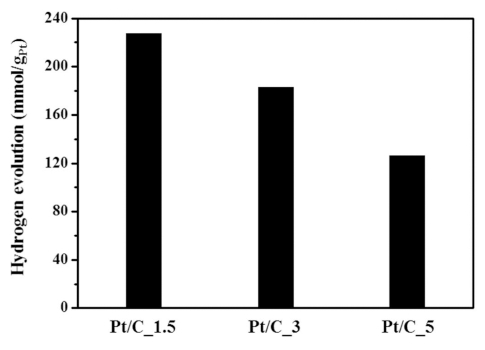
Hydrogen evolution over the Pt/C_X catalyst was examined; the results are presented in Fig. 2. Most hydrogen evolved during the initial stage of the catalytic reaction. Hydrogen increased drastically with increasing reaction time, and there was no significant increase in hydrogen evolution after 15 min. Therefore, hydrogen evolution over the Pt/C_X catalyst was calculated using the amount of hydrogen evolved during a 15 min-catalytic reaction. The amount of hydrogen produced decreased with increasing platinum content(X), and accordingly, Pt/C_1.5, which had the lowest platinum content of the catalysts evaluated, had the best catalytic activity due to its high dispersion of platinum. In addition, no by-products were observed for any of the catalysts evaluated in this study. The evolved gas in this reaction was pure hydrogen, which we confirmed by gas chromatography. These results indicated that all catalysts were highly selective for hydrogen production through catalytic dehydrogenation of decalin.
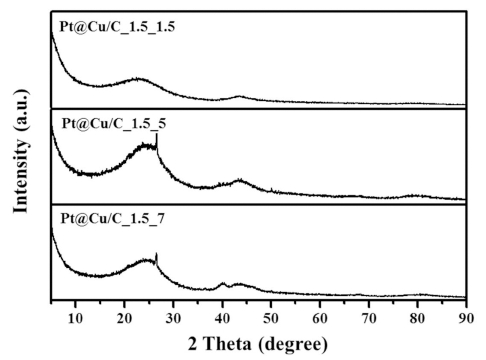
To improve the efficiency of utilization of noble platinum metal, and thus to reduce the platinum content in the catalyst, Pt@Cu/C core-shell catalysts were prepared and examined. Unlike the Pt/C_1.5 catalyst, a characteristic XRD reflection peak for Pt(111) at 2θ = 39.9° was not found in the Pt@Cu/C_1.5_1.5 catalyst(Fig. 3). This indicated that the transmetallation reaction between platinum and copper was successful, and that platinum was finely dispersed on the surface of the copper core. This result confirmed the successful formation of Pt@Cu/C core-shell catalysts using a two-step process(impregnation and transmetallation).
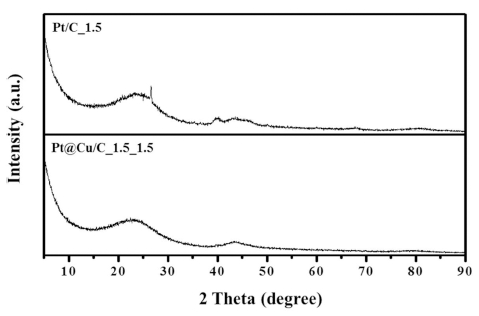
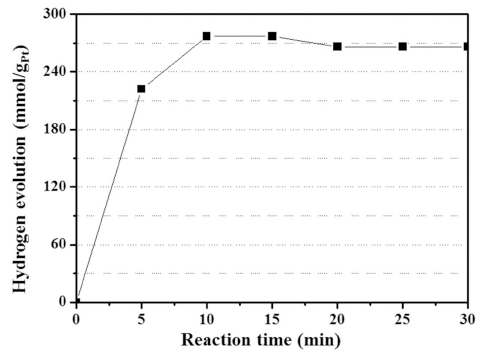
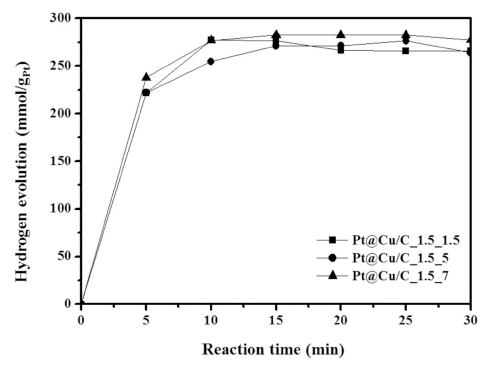
Fig. 4 shows hydrogen evolution over the Pt@Cu/ C_1.5_1.5 catalyst according to time. Hydrogen evolution over the Pt@Cu/C_1.5_1.5 catalyst (276 mmol/gPt) was much higher than that over the Pt/C_1.5 catalyst (227 mmol/gPt) for a 15-min reaction period. This clearly demonstrated that the Pt@Cu/C core-shell catalyst was more efficient than the Pt/C catalyst at producing hydrogen by catalytic dehydrogenation of decalin. These results indicate that a core-shell structure can improve the efficiency of platinum utilization, and thus, reduce the cost of catalyst preparation.
Pt@Cu/C_1.5_Y catalysts with various copper contents (Y) were also prepared to investigate the effect of core metal(copper) content on the catalytic activity of Pt@Cu/ C core-shell catalysts. No significant change in XRD patterns was observed with respect to copper content(Fig. 5). We inferred that platinum was successfully dispersed on the surface of the copper core, regardless of the copper content of the catalyst.
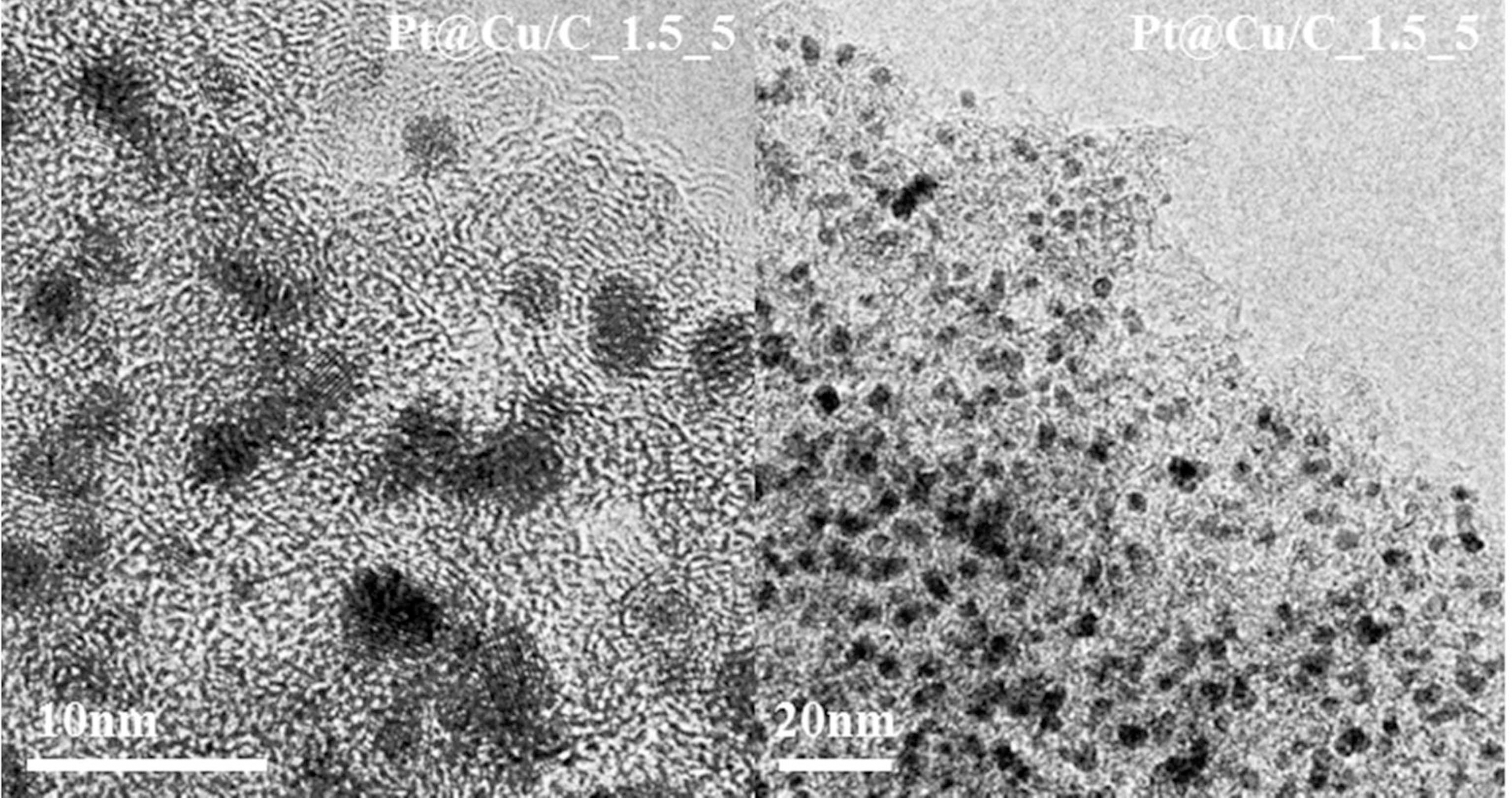
To evaluate the metal dispersion of Pt@Cu/C core-shell catalysts, TEM analysis was conducted. TEM images of the Pt@Cu/C_1.5_5 catalyst are shown in Fig. 6. Pt@Cu/ C_1.5_5 catalyst retained finely dispersed metal particles, and thus, nano-sized and monodispersed metal particles. Fine dispersion of metal particles was found in all Pt@Cu/ C core-shell catalysts prepared in this work. These results indicate that the combination of impregnation and transmetallation is a good approach to synthesize a supported core-shell catalyst. We are currently evaluating a singlestep process to prepare supported core-shell catalysts.
There was no significant difference in hydrogen evolution among the Pt@Cu/C_1.5_Y (Y = 1.5, 5, and 7) catalysts(Fig. 7). In other words, core metal content did not strongly affect the catalytic activity of the Pt@Cu/C core-shell catalyst. Among the catalysts tested in this study, Pt@Cu/C_1.5_1.5 was the most efficient catalyst for hydrogen production through catalytic dehydrogenation of decalin in terms of its catalytic activity and cost.
4. Conclusion
We prepared Pt@Cu/C core-shell catalysts through two preparation processes. The carbon support was first impregnated with copper, and subsequently, the surface of copper particles was exchanged with platinum using the difference in ionization tendency between copper and platinum(transmetallation). The prepared core-shell catalysts were characterized by XRD and TEM analysis, and then used for catalytic dehydrogenation of decalin. The Pt@Cu/ C core-shell catalyst were successfully prepared using an impregnation method followed by a transmetallation reaction. The Pt@Cu/C core-shell catalysts showed better hydrogen evolution than Pt/C catalyst with the same platinum content, indicating that the core-shell catalysts synthesized in this study are more efficient at utilizing platinum than existing catalysts, and are therefore more cost-effective.