

1. Introduction
Tungsten carbide (WC), which contains cemented carbides, has attracted considerable attention owing to its high hardness, high elastic modulus, and wear resistance properties.1) Cobalt, a typical binder material, improves the wettability of conventional cemented carbides and possess excellent sintering properties.2,3) However, cobalt materials face certain disadvantages, including high cost and environmental pollution; thus, a new metal binder is required to replace them. In recent years, several studies have been conducted to develop new hard materials using various cemented carbides, such as VC, Cr3C2, TiC, TaC, and NbC.4-6)
Composites sintered with WC-based cemented carbide materials can be strengthened not only by alloying but also by heat and cryogenic treatments. In particular, deep cryogenic treatment could have tremendous benefits, such as mitigating the thermal shock of materials, improving wear resistance, and extending tool life. Recently, several studies based on cryogenic treatment have been reported to significantly improve mechanical properties, such as hardness, compression strength, fatigue resistance, and wear resistance.7) Kalsi et al.8) reported that cryogenically treated tungsten carbide tools improved the flank wear resistance, thereby providing a better surface finish. Similarly, Ozbek et al.9) observed an increase in the hardness and wear resistance of cryogenically treated tungsten carbide inserts. In addition, Yong and Ding10) proved that cryogenic treatment improves the compressive as well as fatigue strength of cemented carbide tools without affecting their toughness and bending strength.
Therefore, the cryogenically treated WC-based cemented carbide improves the mechanical strength of the materials. However, studies have revealed that crystallographic changes in materials with cryogenic treatment time can have negative and positive effects on their mechanical performance. Therefore, in this study, the correlation between the crystallinity and mechanical strength of the WC-5 wt% NbC fabricated with different cryogenic treatment times was scrutinized.
2. Experimental Procedure
WC powder (W: 94.0 wt% and C: 6.0 wt%, ≤0.5 μm, TaeguTec Ltd., Korea), which has 99.9 % purity and an average particle size of 0.5 μm, was used as the starting material. Niobium carbide (NbC) powder (Alfa Aesar, UK) with a purity of 99.5 % and average particle size of 10 μm was used as an additive material. The NbC powders with a composition ratio of 95:5 wt% were fabricated using a highenergy ball mill (Pulverisette5, FRITSCH Ltd., Germany) at 250 rpm for 10 h. WC compacts with a 5 wt% NbC were fabricated using a pulsed current activated sintering (PCAS) system, including the 25 V and 1,000 A of DC power supply. First, the PCAS system was evacuated at a base pressure of 10-3 Pa, and subsequently, a uniaxial pressure of 60 MPa was applied. The heating rate was approximately 2 °C/sec during the entire process, and natural cooling was performed until the temperature of the sintered body decreased to room temperature. The relative density of the sintered body was measured by the Archimedes method. Furthermore, the naturally cooled compact was cryogenically treated as direct contact between the cryogen and the samples. Liquid nitrogen was used as the cryogen, which allowed the ambient temperature of the sample to drop to -196 °C. The structural and mechanical properties of WC-5 wt% NbC compact, cryogenically treated in liquid nitrogen for 6, 12, and 24 h, were investigated in detail.
To confirm the microstructure of the sintered body, the cryogenically treated or untreated specimens were etched at room temperature for 30 s using a Murakami solution. This reagent was stirred for 3 min after mixing 10 g NaOH powder and 10 g potassium ferricyanide (K3Fe(CN)6) in 100 ml distilled water. The surface morphologies of the etched specimens w ere ex amined u sing f ield-emission s canning electron microscopy (FE-SEM, Quanta 200, FELMI-ZFE, Austria). In addition, the average grain size of the WC-5 wt% NbC sintered body was obtained using the Image-Pro software from the FE-SEM images by measuring the length of the linear intercept. The crystallinity of the sintered body was analyzed using X-ray diffraction (XRD, PANalytical X’pert MPD), and the Vickers hardness test was used to analyze the mechanical properties of the WC-5 wt% NbC hard materials.
3. Results and Discussion
Fig. 1(a) shows variations in the sintering temperature and shrinkage displacement of WC-5 wt% NbC compact as a function of sintering time. As shown in Fig. 1(a), the WC-5 wt% NbC compact had three distinguishable inflection points in terms of shrinkage displacement. The critical points were divided into three regions at specific temperatures: Stage I (550~700 °C), Stage II (700~920 °C), and Stage III (920~ 1,000 °C). Stage I is the initial stage of sintering, which represents the region in which the particle movement by thermal expansion forms a neck. The sintering properties are determined in Stage II, where the grain growth and densification processes occur. The final densification region represented by Stage 3 involves the removal of closed pores caused by grain growth, diffusion, and plastic deformation of WC-5 wt% NbC. After completion of the sintering process, WC-5 wt% NbC sample had a relative density of 99.1 %, thus confirming that the densification process was totally completed.
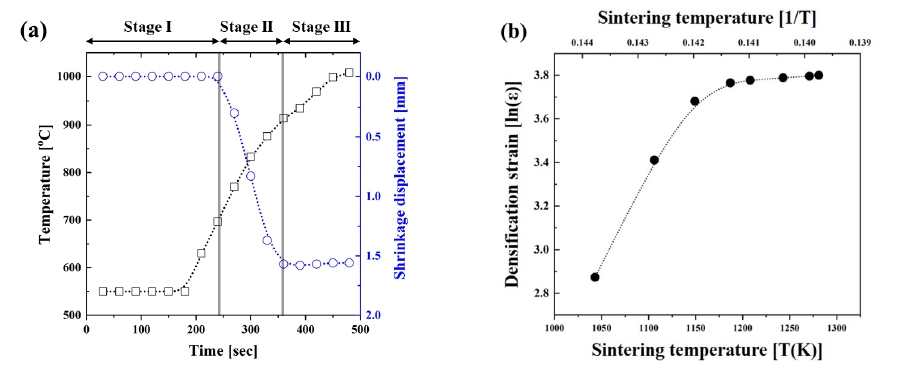
Fig. 1
(a) Temperature and shrinkage displacement of WC-5 wt% NbC sample as a function of sintering time, (b) Variations in densification strain in the shrinkage zone.
Densification can be inferred from the sintering exponent derived from the shrinkage displacement and sintering temperature. The sintering exponents were calculated using the following equation [Eq. (1)],11) which can also be expressed as a logarithmic function.
The sintering exponents can be defined using the slope of the shrinkage strain vs. temperature plot, as shown in Fig. 1(b). The WC-5 wt% NbC sample exhibited a proper sintering exponent (m = 4.1) in the shrinkage-activated region (Stage II), which indicates that the densification completely progressed with the help of high shrinkage strain.
Fig. 2 shows the surface morphologies of starting materials (WC, NbC, and ball-milled WC-NbC powders) and WC-5 wt% NbC sintered bodies with the different cryogenic treatment times. Sample (d), without cryogenic treatment, had an average grain size of 368 nm, which was similar to that of WC powders as the starting material. As shown in Fig. 2, the WC-5 wt% NbC sample had a grain size similar to that of starting materials, which indicates that grain growth was considerably suppressed during the densification process. In addition, the average grain sizes of the cryogenically treated samples (e~g) were 351, 317, and 403 nm, respectively, which were similar to those of the untreated samples. However, when comparing the average grain size of the WC-NbC sintered body according to the cryogenic treatment time, the average grain size gradually decreased when the cryogenic treatment time was less than 12 h, and the lowest grain size was shown at the cryogenic treatment time of 12 h.
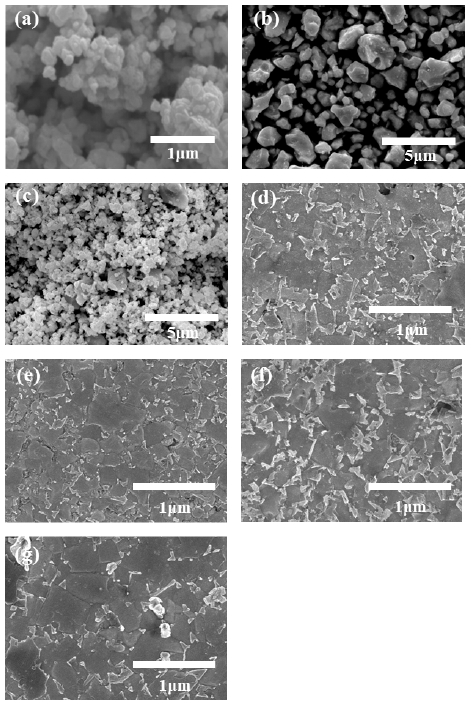
Fig. 2
Surface morphologies of starting materials; (a) WC, (b) NbC, and (c) ball-milled WC-NbC powders. WC-5 wt% NbC sintered bodies with the different cryogenic treatment time: (d) untreated, (e) 6 h, (f) 12 h, and (g) 24 h.
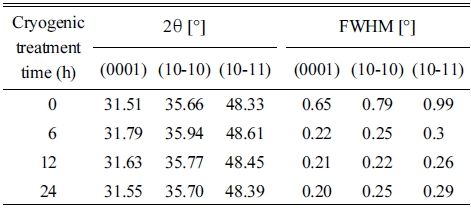
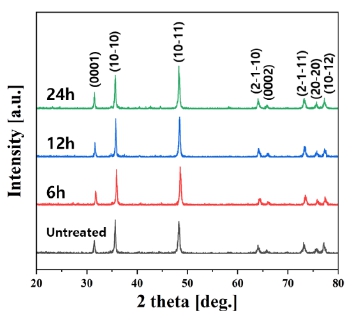
Fig. 3 shows XRD patterns of cryogenically treated and untreated WC-5 wt% NbC samples depending on the dipping time. Only diffraction planes corresponding to the hexagonal structure were observed in all the samples, whereas any secondary phases, such as carbon or NbC additive were not observed. This indicated that the PCAS-based sintered bodies have excellent crystallographic properties. As shown in Fig. 3, the diffraction peaks exhibited by all the cryogenically treated samples shifted to higher angles compared to the untreated samples. According to the Bragg’s law, the diffraction angle and lattice constant are inversely proportional; hence, compressive strength can be inferred to exist in the cryogenically treated samples. Interestingly, the diffraction peaks gradually shifted to lower angles as the cryogenic treatment time increased. In addition, the FWHM values of the dominant peaks corresponding to the diffraction planes, such as (0001), (10-10), and (10-11), were almost constant regardless of the cryogenic treatment time. The XRD results revealed that the cryogenic treatment of WC-5 wt% NbC sample developed compressive stress in the sintered body, which significantly improved its mechanical properties. However, tensile stress was weakly expressed in the sintered body with a gradual increase in the cryogenic treatment time, thereby leading to a decrease in the mechanical strength of the sintered body. Therefore, the sintered body must be strengthened via proper cryogenic treatment conditions.
To examine the effect of cryogenic treatment on the mechanical properties of the sintered body, variations in Vickers hardness and fracture toughness according to the cryogenic treatment time are presented in Fig. 4. The hardness and fracture toughness were determined through indentation cracking with a load of 20 kgf. In addition, as shown in Fig. 5, fracture toughness (KIC) obtained from the crack propagation lengths in the four directions of the indentations were used to determine the cracking resistance, which was calculated by the Antis formula [(Eq. (2)].12)
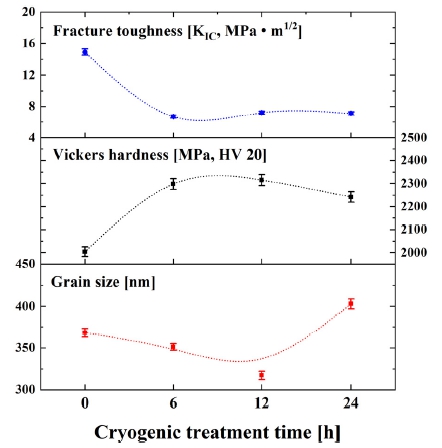
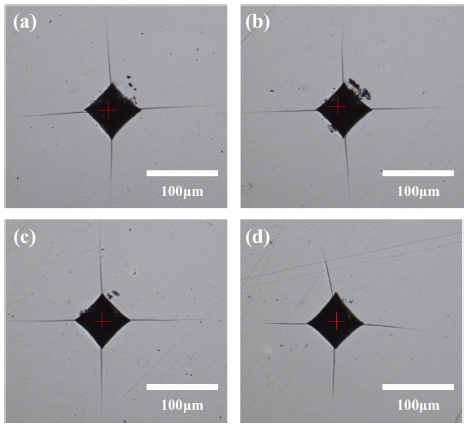
Fig. 5
Microstructure images with hardness indentations of sintered bodies with different cryogenic treatment time; (a) 0 h, (b) 6 h, (c) 12 h, and (d) 24 h.
where, E is the elastic modulus, H is the hardness, P is the applied load, and C is the length of crack propagation.
The untreated sample exhibited Vickers hardness of 2,003.8 ± 20.5 kg/mm2 and rupture strength of 14.9 ± 0.4 MPa*m0.5. In contrast, all the cryogenically treated samples exhibited an average Vickers hardness of 2,214.6 ± 22.8 kg/mm2, which was approximately 10.5 % higher than that of the untreated sample. Furthermore, the rupture strength of the cryogenically treated sample exhibited a decrease of more than 60 % compared to the non-cryogenically treated sample, thus verifying that the mechanical properties were dramatically improved. The mechanical properties were closely related to the XRD results; in particular, the compressive and tensile stresses in the sintered body had a significant effect on mechanical strength. The XRD results of the cryogenically treated sample exhibited improved mechanical strength owing to the occurrence of compressive stress in the sintered body. In addition, the improvement in the mechanical properties of the cryogenically treated WC-NbC sintered body can be also explained by the grain size changes, as shown in Fig. 4. The sample (f) cryogenically treated for 12 h showed the lowest grain size of 317 nm and had the highest value of Vickers hardness of 2,315 kg/mm2. This means that as the average grain size decreases, the increased grain boundary significantly restricts the dislocation movement, resulting in improved mechanical properties due to grain boundary strengthening. Consequently, the results verified that the compressive stress formed in the sintered body through cryogenic treatment significantly contributed to the improvement of the Vickers hardness and rupture strength. Nonetheless, note that excessive cryogenic treatment may degrade the crystallinity and decrease the mechanical strength of the sintered body; therefore, precise control of the cryogenic treatment time is necessary.
4. Conclusions
The effects of cryogenic treatment in improving the mechanical properties of WC-5 wt% NbC hard materials were studied in detail (see Table 1). Compressive stress in the sintered body emerged with increasing cryogenic treatment time owing to the decrease in the lattice constant. Regardless of the deep cryogenic treatment time, none of the samples showed phase changes, precipitation, or secondary phases in the specimens. However, the sample treated for 24 h revealed tensile stress, which resulted in degradation of the mechanical strength. This is significant because cryogenic treatment for effective tool hardening has an inflection point that can performance. Therefore, more precise control in cryogenic treatment time should be required.