


1 Introduction
Well known shape memory alloys might be replaced by the iron based shape memory alloys since the research has unfolded their features of cost effectiveness and weldability1) Research on properties of newly advent of many different types of iron-based SMAs during the last decade, show that they have great potential to be the counterpart of Nitinol2) Various advantageous mechanical characteristics such as ductility, shape memory effect, elasto-plastic damping and strain hardening in austenitic ferrous high-manganese alloys and steels are induced as a result of deformation induction γ to ε martensitic phase transformation(ε-MT)3-7) While investigating the martensitic transformation of Fe-30Mn-1Si alloy single crystals, it has been observed that addition of Si in Fe-30Mn stimulates γ → ε transformation, dominating the α-martensites formation which results in tensile stress in <414> direction and it finally leads to successive ε-martensites induction. Furthermore, considerably heating above As temperature produces different shape memory effect in the alloy as compared to the one obtained in case of TiNi and Cu based alloys. It has been observed that tensile deformation is responsible for the shape memory effect as the primary dislocations caused by these deformation are 104 times higher in density to the secondary ones5) Faraday type magnetic balance has been used to investigate the magnetic susceptibility of Fe-Mn-Si SMA alloy, while doing so it has been observed that these are associated with the complete and incomplete shape memory affects attained by examining the thermally activated dislocation motion.6)
2 Types of Ferrous based Shape Memory Alloys
Shape memory alloys have revolutionized the material engineering sciences as they exhibit exclusive features i.e. (SME) Shape memory effect and Super-elasticity. More research has revealed the effectiveness of Fe-based shape memory alloys comparing with NiTi(high processing cost and low cold workability) SMAs. These Febased shape memory alloys have been used because of the low cost and high cold workability. Further, some of the Fe-based shape memory alloys i.e. Fe-Pd, Fe-Pt show super-elasticity because of thermo-elastic martensitic transformation. Therefore, the Fe-SMA alloys that bears nonthermoelastic martensitic transformations are changed to thermo-elastic martensitic by precipitating nano-sized coherent particles with ordered structure. Typically, Kainuma et al. established the Fe40.95Ni28Co17Al11.5Ta2.5B0.05 and Fe43.5Mn34Al15Ni7.5 SMAs with thermo-elastic martensitic transformations by precipitating nano-sized coherent γ’ and B2 phases respectively. Fe40.95Ni28Co17Al11.5Ta2.5B0.05 exhibits a huge super-elastic strain of 13.5 %, and Fe43.5-Mn34Al15Ni7.5 also has the super-elastic strain of over 5 %. Fe43.5Mn34Al15Ni7.5 SMA has vast application vision over the other Fe-based SMAs because it shows superelasticity for large temperature range i.e. from 196 °C to 240 °C with minor super-elastic stress temperature dependence. 8) Further research is being conducted on SMAs to improve and impinge better attributes by improving the material compositions, quantifying the SMA phase transition temperature etc. Experiments are being commenced on different forms and shapes of shape memory materials and their applications. Research is also being done on improving material composition as it results in the better workability, wide range of operating temperature range with material stability and compatibility of material with design and manufacturing process as shown in preceding sections. Further details of recent applications and development of SMA are also described in the subsequent sections. There are many types of Fe- SMAs, these are categorised as mentioned in following subsections.
2.1 FeMnSi based shape memory alloys
Fe-Mn-Si based alloys discovered as a single crystal of Fe-30Mn-1Si during 1980s. They show a pronounced shape memory effect(SME) even though mainly in oneway. They have encouraging potential to be used as tighteners(pipe coupling) because of their low cost and fine formability. Special concern is given to the fcc(γ) →hcp(ε) transformation mechanism featured by low stacking fault energy and the approaches aiming to the enhancement of SME. The thermodynamic considerations regarding the critical driving force, interfacial energy and stacking fault energy, the prediction of Ms temperature, the crystallography and the transformation mechanism are the main topics for the study of martensitic transformation in Fe-Mn-Si based alloys9) It has been revealed by the research that the shape memory capacity of Fe- Mn-Si alloy depends on the annealing temperature. It can be further demonstrated as the effect of annealing on γ → ε transformation. As the annealing condition greatly influences the defects and nature of austenite, therefore a high annealing temperature results in a low density of stacking faults, causing a low nucleation rate during stress induced γ →ε transformation giving rise to the growth of ε martensite plates instead of new formation further resulting into the local slip deformation and finally leading to the deprivation of shape memory effect. Annealing at low temperature also yields to degradation of shape memory effect. Since shape memory effect is dependent of γ → ε transformation therefore pre-strain, annealing treatment, thermomechanical training and deformation temperature influences the shape memory effect of Fe-Mn-Si SMA as these factors impart effect on the γ → ε transformation10) FeMnSi-alloys exist in different forms depending upon their use and required characteristics. These types are summarized in Table 1.
Table 1
Ferrous based shape memory alloys(FeMnSi-SMAs).
2.2 FeNiCo based shape memory alloys
Recently, the martensite formation in quaternary FeNi- CoX alloy is ongoing interest in research as it has not yet been unrevealed. So, Transmission electron microscope (TEM), Mössbauer spectrometer, Scanning electron microscope( SEM) and differential scanning calorimeter(DSC) have been utilized to observe the morphological, kinetic, crystallographic, magnetic and thermal characteristics of thermally induced martensite in FeNiCoX alloy and the kinetics of transformation was observed to be athermal. While observing through the microscope, lenticular martensite morphology existed. Besides, observation by differential scanning calorimeter showed the martensite start temperature(Ms) to be −63 °C and the paramagnetic character for the austenite phase and a ferromagnetic character for thermally induced martensite phase was determined by Mössbauer spectra50) FeNiCo-alloys exist in different types depending upon their use and required characteristics. These types are collected in Table 2.
Table 2
Ferrous based shape memory alloys(FeNiCo-SMAs).
2.3 FeMnAl based shape memory alloys
Shape memory alloys have revolutionized the material engineering sciences as they exhibit exclusive features i.e. (SME) Shape memory effect and Super-elasticity. More research has revealed the effectiveness of Fe-based shape memory alloys comparing with Nitinol(high processing cost and low cold workability). These Fe-based shape memory alloys have been used because of the low cost and high cold workability. Further, some of the Febased shape memory alloys i.e. Fe-Pd, Fe-Pt show superelasticity because of thermo-elastic martensitic transformation. Therefore, the Fe-SMAs which bear non-thermoelastic martensitic transformations are changed to thermoelastic martensitic by precipitating nano-sized coherent particles with ordered structure. Typically, Kainuma et al. established the Fe40.95Ni28Co17Al11.5Ta2.5B0.05 and Fe43.5-Mn34Al15Ni7.5 SMAs with thermo-elastic martensitic transformations by precipitating nano-sized coherent γ and B2 phases respectively. Fe40.95Ni28Co17Al11.5Ta2.5B0.05 exhibits a huge super-elastic strain of 13.5 %, and Fe43.5Mn34-Al15Ni7.5 also has the super-elastic strain of over 5 %. Fe43.5Mn34Al15Ni7.5 SMA has vast application vision over the other Fe-based SMAs because it shows super-elasticity for large temperature range i.e. from 196 °C to 240 °C with minor super-elastic stress temperature dependence. Hence, FeMnAlNi shape memory alloys have a wider application prospect comparing with other shape memory alloys in the field related to the super-elasticity.8) FeMnAl-alloys exist in different types depending upon their use and required characteristics. These types are collected in Table 3.
Table 3
Ferrous based shape memory alloys(FeMnAl-SMAs).
2.4 Ferromagnetic shape memory alloys
Unique properties of ferromagnetic shape memory alloys such as magnetic field induced strain(MFIS) and quick response make them useful for diverse applications e.g. sensors and actuators. This exclusive feature, magnetic field induced strain(MFIS) was first observed by Ullakko. Moreover, in order to get excessive MFIS e.g. (twin boundary mobility, high magnetic an-isotropy energy and low volume change as a result of transformation) some specific magnetic and micromechanical requirements must be met69) Ferromagnetic shape memory alloys exist in different types depending upon their use and required characteristics. These types are collected in Table 4.
3 Properties of Fe-Based SMA
Heat treatment, hot & cold working and configuration of material, are the factors affecting the mechanical characteristics of Fe-Mn-Si SMAs. Table 5 evidently shows the fundamental properties of hot worked Fe-28Mn-6Si- 5Cr shape memory alloys.7)
Table 5
7) Fundamental properties of Fe-28Mn-6Si-5Cr SMAs.
3.1 Recovery stresses
It has been observed that material properties such as recovery stresses and stacking fault energy are associated not only with the microstructural features of materials i.e. distribution and size of second-phase particles and the grain size, but also on alloy composition. These features affect transformation temperatures and stacking fault energy. Though, alloy configuration is also responsible for recovery stress property. Table 6 shows the results of recovery stresses with different procedures and Fe-Mn-Si configurations.7)
Table 6
7) Recovery stresses and transformation temperature for different Fe-Mn-Si alloys.
3.2 Corrosion resistance
Examining the corrosion resistance property for different configurations of Fe-Mn-Si shape memory alloys against the harsh atmosphere of NaCl and H2SO4 solutions,39,75-82) It has been revealed that the good corrosion resistance is due to the high quantity of Si in Fe-based shape memory alloys. It is evident from the fact that the Fe-Mn-Si-Cr- Ni-(Co) alloy containing 8.8 wt% to 12.80 wt% of Cr against H2SO4 environment shows better or same corrosion as stainless steel 304. Though Fe-Mn-Si-Cr-Ni-(Co) contains less amount of Cr as that of stainless steel 304.79,81-82)
3.3 Weldability
Experiments have been conducted to study the welding properties of Fe-Mn-Si alloys using TIG(tungsten inert gas) welding, LB(laser beam welding) and EB(electron beam welding)83,36) Recently a manufacturing technique for shaft and pipe coupling using welding and forming of Fe-15Mn-5Si-9Cr-5Ni SMA has been suggested. The results for the experiments revealed that welding affected the fracture in welded zone and lowering of the degree of shape recovery by 15 %. Though, the technique can provide appropriate coupling force therefore this manufacturing practice needs to be more explored.17)
3.4 Production
Since the most common method used for the production of Fe-Mn-Si based SMA is thermo-mechanical process involving melting and casting in high vacuum. However, for the mass production electric furnace cannot be implemented for melting of any type of shape memory alloy containing large quantity of Mn elements and having high heat capacitance. As proposed by Maruyama and Kubo for SMA containing more than 20 % Mn, that the impurities in Mn raw materials results into fatal faults in the mechanical characteristics of shape memory alloys. Therefore, lowering the amount of Mn will result in improving mass production and it is cost-effective as well. Another technique for the production of Fe-Mn-Si SMAs uses solid state reactions among powders because of high energy collisions for alloying. While the alloying in technique is followed by sintering.7)
3.5 Workability at room temperature
As the workability of Fe-Mn-Si SMA’s has not yet been explored much but according to Sato et al Fe-Mn-Si SMAs are identical to TRIP/TWIP steels in the manner that they possess good workability but it should also be taken into consideration that the workability is affected by carbide and nitride produced as a result of adding C or N to prevent SMAs from fracture due to heavy distortion.7)
4 Results & Discussions
Following subsections describe the results and discussions of this work.
4.1 Fe-SMA Types and properties
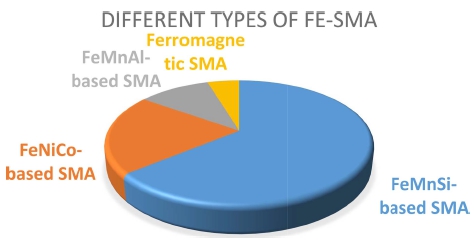
There are several types of Fe-SMAs. These types are characterized as FeMnSi-based SMA, FeNiCo-based SMA, FeMnAl-based SMA and Ferromagnetic shape memory alloys. The results showing characteristic features of each of these types, have been discussed in detail in subsection 2.1→subsection 2.4. A detailed review of a lot of existing types of each of FeMnSi-SMAs, FeNiCo- SMAs, FeMnAl-SMAs and Ferromagnetic-SMAs, is performed there. All these types have been individually collected in Table 1→Table 4 with proper composition and references. Hence, Table 1→Table 4 also show the results of this work. Fig. 1 shows the analysis performed by observing the data in Table 1→Table 4. It shows that most of the existing types of Fe-SMAs are FeMnSi- SMAs, secondly FeNiCo-SMAs, thirdly FeMnAl-SMAs and fourthly Ferromagnetic-SMAs. Researchers are not only trying to develop the existing types of Fe-SMAs, but they are also trying to find new types of Fe-SMAs. The authors hope that promptly growing development and research on Fe-SMAs will lead towards excellence in the coming near future.
The results related to different properties of Fe-SMAs have already been discussed in section 3.
4.2 Importance of Fe-SMAs
A literature analysis has been carried out using the “google scholar search engine” with search keywords of “ferrous based shape memory alloys”. An increasing sequence of Publications & US Patents was observed for different year groups mentioned in Fig. 2, during the last 50 years. This increasing sequence was observed during the both cases (i) when keyword is anywhere in the research article (ii) when keyword is in title of research article as shown in Fig. 2.
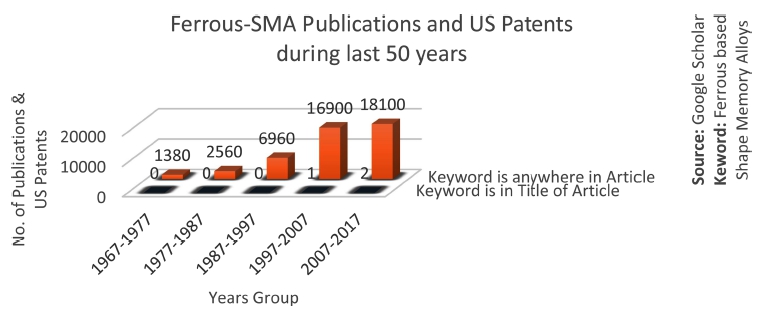
Fig. 2
Increasing sequence of ferrous based SMA’s publications & US patents during the last 50 years accessed in 2017.
A literature analysis has been carried out using the “google scholar search engine” with search keywords of “FeMnSi based shape memory alloys”. An increasing sequence of Publications and US Patents, was observed for different year groups mentioned in Fig. 3, during the last 50 years. This increasing sequence was observed during both cases (i) when keyword is anywhere in the research article (ii) when keyword is in title of research article as shown in Fig. 3.
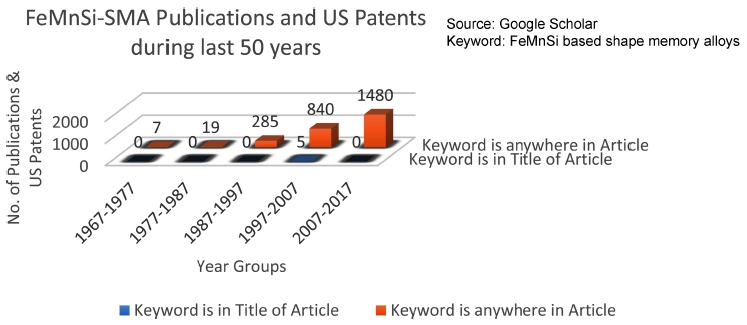
Fig. 3
Increasing sequence of Fe-Mn-Si based SMA’s publications & US patents during last 50 years accessed in 2017.
A literature analysis has been carried out using the “google scholar search engine” with search keywords of “FeNiCo based shape memory alloys”. An increasing sequence of Publications and US Patents, was observed for different year groups mentioned in Fig. 4, during the last 50 years. This increasing sequence was observed during both cases (i) when keyword is anywhere in the research article (ii) when keyword is in title of research article as shown in Fig. 4.
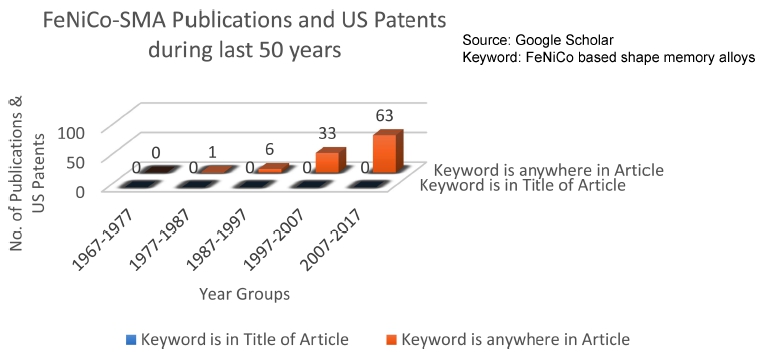
Fig. 4
Increasing sequence of Fe-Ni-Co based SMA’s publications & US patents during last 50 years accessed in 2017.
A literature analysis has been carried out using the “google scholar search engine” with search keywords of “FeMnAl based shape memory alloys”. An increasing sequence of Publications and US Patents, was observed for different year groups mentioned in Fig. 5, during the last 50 years. This increasing sequence was observed during both cases (i) when keyword is anywhere in the research article (ii) when keyword is in title of research article as shown in Fig. 5.
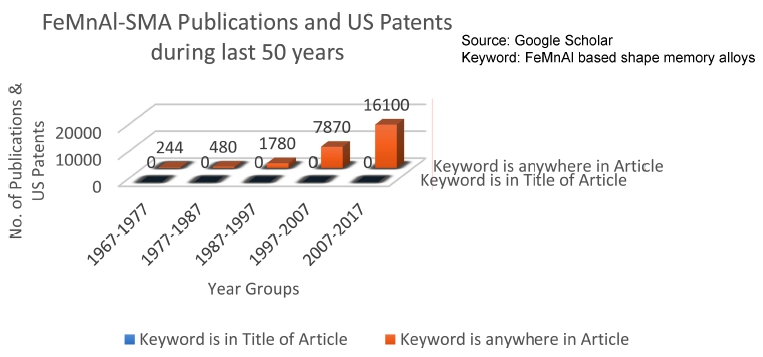
Fig. 5
Increasing sequence of Fe-Mn-Al based SMA’s publications & US patents during last 50 years accessed in 2017.
A literature analysis has been carried out using the “google scholar search engine” with search keywords of “ferromagnetic shape memory alloys”. An increasing sequence of Publications and US Patents, was observed for different year groups mentioned in Fig. 6, during the last 50 years. This increasing sequence was observed during both cases i.e. (i) when keyword is anywhere in the Research Article (ii) when keyword is in title of Research Article as shown in Fig. 6.
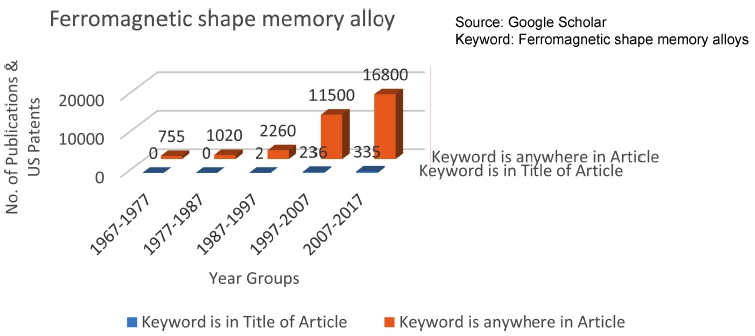
Fig. 6
Increasing sequence of ferromagnetic SMA’s publications & US patents during last 50 years accessed in 2017.
The above-mentioned analysis in the form of Fig. 2 to Fig. 6 as well as results and discussions on these Fig. 2 to Fig. 6, show that there is an increasing trend in all types of ferrous based shape memory alloys during the last 50 years, In other words, number of publications and US Patents are being increased with the passage of time. Researchers are taking more interest in evaluating the features of Fe-SMAs and trying to enhance the number of applications of such type of cheap and commercially available alloys.