


1 Introduction
Fuel cells, which are capable of operating in the intermediate temperature range of 200~400 °C are drawing attention owing to their advantages such as their reaction rates, resistance against CO poisoning, reusabilitys of fuel, and decrease in the usage of precious metal-based catalysts.1-4) Since this temperature range lies in the fuel cell operable gap between the currently used high and low temperatures, it is also strategically important.5) In the intermediate temperature range, of lately, many new electrolytes are being considered; however, among them, since glass materials show stable physical properties and possess open structures without grain boundaries, generally they are expected to have higher ion conductivity than crystalline materials.6) In particular, phosphate glass is more appropriate among the glass materials, as a solid electrolyte material. Phosphate glass, which includes alkali ions, has a structure that is favorable for the mobility of protons; since such a structure maintains a hydrogen bond network between the adjacent oxygen atoms such that a hopping mechanism leads to proton mobility, this structure leads to high ionic conductivity.6-7) The structural characteristics of the phosphate glass show that it has a phosphorus atom at the center and oxygen atoms at the four corners; this can be represented as [PO4]3−.8) Among the four oxygen atoms, three of them are cross-linked oxygen atoms, and the last remaining one is dual bonded to the phosphorus atom of [PO4]3−.9) A single [PO4]3− group is linked to other three through a −P−O−P− bond. When cations such as Ca2+ are added to the glass, the three-dimensional network collapses and the characteristics change as evidenced by the breakage of the −P−O−P− bond and production of non-cross-linked oxygen atoms.10) In contrast, when metal cations are added, the amount of the modifier increases. This is because of decrease in the number of polymeric chains when [PO4]3− changes to [PO3]− owing to the collapse of the bond between [PO4]3 tetrahedrons. Abe et al.6,11) reported that the phosphate glass materials such as BaO-P2O5 and SrO-P2O5 that include an OH group have higher ionic conductivity than other glass types. It is known that many amorphous phosphate glasses such as zirconium phosphate,12-13) calcium phosphate hydrogels14) and titanium phosphate glasses15) also show high conductivity even at room temperatures. However, materials that are fundamentally based on phosphate glasses have some demerits. Since phosphorus is volatilized at high temperatures and leads to content reduction phenomena when performing heat treatment, and easily bonds with water, the glass structure is highly vulnerable to breakage.16) Especially, the phosphorus volatilization become more serious in phosphate glass thin films as reported in the previous studies,17-18) which is preferred as an electrolyte form for fuel cells, compared to conventional bulk glasses. Therefore, it is important to improve the chemical and mechanical stabilities of such materials at high temperatures.
In this study, we fabricated niobium phosphate(NbP) glass thin films through sol-gel processing and report their electrical properties at intermediate temperature range and also their chemical stability. When the content of phosphorus is physically increased, the chemical stability of the phosphate glass is degraded. However, such degradation can be reduced by bonding with cations such as Zr4+, Al3+ and Nb5+.13,18-19) Especially, niobium phosphate possesing O−Nb−O bonds has been reported to have high chemical stability.20) In another study, using fourier transform infrared spectroscopy(FT-IR), it was reported that the phosphorus atoms in the tetrahedral coordination of −P−O−P− can be substituted by Nb atoms.21) From a raman spectroscopy study on O−Nb−O, O−P−O, and mixed −O−P−O−Nb−O chains,22) the number of Nb−O−Nb, −O−P−O−Nb−O− chain increases by adding niobium. In such chains, Nb bonded with P can prevent the volatilization of P at high temperatures, and can maintain an ion-conducting medium, thereby improving conductivity.
2 Experimental
The NbP glass thin films were prepared using phosphorus pentoxide (P2O5 powder, 98.5 %, Sigma-Aldrich), niobium chloride (NbCl5 Powder, 99 %, Sigma-Aldrich) and ethylene glycol monomethyl ether (CH3OCH2CH2OH, 99.5 %, DAEJUNG Chem). The precursor solution was prepared by dissolving P2O5 into 10 ml of ethylene glycol monomethyl ether solvent by stirring at room temperature for 20 min. In a similar manner, NbCl5 was dissolved in ethylene glycol monomethyl ether solvent by stirring at room temperature for 20 min. Then NbCl5 solution was added to a P2O5-ethylene glycol monomethyl ether solution. The atomic ratio of the two precursor solutions was Nb:P = 1:4. The prepared precursor solutions were used for deposition of the glass thin films. Si wafers and Pt-coated Si wafers(Pt/Si) were used as substrates and for measuring electrical conductivity. Before using them as substrates, Pt/Si wafers were pretreated to remove moisture and impurities such as hydrocarbons, which are adsorbed on the surface. The deposition of the glass film was performed through spin coating for 30s at 3000 rpm, followed by drying on a hot plate at 180 °C for 5 min; subsequently, calcination was performed at 400 or 700 °C (from now on, NbP400 and NbP700) for 5min in an electric furnace. This deposition cycle was repeated for a total of 10 times where the heat treatment during the last deposition cycle was performed for a long time of 30 min.
The microstructure of the glass thin films was observed through field emission scanning electron microscopy(FESEM, JEOL, model JSM-6500F). X-ray diffraction(XRD, Rigaku, model SWXD(X-MAX/2000-PC) using Cu Kα (λ = 0.15406 nm) radiation was used for validating the amorphous nature of the glass films. Fourier transform infrared spectroscopy(FT-IR, BRUKER BIOSPIN, model Vertex 80 V(Hyperion 2000)) was used to study the bond structure and forms of oxide chains. Further, X-ray photoelectron spectroscopy(XPS, Thermo Fisher Scientific, and model Multilab-2000) was used for studying the content of P in the glass thin films and the bridging oxygen(BO) - non bridging oxygen(NBO) bond structure.
NbP glass thin films were prepared on a Pt wafer for measuring resistance in order to improve conductivity. A gold electrode with diameter of 500 um was formed on the film by using Au sputtering. The resistance was measured by contacting two Ag wires. An upper and a lower electrode were formed by grounding one Ag wire to the Au point electrode and other to the Pt/Si wafer. Resistance analysis equipment was driven by AC current in the frequency range 1 × 10³ ~ 8 × 10⁶ Hz and voltage range 10~20 mV. During resistance measurement, the dependence of conductivity on temperature was studied by increasing the temperature in 50 °C intervals from 150 to 400 °C by using a hot plate.
3 Results and Discussion
Fig. 1 shows the measured electrical conductivity of NbP glass thin films. During the measurement, the dependence of conductivity on temperature was validated by increasing the temperature in 50 °C intervals from 150 to 400 °C. The Arrhenius plot of NbP thin films shows straight lines implying just one ion conduction mechanism exists. That is, the typical conductivity drop over 100 °C due to rapidly reduced vehicle conduction through remained water molecules which is often found in sol-gel derived gel glass thin films is not found in the plot. Such result strongly support the idea of the existence of hydroxyl group in the phosphate to be preserved at the intermediate temperature region of 150~450 °C. The measured maximum conductivity of NbP400 is 1.17 × 10⁻⁴ Scm−1 at 400 °C, and the conductivity decreased about 5~10 folds as the preparation temperature increased to 700 °C. As shown in Table 1, such decrease in ion conductivity is not surprising because the P concentration(P/ Nb) decreases from 3.35 in NbP400 to 2.9 in NbP700, although the observed change is not so significant as those in zirconium phosphate glass thin films.18) This implies that heat treatment at high temperatures can contribute to changes in the P concentration and ion conductivity.
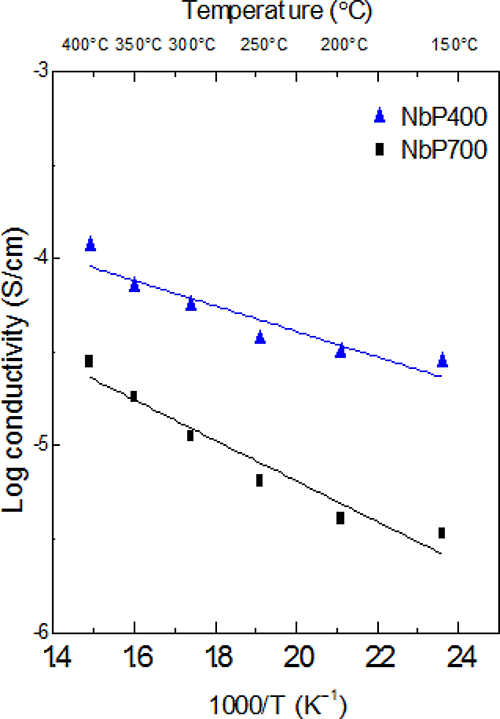
Table 1
Phosphorus content, calculated proton concentration and log10Ao values of NbP thin films.
| P/Nb (initial ratio = 4) | [H+] (mol/L) | log10Ao (Scm–1mol−2l2) | |
|---|---|---|---|
| NbP400 | 3.35 | 1445.3 | –10.87 |
| Nb700 | 2.9 | 758.6 | –11.23 |
The fabricated NbP glass thin films were observed by field emission scanning electron microscopy(FE-SEM). Fig. 2 shows that the glass thin films were very densely formed and defect-free. The measured film thickness of NbP400 and NbP700 was 135 nm and 130 nm, respectively. Further, it was validated that the difference between the thickness of the sample heat-treated at 400 °C and that of the sample heat-treated at 700 °C was not significant.
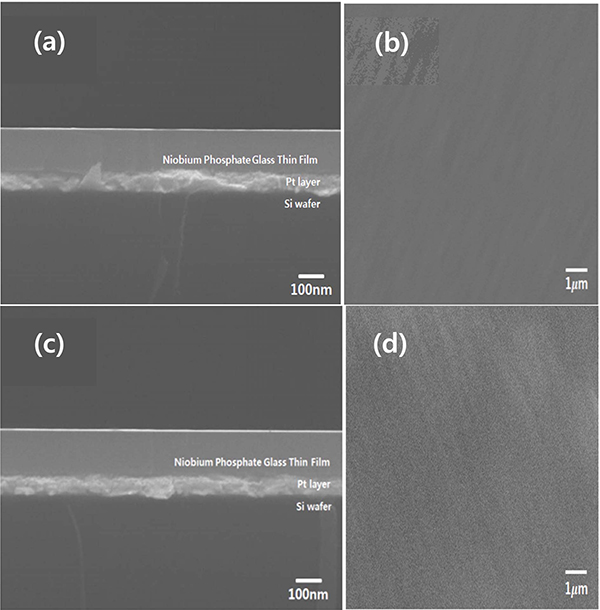
Fig. 2
FE-SEM images of NbP glass films: cross sections and surfaces of NbP400 ((a), (b)) and NbP700 ((c), (d)).
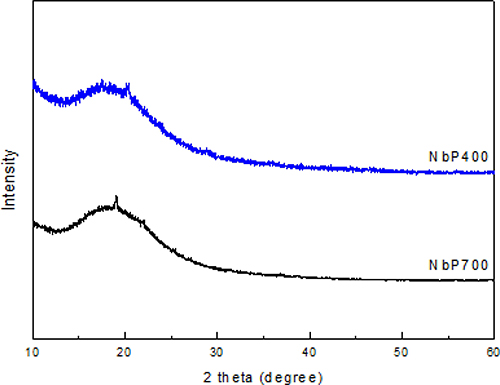
Fig. 3 shows the XRD patterns of NbP400 and NbP700. The glass thin films have an amorphous phase for which any crystalline peak is not observed. The broad peak observed in the vicinity of a 2θ value of approximately 18° represents an amorphous oxide. The increase of peak intensity under a 2θ value of approximately 10° apply characteristic of typical nanoporous sol-gel glasses.23) For this reason, water easily penetrates the pores in a wet environment; the moisture present in the pores resulted in an increase in the mobility and concentration of protons. However, since the moisture evaporates at temperatures greater than 100 °C, this merit disappears and the measured ionic conductivity decreases.
Scholze reported that since the O-H bond in an oxide glass shows stretching vibrations, there exist two types of special absorption bands.24) One of them is observed in the vicinity of approximately 3600 cm−1 and is called as band-1. The other one is observed in the vicinity of 2900 cm−1 and is called as band-2. Similar to the conventional oxide glass prepared by melt-quenching technique, the fabricated phosphate glass thin films also shows two types of special absorption bands Fig. 3(a): one with a strong hydrogen bond and other with a weak hydrogen bond. In band-2, proton bonds with hydrogen, whereas in band-1, proton does not bond with hydrogen. The proton that bonds with the hydrogen of b- and-2 has a higher mobility than that of the proton in band-1.25) Abe et al.26,27) demonstrated experimentally by using Eq. 1~Eq. 3 that dc electrical conductivity, proton concentration and activation energy are all closely related in phosphate glasses.
A0: constant of proton mobility
σ: conductivity at 417K
[H+]: mobile proton concentration
υOH: wave number of hydrogen-bonded OH
e: electronic charge
μ: mobility
Fig. 4(a) shows band-2 of NbP400 and NbP700 and the Fig. 4(b) shows the correlation between υOH and A0. log A0(= σ(417) /[H+]2) decreases linearly with increasing υOH with a slope ratio of −0.00937(Eq. 2). The value of υOH of these glasses lie in the range from 2650 to 3450 cm−1.25) This means that there exists hydrogen bonded OH groups; the protons of the former must be responsible for the electrical conduction. Eq. 3 implies that μ is a function of proton concentration and mobility-related constant A0. From Fig. 4(b), it is found that the mobility of protons in the obtained NbP glass thin films is relatively high, and with the obtained A0 values, proton concentration values for NbP glass thin films are calculated Table. 1. The proton concentration of the NbP glass thin films is about 100~1000 times higher than those of the bulk glasses prepared by melt-quenching technique. For example, [H+] of melt-quenched 40BaO- 60P2O5 glass is only 1.0 mol/L6) and [H+] is decreasing with an increase of heat-treatment temperature from 400 °C to 700 °C. It is evident that the high proton concentration directly attribute to an drastic increase in conductivity not to mention that the conductivity of the NbP glass thin films is on the order of −5~−6 compared to those of melt-quenched phosphate glasses is −15~−8. For example, BaO- and MgO-phosphate glasses have conductivities of about 10−9 and 10−12 S/cm, respectively, at 150~300 °C.28-30) Therefore, the drastically increased electrical conductivity of the NbP phosphate glass thin films compared to melt-quenched glasses is due to such high proton concentration and relatively high proton mobility.
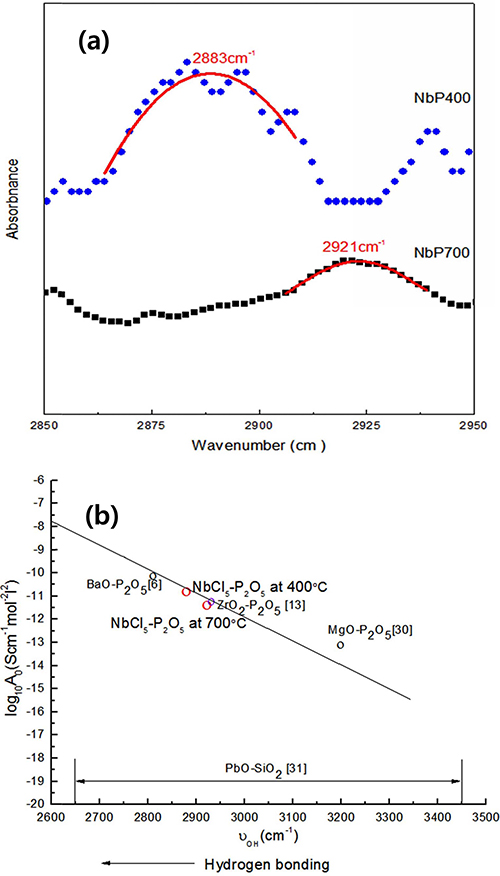
Fig. 4
Hydroxyl group analysis: (a) Band-2 spectra from FT-IR patterns of NbP thin films, (b) Relationship between A0 for various proton concentrations and υOH for the O-H bond in glass.
As mentioned in the previous section, when the content of phosphorus is physically increased in order to acomplish high proton conductivity, the chemical stability of the phosphate glass is significantly degraded, especially in thin film form with large specific surface area. The measured P/Nb ratios of the heat-treated NbP thin films are listed in Table 1. The decreases of phosphorus content measured after heat-treatment are 16.2 % (P/Nb = 3. 35) and 27.5 % (P/Nb = 2.9) for NbP400 and 700, respectively. The volatilization is not significant compared to that in previously studied sol-gel derived phosphate glass thin films, i.e. ZrO2-P2O5(ZP),18) BaO-P2O5(BP) and BaO-La2O3-Al2O3-P2O5(BLAP).17) 34 % in ZP, 51 % in BP and 31.6 % in BLAP of phosphorus was volatilized after heat treatment at 400 °C, and the loss drastically increased up to 76.6 % in BLAP by increasing heat treatment temperature to 700 °C. Such a reduced P loss in NbP thn films is attributed to improved oxide bonding strength with Nb5+ through forming −O−P−O−Nb−O− chains. Therefore, it is noteworthy that the chemical stability of the phosphate glass thin films can be significantly changed by cations which bonds with phosphorus.
It was validated from the results of component analysis through XPS that the P concentration, which affects proton conductivity, was more in NbP400 than that in NbP700. As shown in Fig. 5, the two factors, namely, nonbridging oxygen(NBO) and bridging oxygen(BO), which affect proton conductivity, can be validated from the O1s spectra of XPS. Through NBO, the dissociated protons are mobile by hopping from the initial site of H+ to a neighboring site of H+. However, through BO, protons are immobile because of strong hydroxyl group(Fig. 6). Since XPS photoelectronics is generally used for studying the core electron energy of various atoms, it is possible to distinguish the bond structure, BO and NBO, of phosphate glasses. The aforementioned two factors can be validated by binding energy; higher binding energy shown by the BO peak corresponds to approximately 533eV, whereas a lower binding energy show n by the NBO peak corresponds to approximately 531eV. In addition, there exists a peak with moderate binding energy (approximately 532eV) for BO and NBO; this peak is called the asymmetric bridging oxygen(ABO) peak.31,32) Since the quantitative relationship between BO and NBO can be determined through deconvolution by considering some assumptions with regard to the binding state present in the O1s spectra, the O1s line in the XPS spectrum can represent BO, ABO, and NBO. From Fig. 5, the relationships of BO-NBO for NbP400 and NbP700 can be compared. It was validated from the patterns of NbP700 that the concentration of BO was relatively more than that of NBO. On the other hand, the patterns of NbP400 showed that BO and NBO were present in similar forms; by comparing the patterns of NbP400 and NbP700, it was validated that the concentration of NBO in NbP400 was relatively higher than that in Nb P700. Since hydrogen bonding was strong as the heat treatment temperature increased, it implies an increase in the concentration of BO. According to previous studies,33-34) the NBO structure in phosphate glasses increases as the P concentration increases. Therefore, the mediator that can promote protonmobility increase as the concentration of NBO increases, and because of this, the proton concentration and mobility increases.
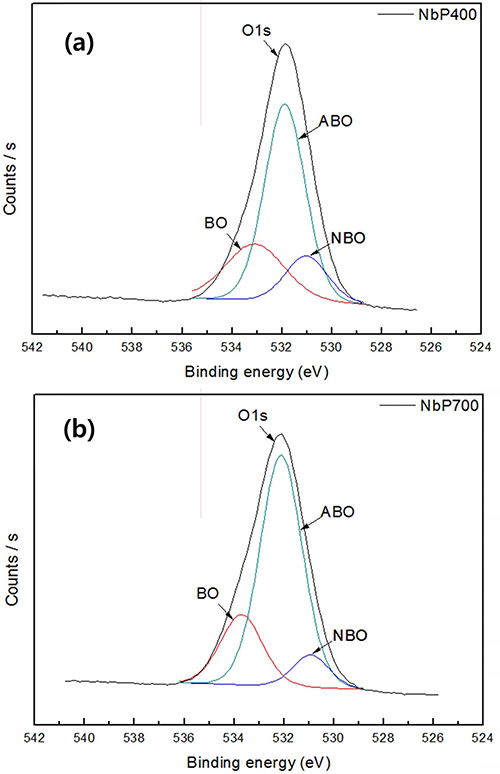
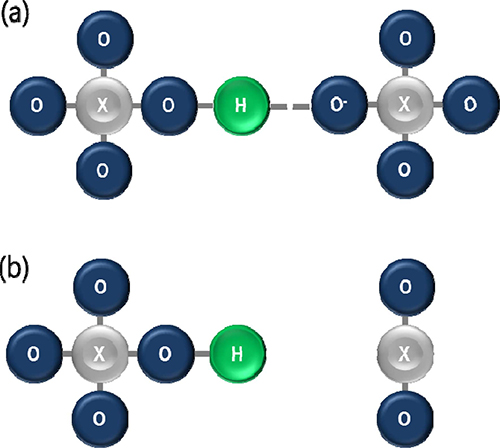
Fig. 6
(a) Bridging oxygen(BO) with hydrogen bonding(weak OH bonding, mobile proton) and (b) non-bridging oxygen(NBO) which is free from hydrogen bonding(strong OH bonding, immobile proton). (X: cation, O: oxygen, H: hydrogen).
It can be seen from FT-IR spectra that the absorption band of band-2 can be simultaneously observed in NbP400 and NbP700. How- ever, band-2 of NbP400 was more intense than that of NbP700, which means that protons in NbP400 are more mobile. Generally, the proton conduction properties can be explained by a twostep processes; first, the protons move owing to the bond breakage between oxygen and hydrogen atoms in NBO, and then they hop to the neighboring NBO sites.35) Therefore, the high concentration of NBO is related to proton concentration and can improve electrical properties. In addition, the activation energy of NbP400 and NbP700 was calculated by the slope of conductivity and was found to be 0.14eV and 0.21eV, respectively. Since activation energy represents the energy required for proton hopping,36) such results indicate that NbP400 has more effective proton conduction. The high conductivity and low activation energy of NbP400 proves that the concentration of NBO and proton mobility in the glass structure is high. As mentioned previously, the proton conductivity of the fabricated NbP glass thin films was much higher than those of other melt-quenched phosphate glasses. Such an increased conductivity of NbP glass thin films can be explained as very high proton concentration and low activation energy for proton conduction due to increased proton mobility by high NBO concentration.
4 Conclusion
Niobium phosphate glass thin films were fabricated using sol-gel process. The serious volatilization of phosphorus during fabrication of phosphate glass thin films which significantly affect bonding structure and electrical properties could be successfully reduced by adding niobium as cation source compared to previously studied sol-gel derived phosphate glass thin films. Such an increased chemical stability is attributed to strong oxide bonding of Nb5+ through forming −O−P−O−Nb−O− chains. In a given temperature range, the fabricated glass thin films showed very high electrical conductivity (1.17 × 10⁻⁴ S/cm at 400 °C) than those of conventional phosphate glasses prepared by melt-quenching technique. The observed high conductivity of NbP glass thin films is attributable to very high proton concentration and low activation energy for proton conduction due to increased proton mobility by high NBO concentration.