


1. Introduction
The aggregation of colloidal particles is a critical phenomenon in numerous industrial processes. Suspensions containing magnetic particles are particularly susceptible to aggregation and flocculation due to their inherent permanent magnetic moments. The macroscopic rheological properties of these magnetic inks are primarily governed by the nature of the interparticle interaction forces.1) While the rheology of model magnetic suspensions has been studied,2,3,4,5) the specific structural evolutions occurring under shear flow remain poorly understood. Despite extensive research on the rheology of non-interacting spherical particles, the behavior of suspensions containing strongly interacting particles of varying geometries remains relatively unexplored. This study focuses on the shear-induced structural transitions of magnetic aggregates and their subsequent impact on rheological performance.
Concentrated particulate suspensions often form complex internal architectures characterized as elastic networks.3) These networks, which extend throughout the sample volume, are responsible for significant non-Newtonian behaviors. Previous studies3,6,7) have applied molecular fluid concepts and advanced experimental techniques to investigate the interactions within colloidal aggregates. Research in this field is generally categorized into two domains: emulsions and hard-sphere dispersions.
In the study of flocculated emulsions, Wessel and Ball8) demonstrated that floc size typically decreases with increasing shear stress, often resulting in complete dissociation into primary particles at high shear rates. The observed yield stress in these systems - often defined as the transition point between solid-like and liquid-like behavior9,10,11) appears independent of droplet size.12) Conversely, hard-sphere suspensions exhibit diverse microstructural behaviors depending on particle size, volume fraction, and the state of aggregation.13,14,15,16) While simulations have progressed in reproducing such data,17) a comprehensive understanding of how specific structures dictate flow behavior is still lacking.
The rheological response of non-spherical particulate suspensions is highly dependent on particle orientation, aspect ratio, and shape.18) Unlike conventional spherical colloids, magnetic inks, even at relatively low concentrations, tend to form robust internal structures.19) We hypothesize that the fundamental flow units in these inks are flocs: small clusters of particles and entrapped solvent that persist even at elevated shear rates. Due to interparticle magnetic interactions, these flocs possess inherent elasticity.
In contrast to spherical systems, rod-type particulate suspensions have received less academic attention.20) Investigations into magnetic iron oxide suspensions have revealed abnormally high intrinsic viscosities at high shear rates, suggesting that particles exist as aggregates rather than discrete units.2,21,22) It has been proposed that these structures form linear chains with high aspect ratios along the flow direction; however, this has not been definitively proven through microstructural modeling.
Significant progress has been made in understanding the physics of colloidal aggregate breakup in systems such as polystyrene latex.23,24) Firth and Hunter6) proposed three distinct models treating the flow unit as either a single particle, a hard floc, or an elastic floc. In these frameworks, the Bingham yield value is directly related to the interaction energy between flow units. Furthermore, Potanin et al.25) and de Rooij et al.26) developed microrheological models for weakly aggregating dispersions. While these models provide physical significance, they often fail to account for structural transitions as a function of increasing shear rate, particularly in high-concentration systems with strong interactions.27,28)
In this paper, we utilize the elastic floc model to investigate the viscosity and structural transitions of a model magnetic ink. We treat the flow units as deformable elastic spheres rather than rigid primary particles, drawing parallels to the deformation of droplets in emulsion systems.29)
2. Experimental Procedure
The magnetic particles utilized in this study were single-domain particles designed for high-density commercial storage media. Metal particles (MP), characterized by smaller dimensions and stronger magnetic interactions compared to conventional iron oxide, were sourced from Quantage Co. (Specific physical properties are summarized in Table 1).
Table 1.
The properties of magnetic particles.
| Property | Metal particle |
| Magnetization (emu/cc) | 750 |
| Coercivity (Oe) | 1750 |
| SSA (m2/g) | 42 |
| Length (µm) | 0.2 |
| Aspect ratio | 8 |
| Density (g/cm3) | 5.7 |
MP and polymer binder solution were mixed in a plate mixer with high shear to give dough. The polymer binder adsorbed onto MP in this stage. The particles were coated with polyvinylchloride copolymer (MR 110, Mn = 12,000, Nippon Zeon) containing 0.7 wt% SO4 and 0.5 wt% OH functional groups as a wetting resin.30) This wetting resin adsorbed on the surface of magnetic particles to provide strong steric repulsion depending on its amount. The prepared dough is mixed with more solvent and milled in a bead mill for 3 h. All these stages were needed to obtain high magnetic properties. The weight ratio of polymer to metal particle was fixed as 0.175 for all MP ink samples.
All samples contained polymer binder of 2.7 wt% and magnetic particles of 34.2 wt% with the balance being solvent. This corresponds to a volume fraction of 9.7 % particles. The same polymer binder for MP inks was used. In a field, they use several kinds of solvent to disperse the particles. In this study, we used cyclohexanone for a continuous phase because it is not volatile relatively. The inks were prepared by ball milling for 48 h in paint cans.
Steady shear measurements were performed using a stress-controlled rheometer (HAAKE RS100). The device was equipped with a 35 mm diameter, 4° cone-and-plate geometry. For standard tests, a gap of 0.135 mm was maintained. To ensure the validity of the data and check for potential wall slip or phase separation, supplementary measurements were conducted at varying gap sizes. The absence of gap-dependent results confirmed that significant wall slip did not occur during the measurement range. All experiments were conducted at a controlled temperature to minimize the impact of solvent evaporation.
3. Results and Discussion
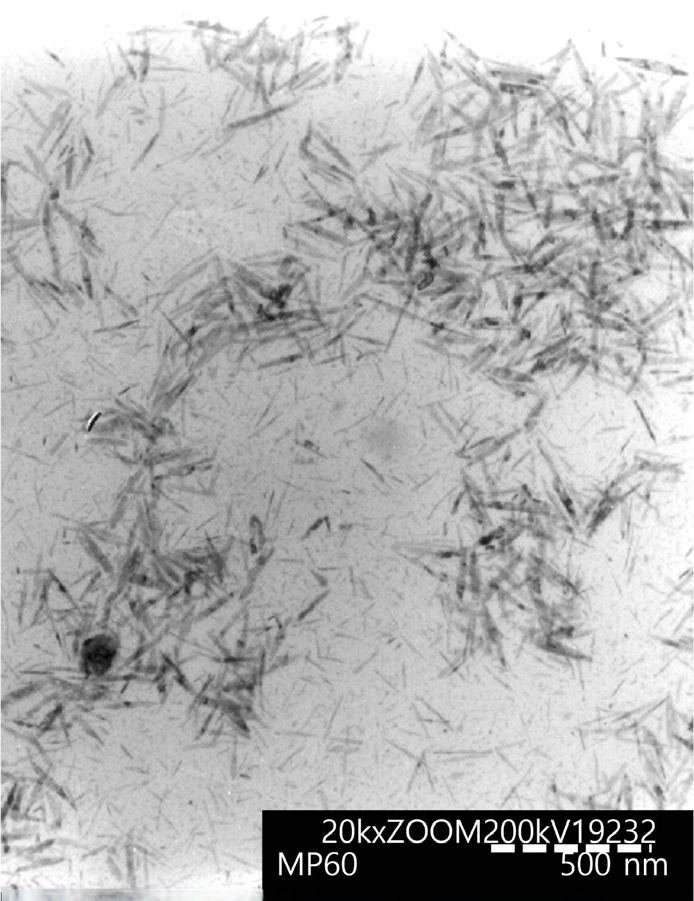
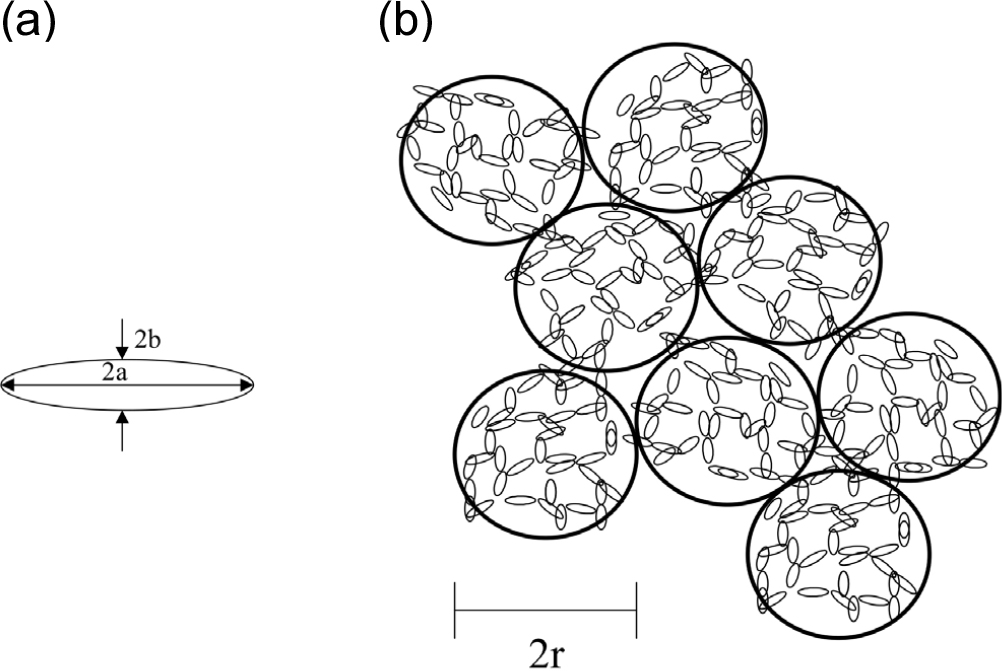
Fig. 1 shows a cryogenic transmission electron microscopy (Cryo-TEM) image of a magnetic ink made with MP 5 vol%. Most particles are found in bundles of two or more because of the very strong magnetic forces and are not easily separated. Floc form because of the residual magnetic moments of these aggregates, which exert a long-range attractive force. Fig. 2 shows a single magnetic particle (a) and a model network structure (b) formed by flocs of radius r. The floc is formed by aggregated particles and links with each other to give a network structure. We assume a uniform floc size for simplicity.
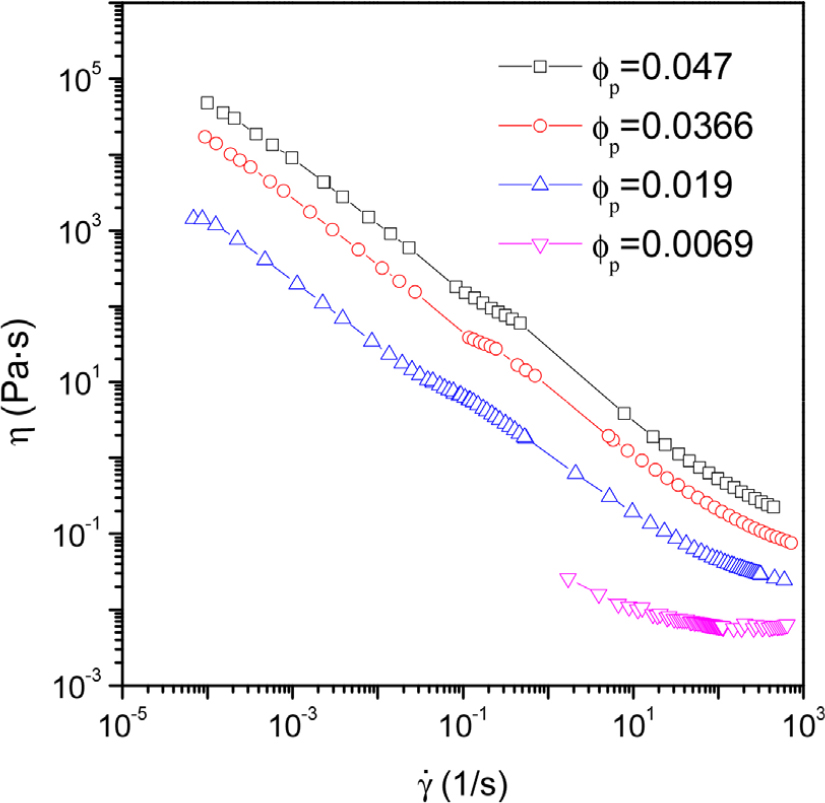
The steady shear viscosity of the four model MP inks is illustrated as a function of shear rate, in Fig. 3. All samples exhibited pronounced shear-thinning behavior across the measured range. All the inks had the same ratio of polymer binder to magnetic pigment as 0.175. Here the particle volume fraction 𝜙p was represented that of plain particle in ink, i.e., not including adsorbed polymer binder on it. To further elucidate the underlying structural transitions, the viscosity was plotted against shear stress in Fig. 4, revealing the presence of an apparent yield stress. The MP inks display shear-thinning behavior with apparent yield stress indicating the existence of structure. The yield stress implies extensive rupture of connectivity of the structure. This yielding behavior was not significant below 𝜙p = 0.019 and hardly found at 𝜙p = 0.0069. The disappearance of yielding in system was well explained by Kanai et al.3) introducing percolation concept into magnetic inks. They found a critical floc volume fraction below which the suspension did not show yield stress. In our system the critical floc volume fraction placed between the 𝜙p of 0.019 and 0.0069. Below the critical volume fraction, the colloidal suspension shows relaxation in dynamic measurement indicating there is no network structure.27)
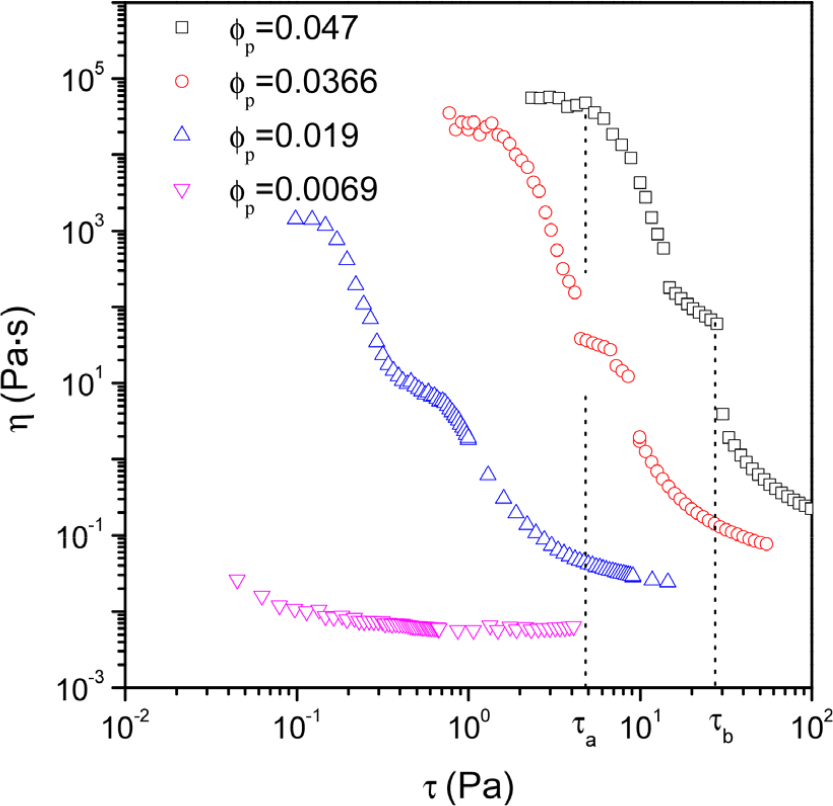
For samples above the critical concentration, two distinct yielding behaviors were identified. The first yielding stress, 𝜏a, corresponds to the disruption of physical links between flocs, while the second, 𝜏b, represents the mechanical rupture of the flocs themselves.
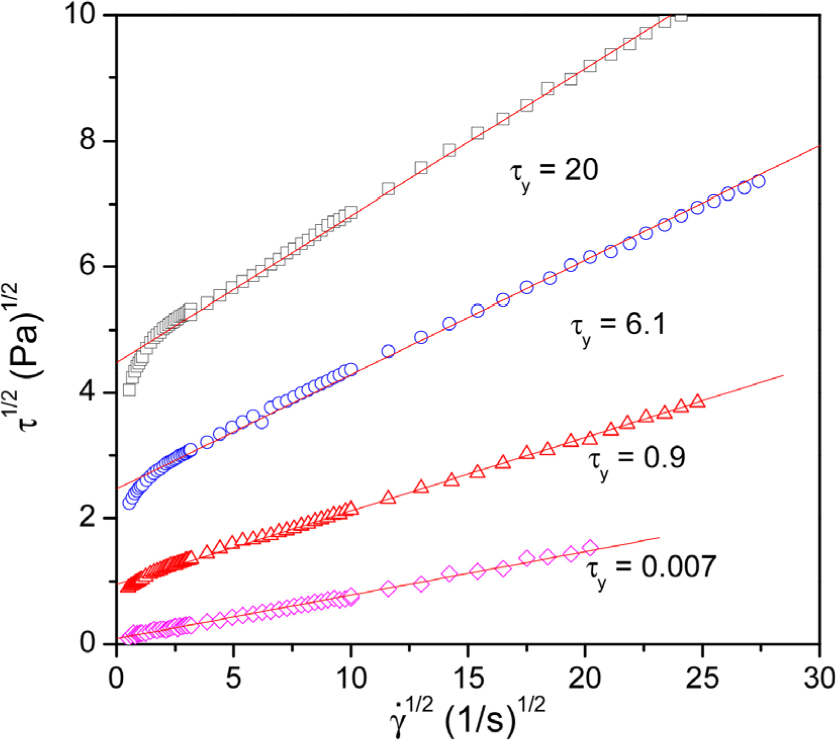
Fig. 5 presents the Casson fitting results based on Eq. (1), providing additional evidence for the network formation threshold. Casson yield value is another important proof which shows the critical volume fraction. The yield value is very small at a low volume fraction and rises at the volume fraction of 0.019, indicating that the network formation begins to be noticeable at around this point. As we consider network structure, 𝜙p above the critical fraction is our interest.
There is no first or second Newtonian region of shear viscosity in our experimental range. Since we are unable to determine 𝜂0, the well-known Herschel-Bulkley relation or the Cross model cannot be used to describe the constitutive relation. The shear thinning indicates a continuous change of motion of particles with raised shear rate in inks beyond Brownian motion. The shear thinning index was expected for colloidal suspension as 0.83 by Silbert and Melrose.17) Our experiment has good agreement with that.
To validate the microstructural basis of our model, it is necessary to identify whether the fundamental flow units are discrete primary particles, linear chains, or aggregated flocs. Previous studies, such as those by Kwon et al.,5) suggested that in certain magnetic suspensions, the flow unit might consist of single particles or straight-chain aggregates aligned with the flow.
To test this hypothesis, we evaluated the rotational dynamics of the particles. The magnetic particles in this study are characterized as prolate ellipsoids.
This definition of the aspect ratio is given in Eq. (2).
where represents the semi-major axis (half-length of the axis of revolution) and denotes the equatorial radius. Following the theoretical framework established by Brenner18) for dilute suspensions of Brownian particle, the averaged rotational diffusion coefficient () for a prolate ellipsoid is calculated using Eqs. (3), (4), (5), (6).
for the prolate ellipsoid (p > 1), where k is Boltzmann constant and T is absolute temperature. Since the maximum shear rate indicated that the Peclet number, Pe ≤ 3 in our experiment range, where Pe = /Dr particle orientation induced by shear flow hardly occurs in single particle system.
Yang et al. obtained [𝜂]∞ of 3.2 for prolate spheroid of the aspect ratio of 8.2) It requires an aspect ratio > 100 to get such intrinsic viscosity. It was also noticed in 𝛾-Fe2O3 dispersions by Nagashiro and Tsunoda21) and Kwon et al.22) The large [𝜂] value was explained with that flocs containing immobilized liquid exist. In addition, they suggested the decrease in [𝜂] with increasing shear rate results in a decrease of average floc size. They also found that the [𝜂] is abnormally high even at high shear rate indicating align of more than 100 particles to flow direction. From those results, we assume the flow unit is floc rather than single particles even at high shear rate.
In the aggregated dispersion model, we have several free parameters to be obtained by fitting. In order to get 𝜙m in Eq. (8), the adsorbed layer ought to be considered as a part of the particle, since it is fixed on the particle surface and moves with the core particle. The thickness of adsorbed layer, d, was obtained from commercial reference of polymer binder (MR110) and measurement of intrinsic viscosity of polymer binder solution.30) We adopt d = 2 nm. We redefined the solid component consisting of the magnetic particle core and the adsorbed polymer layer shell. The effective volume fraction for magnetic particles can be calculated by Eq. (7).
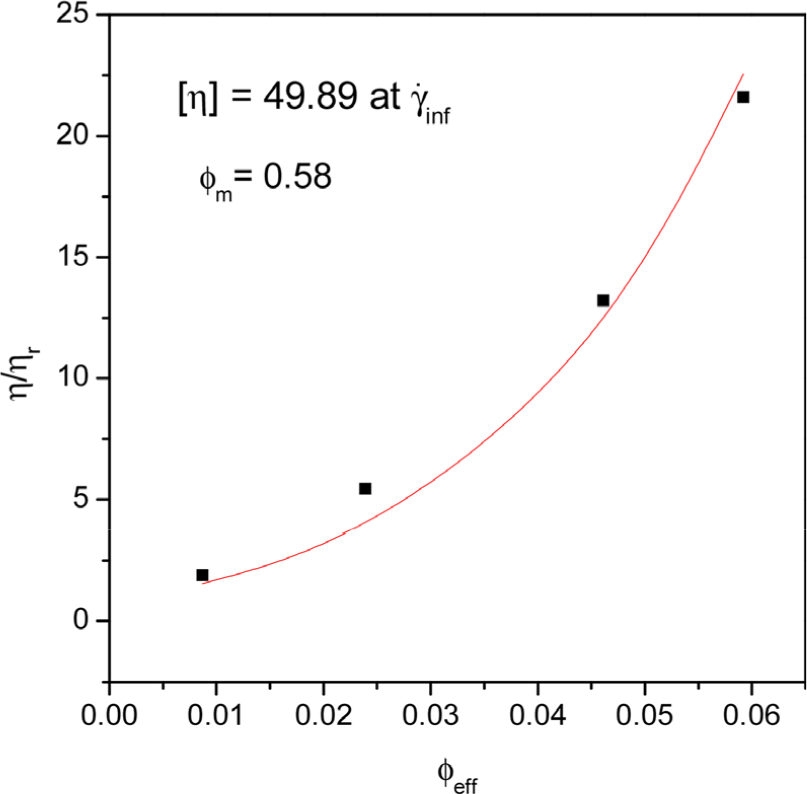
The value of 𝜙m was obtained from the empirical use of Krieger-Dougherty equation.31)
The Krieger-Dougherty prediction was developed for suspensions of spheres. The model, however, has been extended to non-spherical particles.32,33,34,35) We made a plot of Eq. (8) with 𝜙eff in Fig. 6 and determined 𝜙m as 0.58.
In a single particle model, the yield stress of the system at fixed 𝜙, 𝜏* can be determined by using the following equation.6) This relationship is written as Eq. (9).
At very low particle volume fraction (below critical point) 𝜏* is considered as a stress related to small aggregates since there is no network structure. The Vsep can be considered as the energy required to break two single particles or smaller aggregates. Here Vsep was calculated from MP ink of 𝜙 = 0.0069. 𝜏* at this volume fraction for MP ink was obtained from Fig. 5. Vsep was calculated as 9.53 × 10⁻²¹ J and used for other 𝜙p of MP inks.
The number of particles, N, contained inside a sphere of radius r of the aggregate is given by
where Ld is the unit cell length relating the particle radius and No is a numerical coefficient close to unity. The floc radius r and fractal dimension df were obtained from Eq. (10) by best fitting.
The unit cell length Ld is defined by logarithmic mean diameter of magnetic particle. The corresponding expression is given in Eq. (11).
The fractal dimension df was obtained from the relation suggested by Shih et al.35) This relationship is expressed in Eq. (12).
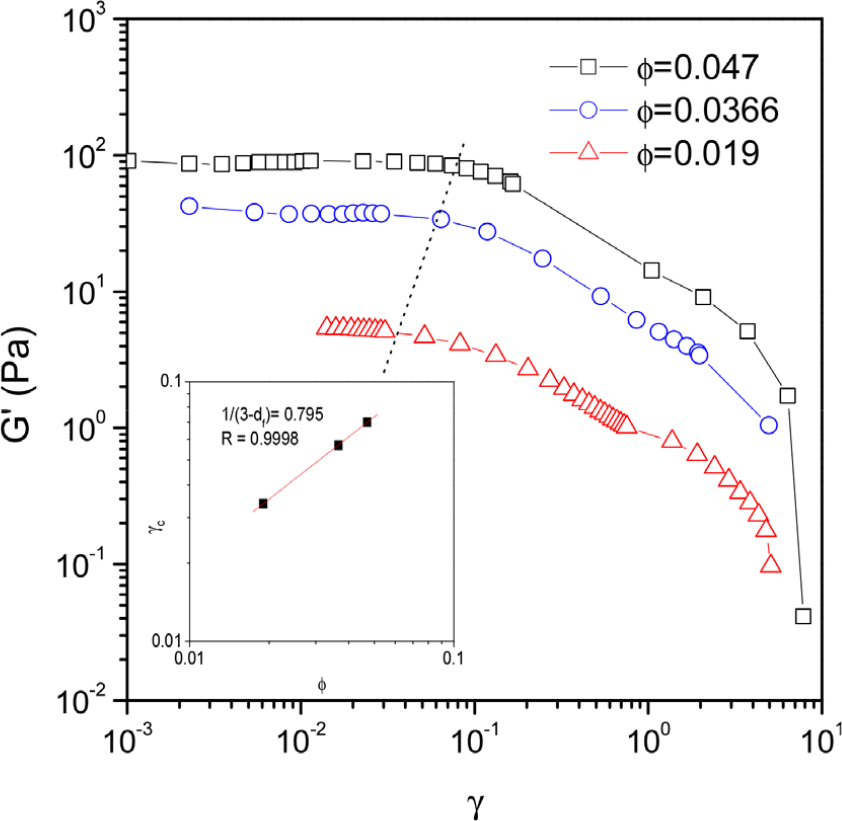
where D is the Euclidean dimension of the system and 𝛾c is critical strain which represents the limit of linearity. The 𝛾c for our model MP inks is shown in Fig. 7. The inset of Fig. 7 shows df = 1.74 in our model MP ink. This value is corresponding to the fractal dimension for fast aggregation, which is coincident with the result of the floc-floc aggregation model.35) Since the MP inks of higher particle volume fraction has higher rigidity, it is expected that the 𝛾c is shifted to lower as the 𝜙p is increased. However, our result shows that the 𝛾c was shifted to lower value as the 𝜙p decreased.
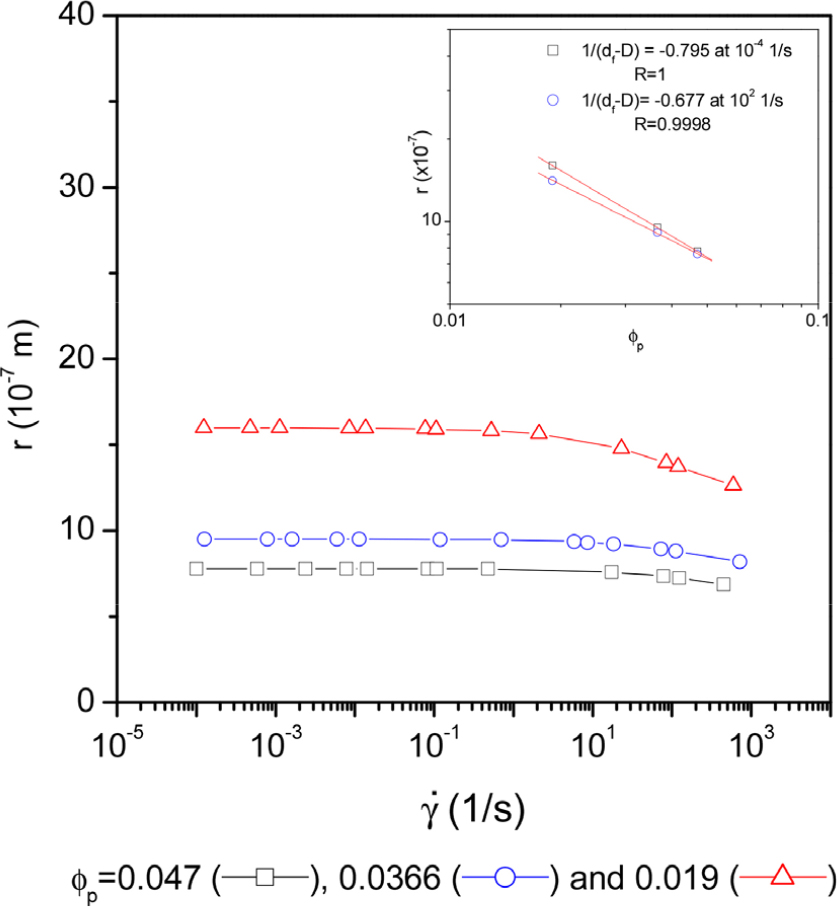
The size of floc as flow unit was obtained as a function of shear rate for three volume fractions above critical point. The result is shown in Fig. 8. It shows that the floc radius increases as 𝜙p decreases. According to Shih et al.,35) an increase in particle concentration results in smaller and more rigid flocs, while lower particle concentrations favor the formation of larger and less rigid flocs. This concentration-dependent floc size follows the scaling behavior described by Eq. (13).
The observed decrease in critical strain (𝛾c) with decreasing particle volume fraction (𝜙p) can be elucidated using the weak-link model proposed by Shih et al.35) According to this model, when the interactions between flocs are significantly weaker than the internal stiffness of the flocs themselves, the system’s elasticity is governed by these inter-floc links. In our magnetic inks, lower particle concentrations result in the formation of larger, less numerous flocs. These sparse networks possess a lower density of inter-floc junctions, making the global structure highly sensitive to mechanical deformation. This sensitivity manifests as a reduction in 𝛾c as 𝜙p decreases, indicating that the network reaches its limit of linearity at smaller strains compared to more concentrated, densely interconnected systems. The positive scaling exponent derived from df = 1.74 further confirms that the inter-floc connectivity is the limiting factor for the structural stability of the ink.
This scaling behavior was expected in linear regime. The inset shows how the floc radius varies with volume fraction over the shear rate range from 10-4 to 102 1/s. Our result shows good agreement with the scaling behavior at low shear rate. At high shear rate, it does not obey the scaling behavior which obtained from linear regime. The behavior will be accepted until rupture of floc since the size of floc is not much changed. The observed agreement with Eq. (13) in the steady shear regime, although originally derived for the linear regime, can be elucidated by the hierarchical nature of the magnetic ink microstructure. At shear rates between the primary (𝜏a) and secondary (𝜏b) yielding points, the hydrodynamic stress is sufficient to break the global network but remains lower than the internal cohesive energy of the individual flocs. Consequently, these flocs function as robust, elastic flow units that preserve the fractal scaling laws established during their initial aggregation at rest. This suggests that the steady-shear viscosity in this specific regime is governed by the volume of preserved fractal aggregates rather than by a continuous fragmentation process. The scaling relationship begins to deviate only beyond the secondary yielding threshold (𝜏b), where the hydrodynamic forces finally overcome the intra-floc rigidity, leading to irreversible structural disintegration.
Qualitatively, this coincidence can be explained by the fact that the network structure continues to deform until the flocs are broken. At this shear rate, the network structure in the ink is barely disrupted. Since steady shear flow tends to break down the structure, a physically linked network is not expected to remain. However, magnetic interactions between flocs can act over a finite distance, allowing the flocs to remain effectively connected even after the physically linked network has been disrupted. The 𝜏a in Fig. 4 is the critical stress at which weak interactions are broken up with further shear rate. As evidenced by the Cryo-TEM image in Fig. 1, the magnetic particles form dense bundles driven by potent short-range magnetic attractions. This internal architecture is robustly bonded, such that minor variations in long-range magnetic interactions do not significantly alter the physical volume of the flocs. In contrast, long-range magnetic interactions predominantly govern the inter-floc connectivity required to establish the macroscopic network, which corresponds to the primary yielding stage (𝜏a). Thus, although increased magnetic interactions enhance the overall rigidity of the network framework, the dimensions of the constituent flocs - acting as the fundamental structural units - remain relatively constant. The insensitivity of floc size to long-range magnetic interactions suggests a clear decoupling between the energy scales of inter-floc networking and intra-floc structural formation.
The flocs still link each other with very weak interactions at the shear rate. Further shear flow deforms the shape of flocs and finally breaks the flocs. The critical shear rate at which the size of floc decreases significantly appears at lower as the 𝜙p decreases. It tells us that the floc in lower 𝜙p is easier to break as increased shear rate. It is strongly related to the rigidity of the flocs. At a certain shear rate, which is the critical shear rate in this case, the flocs are broken to smaller flocs. This second yielding is corresponding to 𝜏b in Fig. 4. The result from the interaction control experiment supports the possibility of our explanation.
Between these two yielding, the structure change with increased shear rate is not revealed in our model. Since the floc is considered as elastic sphere in our model, we suppose the floc deforms like drop and soft sphere in this shear region. As the size of floc decreased, the hydrodynamic force increases and the structure force decreases. While the attribution of 𝜏b to total floc rupture is quantitatively supported by the correlation between the secondary yield threshold and the limit of the linear viscoelastic region, it is important to acknowledge the limitations of the current study. Direct in-situ microstructural evidence, such as high-shear small-angle X-ray scattering (SAXS)/small-angle neutron scattering (SANS) or flow-cell Cryo-TEM, was not obtained to visualize the fragmentation process in real-time. Nevertheless, the alignment of the secondary yielding point with the mechanical failure of the floc-network suggests that τb represents a critical transition from elastic deformation to irreversible structural disintegration. Future investigations utilizing scattering techniques under shear flow are required to further validate these microstructural transitions.
4. Conclusion
The steady-state viscosity and microstructural evolution of aggregated magnetic inks were successfully characterized using a microrheological model that identifies the elastic floc as the fundamental flow unit. This theoretical framework provides a consistent explanation for the rheological behaviors observed across varying particle volume fractions and magnetic interaction strengths. The study identifies a distinct transition in the internal architecture of the flow before and after a secondary yielding point. The yielding process is characterized by a two-stage mechanism. Primary yielding stage is interpreted as the physical separation and initial breakup of the globally linked network. Intermediate deformation is located between the first and second yielding points, the flocs undergo mechanical deformation while maintaining weak residual interactions. Secondary yielding regime corresponds to the total rupture and disintegration of the individual flocs. Furthermore, the linearity observed in dynamic measurements was found to correlate strongly with the critical shear stress and shear rate thresholds identified in steady shear measurements. The pervasive shear-thinning behavior in all investigated magnetic inks serves as a macro-scale indicator of these continuous microstructural transitions. Finally, the model demonstrates that floc dimensions are inversely proportional to the particle volume fraction. Notably, this structural size is independent of long-range magnetic interactions, suggesting that the aggregate dimensions are primarily governed by the balance of hydrodynamic forces and local packing constraints.