


1 Introduction
Tungsten can potentially be an excellent high-temperature structural material because of its attractive properties e.g., a high melting point of 3,420 °C, an elastic modulus of 407 GPa, a hardness of 9.75 GPa, good thermal conductivity, a low coefficient of thermal expansion, and a low vapor pressure.1) However, it is difficult to achieve the sintering of a conventional microcrystalline W powder.2,3) Malewar et al.4) has reported that a sintered density as high as 97.4 % was achieved at 1,790 °C for 900 min, using nanopowder of W, but the grain size in this sintered W was remarkably coarse i.e., 15-30 μm, compared to an initial powder size of 8 nm.
Recently, the properties of nanostructured materials as advanced engineering materials have received great attention. These properties include fracture toughness and a high degree of hardness.5,6) To hinder the grain growth during sintering, it is necessary to fabricate nanostructured materials. In this respect, a high-frequency induction heated sintering method has been presented as an effective technique for making nanostructured materials at a lower temperature in a very short heating period.7-9) The grain growth of the W matrix is blocked by the presence of an oxide particle at the grain boundary of W. The dispersed oxide makes the enhancement of creep resistance and high-temperature strength due to pinning effect of grain boundary and block sliding of the grain boundary.10)
This study reports the fabrication of nanopowders of W and Al2O3 from WO3 and 2 Al powders by a mechanical ball mill and nanostructured W-Al2O3 composites. These materials were made within three minutes by a high-frequency induction heated sintering method and evaluated in terms of its hardness, fracture toughness, and microstructure.
2 Experimental Procedures
Powders of WO3(99.8 purity, < 10-20 μm, Alfa Aesar, Inc.) and Al(99.5 purity, < 45 μm, Alfa Aesar, Inc.) were used as initial materials. A high-energy ball mill (a Pulverisette-5 planetary mill) was conducted for 4 h under an argon atmosphere after WO3 and 2Al powders were mixed. WC-8Co hard materials were used as balls with 10 mm in diameter.
Milled powder(Al2O3-W) was placed in a graphite die using upper and lower graphite punches. High-frequency induction heated sintering equipment is shown schematically in Ref.11) The sintering process consists of four stages. In stage 1, the system was evacuated under a vacuum of 20 Pa. A uniaxial pressure of 80 MPa was applied to powder in stage 2. An induced current was introduced and maintained to 1,400 °C with a heating rate of 1,000 °C/minute in stage 3. And then the powder was turned off without holding time. The specimen was cooled to room temperature at the end of the stage.
Grain sizes of W and Al2O3 were calculated by Suryanarayana and Grant Norton’s equation.12) Relative densities of the sintered specimen were evaluated after calculating the volume of the sample using Archimedes’ method. Microstructure information of W-Al2O3 composite was observed using SEM with EDS. Phases were evaluated using X-ray diffraction(XRD). Vickers hardness and fracture toughness were calculated, using indentations and crack length on the sintered specimen at a load of 196 N.
3 Results and Discussion
Fig. 1 displays X-ray diffraction patterns of initial powders. In Fig. 1(a) and (b), all peaks are WO3 and Al, respectively. XRD pattern of ball milled powders is shown in Fig. 2. Here reactant peaks of WO3 and Al were not observed. Instead, product peaks of W and Al2O3 were detected. In Fig. 2, full width at half-maximum of the diffraction peak is broad. This indicates that strain was introduced, and powders were refined during the milling. Reactant powders milled with high-energy balls were synthesized during the milling according to equation (1).


The interaction between WO3 and 2 Al in equation (1) is thermodynamically feasible as shown in Fig. 3. Fig. 4 displays a plot of Br cosθ versus sinθ to calculate powder sizes of W and Al2O3 by Suryanarayana and Norton’s formula.12) Powder sizes of W and Al2O3 were 28 and 40 nm, respectively. FE-SEM image and EDS of WAl2O3 powder milled for 4 hours are shown in Fig. 5. Milled powders consist of nanopowders with some agglomeration. In EDS, only W, Al and O peaks were detected without other peaks such as WC and Co, which is possible to introduce during the ball milling.


Al2O3 composite. Thermal expansion shows up to 900 °C as the induced current was applied. And then shrinkage displacement abruptly increased up to 1,200 °C. Shrinkage displacement is nearly constant above the temperature. This means that nearly full density is achieved at 1,400 °C. Fig. 7 displays X-ray diffraction pattern of W-Al2O3 composite heated to 1,400 °C, in which only W and Al2O3 peaks were detected. The corresponding relative density of this composite was 98 %.

Fig. 6.
Variations of temperature and shrinkage displacement with heating time during the sintering of W-Al2O3 powder.

Fig. 7.
X-ray diffraction patterns of Al2O3+W composite sintered using high-frequency induction heating.
The plots of sinθ versus Br cosθ to calculate grain size of W and Al2O3 are displayed in Fig. 8. Average grain sizes of W and Al2O3 in the composite are 148 and 55 nm, respectively. R. Malewar4) has reported that a sintered density as high as 97.4 % was achieved at 1,790 °C for 900 min using nanopowder of W milled by a highenergy ball mill, but the grain size of this sintered W was remarkably coarse as 15-30 μm, compared to initial powder size of 8 nm. In our study, dense nanostructured W- Al2O3 was achieved in 1,400 °C and 3 min using nanopowder of W and Al2O3 milled by high-energy ball mill. And nanostructured W- Al2O3 composite was obtained in a shorter time and lower temperature. Reasons for highly dense nanostructured composite obtained within three minutes at low temperature are as follows. Three factors that contribute to rapid consolidation process can be explained. First, electrical field generated spark discharges that cleaned the surface of powders. Grain boundary diffusion can increase due to this cleaning. Atomic diffusion can enhance under the electric field due to electromigration.13,14) Second, application of pressure during the sintering is helpful in removing pores in the specimen and increasing driving force. Third, high-energy ball mill produced defect, strain and finer powder facilitating sintering.15,16) So, the sintering temperature of milled powders is lower than that of un-milled powders.17)

Fig. 9 displays FE-SEM image and X-ray mapping of the sample sintered at 1,400 °C. Microstructure consists of ultra-fine grey phase and bright phase. Grey and bright phase in Fig. 9 are Al2O3 and W, respectively from mass contrast and X-ray mapping.

Fig. 9.
FE-SEM image and EDS analysis of W-Al2O3 composite : (a) FE-SEM image, (b) Al mapping, (c) W mapping, (d) O mapping.
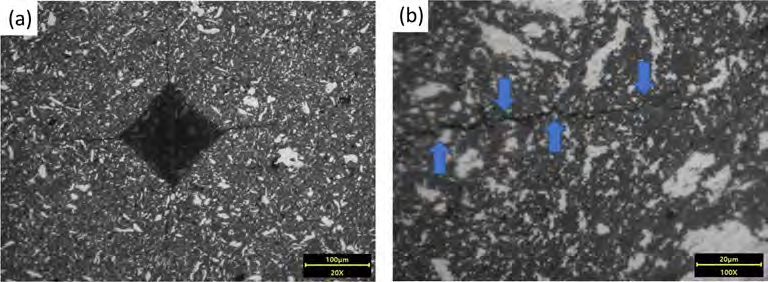
Vickers hardness was evaluated on polished sections of the W-Al2O3 composite under a 196 N load. The calculated hardness value of W-Al2O3 composite sintered at 1,400 °C was 1,364 kg/mm2. This value is higher than that of monolithic W reported as 9.75 GPa.1) Cracks propagated from indent corners as shown in Fig. 10(a). Length of these cracks can permit fracture toughness using the Niihara,s equation.18) Fracture toughness value of the W-Al2O3 composite measured by this method is 7.1 MPa·m1/2. Fracture toughness of the W-Al2O3 composite is higher than that of monolithic Al2O3 reported as 4MPa·m1/2.19) A crack propagated in a branching(↑) and deflective manner(↓) in Fig. 10(b). Enhanced fracture toughness of W-Al2O3 composite is believed that W and Al2O3 in the composite may deter propagation of cracks and W and Al2O3 have nanostructured phases.
4 Conclusions
Nanopowders of W and Al2O3 were synthesized during the high-energy ball mill from WO3 and 2Al powders. The nanostructured W-Al2O3 composite was achieved within three minutes from synthesized powder by highfrequency induction heated sintering. Average grain sizes of W and Al2O3 in composite sintered at 1,400 °C are 148 and 55 nm, respectively and the relative density of the composite was 98 %. The hardness and fracture toughness of the composite was 1,364 kg/mm2, 7.1 MPa·m1/2, respectively. Fracture toughness of the W-Al2O3 composite is higher than that of monolithic Al2O3 reported as 4 MPa·m1/2. Enhanced fracture toughness of W-Al2O3 composite is believed that W and Al2O3 in the composite may deter propagation of cracks and W and Al2O3 have nanostructured phases.