


1. Introduction
Most volatile organic compounds(VOCs) are mainly composed of air pollutants, and as precursors of ozone and photochemical smog, they are significant threats to the environment and human health due to their toxic, carcinogenic mutagenic and teratogenetic nature.1-3) Their treatment technology has been a huge challenge for several years in many industries, and many methods for removing VOCs have been developed: such as absorption, adsorption, incineration, catalytic oxidation, bio-filtration and photo-catalysis.4-8) Among these methods, adsorption is considered one of the best methods for VOCs emission treatment because of its simple and versatile applications.5) Although the most widely used VOC adsorbent is activated carbon, which has a large surface area, it has various disadvantages, such as non-selective adsorption, fire risk, difficult reuse and pore clogging due to polymerization of some VOCs catalyzed by ashes present on activated carbon surfaces.9,10)
Zeolite has been of interest to many researchers because of its non-flammability, stability at high temperature, resistance to humidity and easy regeneration.9,11) Since zeolite is regularly arrayed with fine pores, it selectively adsorbs only molecules that pass through the pores depending on the size of the pores, or selectively adsorbs according to the polarity of the molecules. Furthermore, the SiO2/Al2O3 ratio is a key parameter to control the hydrophobic/hydrophilic nature of the zeolite, and the adsorption performance of zeolite differs according to the SiO2/Al2O3 ratio in the crystal structure.
One type of adsorbent material is fiber, and air filters based on fibers are more efficient, more compact, and easier to handle.12) Furthermore, the movement pathway of adsorbed gas in a fiber becomes longer than in a powder or a grain, and the contact time between the adsorbent and the adsorbed substance becomes longer, which is advantageous for improving adsorption efficiency. An electrospinning method is usually used to produce fibers because of its various advantages, such as simple processing, low cost, and the uniformity of fibers.
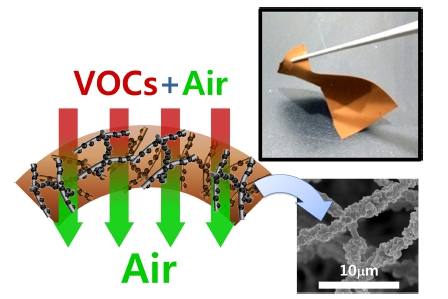
We investigated the adsorption/desorption properties of toluene over flexible zeolite fibers as a function of the degree of exposed zeolite powder on the fibers surface and as a function of acidity of the flexible zeolite fibers. This study confirmed that flexible zeolite fibers are superior to zeolite powder and will be contributed to fabrication of slim and compact VOC(toluene) air purifiers, as shown in Fig. 1. In addition, the adsorption/ desorption characteristics were improved with higher thermal surface etching temperature(higher degree of exposed zeolite powder on the surface) and with higher SiO2/Al2O3 ratio (lower acidity). The specific surface area and the amount of acid were measured by N2 adsorption/ desorption isotherms and ammonia-temperature-programmed desorption (NH3-TPD), respectively, and the adsorption/desorption characteristics were investigated by gas chromatography (GC).
2. Materials and Methods
2.1 Fabrication of Flexible Zeolite Fibers
The flexible zeolite fibers were prepared according to the procedures described in our previous work.13) The Yzeolite powders, CBV 400(SiO2/Al2O3 = 5.1), CBV 720 (SiO2/Al2O3 = 30), CBV 760(SiO2/Al2O3 = 60), and CBV 780(SiO2/Al2O3 = 80) were supplied by Zeolyst International. The purchased zeolite powders were calcined at 500 °C at a rate of 10 °C/min for 1 h to remove adsorbed impurities during the production process. The calcined powders were sieved with a mesh to control the particle size of the powder at less than about 100 μ, and then the mixtures of the zeolite powders, Polyvinylpyrrolidone (PVP, MW = 1,300,000, Alfa-Aesar) and ethanol (Sigma- Aldrich, 99.999 %) with a weight ratio of 1:1:8 were vigorously stirred for 16 h. The zeolite precursor solution was loaded into a 10 mL plastic syringe fitted with a 20 G metallic needle. The electrospinning conditions were 15 kV applied voltage, 15 cm distance between the syringe and collector, 0.5 ml/h feed rate, 250 rpm speed of the rotary collector and 10-40 % humidity. After electrospinning, the as-spun zeolite fibers were dried at 80 °C for 1 h, and then the as-spun zeolite fibers were thermally etched at 300 °C, 350 °C, and 400 °C in air to expose zeolite particles on the surface of the fiber for maintaining flexibility.
2.2 Adsorption/desorption Experiments of Toluene Over Flexible Zeolite Fibers
The adsorption isotherms of the toluene on flexible zeolite fibers were measured according to different values of the thermal etching temperature and SiO2/Al2O3 ratio. For toluene adsorption/desorption experiments, 0.1 g of flexible zeolite fibers was loaded in a Pyrex glass reactor with an inner diameter of 1 cm. Prior to the adsorption experiment, the flexible zeolite fibers were degassed under a flow of nitrogen carrier gas at 300 °C for 2 h. Adsorption isotherms of 1,000 ppm toluene were observed at a constant temperature of 35 °C and a flow rate of 50 cm3/min, and the concentration in the outlet flow was measured by GC. After adsorption, temperatureprogrammed desorption (TPD) experiments were conducted at temperatures from 35 °C to 300 °C at a 5 °C/min heating rate and also measured by GC.
2.3 Material Characterization
The microstructure of the flexible zeolite fibers was analyzed by field-emission scanning electron microscopy (FE-SEM, JSM-6700F, JEOL). The specific surface area of the flexible zeolite fibers was measured by a N2 adsorption method at liquid nitrogen temperature using ASAP 2000 (Micromeritics Inc.), after degassing the samples at 100 °C for at least 12 h under vacuum. The acidity of the flexible zeolite fibers was analyzed by NH3-TPD with BELCAT-B (Bel). The flexible zeolite fibers were pretreated at 300 °C with a He flow for 2 h. After cooling to 100 °C, adsorption of NH3 was carried out for 1 h. When adsorption saturation was achieved, the samples were heated at a rate of 10 °C/min from 100 °C to 500 °C in a He atmosphere.
3. Results and Discussion
3.1 The Effect of Thermal Etching Temperature
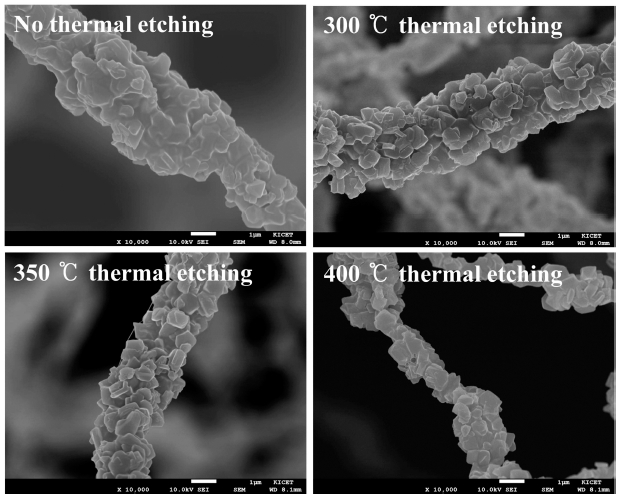
The microstructure of the flexible zeolite fibers(CBV 760, SiO2/Al2O3 = 60, BET surface area = 861 m2/g, t-plot micropore volume = 0.24 cm3/g, pore size = 23.7 nm) with different thermal etching temperatures was investigated by FE-SEM analysis, as shown in Fig. 2. Since a thermal etching temperature range from 250 °C to 450 °C was the appropriate temperature range for maintaining flexibility in our previous work,13) the as-spun zeolite fibers were thermally etched at 300 °C, 350 °C and 400 °C. As the thermal etching temperature increased, PVP polymers in the fibers surface were more and more etched, and the zeolite particles were more exposed on the fibers surface, and the sharper zeolite grain shapes were observed.
The N2 adsorption/desorption isotherms of the flexible zeolite fibers with different thermal etching temperature are shown in Fig. 3. The specific surface area of a zeolite is usually calculated by the Langmuir method and Freundlich method,14) and the Langmuir method is usually used for an adsorbent forming a monolayer of a limited number of adsorption peaks on the adsorbent surface. The flexible zeolite fibers with different thermal etching temperatures were more appropriate for measuring the surface area by the Langmuir method because of the monolayer adsorption being formed on the surface of the thermal etched zeolite fibers. The specific surface areas of the flexible zeolite fibers with no-thermal etching, 300 °C thermal etching, 350 °C thermal etching and 400 °C thermal etching were 185.2 m2/g, 582.9 m2/g, 745.3 m2/g and 906.4 m2/g, respectively. The specific surface area of the flexible zeolite fibers was improved with thermal etching temperature, because zeolite particles were more exposed on the fiber surface.
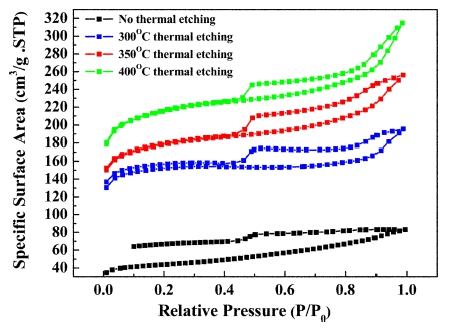
Fig. 3
N2 adsorption/desorption isotherms of the flexible zeolite fibers with different thermal etching temperatures.
The effect of the thermal etching temperature of flexible zeolite fibers for the removal the toluene was investigated by GC, as shown in Fig. 4. The adsorption breakthrough curves in Fig. 4(a) show that adsorption process over the flexible zeolite fibers with no thermal etching process were saturated too quickly and there was a shorter breakthrough time. The breakthrough time is the time at which a C/Co value starts to become 0.05 in the breakthrough curve, and the shorter breakthrough time in the breakthrough curve means that the toluene adsorption was not sufficient. Thus, the amount of desorption was not measurable in the TPD curves of Fig. 4(b). This is because the zeolite particles as active sites for adsorption were covered with the polymer, and not only the specific surface was low, but also the adsorption property of toluene was very poor.
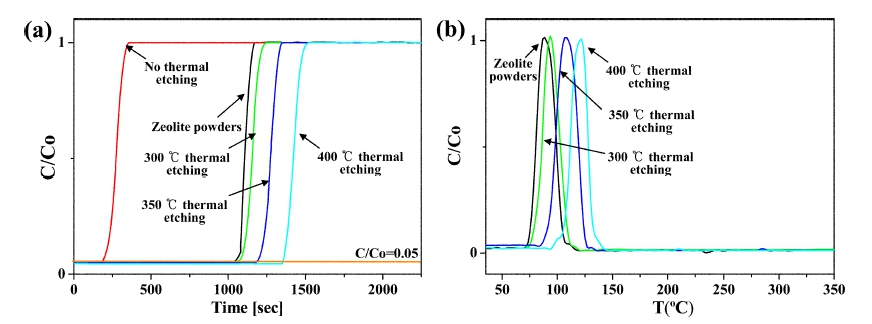
Fig. 4
(a) Adsorption breakthrough curves and (b) TPD curves of the flexible zeolite fibers with different thermal etching temperatures.
Fig. 4(a) also shows that the flexible zeolite fibers with different thermal etching temperatures possessed better adsorption characteristics of toluene than the zeolite powders. Although the slopes in the breakthrough curves for the flexible zeolite fibers were similar to those of the zeolite powders, the flexible zeolite fibers had longer breakthrough times because the moving pathways of toluene molecules in the zeolite powder were different from those of the flexible zeolite fibers. Web structure types of flexible zeolite fibers generally have longer and more complicated pathways, and the time for toluene molecules to stay in the web structure seems to be longer. These longer and more complicated pathways in a web structure for the flexible zeolite fibers seem to play an important role in improving the adsorption characteristics. Furthermore, the flexible zeolite fibers had longer breakthrough times with higher thermal surface etching temperature, and more active sites for adsorption are exposed to the surface of fibers at higher thermal etching temperatures, which results in better adsorption properties. In this regard, the adsorbent with the highest adsorption characteristics of toluene was the flexible zeolite fibers with a thermal etching temperature of 400 °C, and the adsorption characteristics was improved with a higher degree of exposed zeolite powder on the surface by a higher thermal surface etching temperature.
The TPD curves in Fig. 4(b) show the behaviors of toluene desorption with increasing temperature. The desorption temperature generally has a great influence on the recovery of the adsorbent and the reuse of the adsorbent. The adsorbed toluene on the zeolite powders and flexible zeolite fibers were desorbed at below about 150 °C, this means that the absorbents of the zeolite powders and flexible zeolite fibers can be regenerated by hot air. The adsorbed toluene in the zeolite particles was desorbed at a lower temperature than that in the flexible zeolite fibers because the toluene molecules have a longer and more complicated pathway in the web structure of the flexible zeolite fibers as in the adsorption behaviors, and the higher temperature for desorption of adsorbed toluene seems to be required. Furthermore, a higher desorption temperature was observed for the flexible zeolite fibers with a higher thermal etching temperature. It is considered that more energy is required for desorption due to a strong adsorption force by the increase of the active sites for adsorption with the higher thermal etching temperature.
3.2 The Effect of the SiO2/Al2O3 Ratio
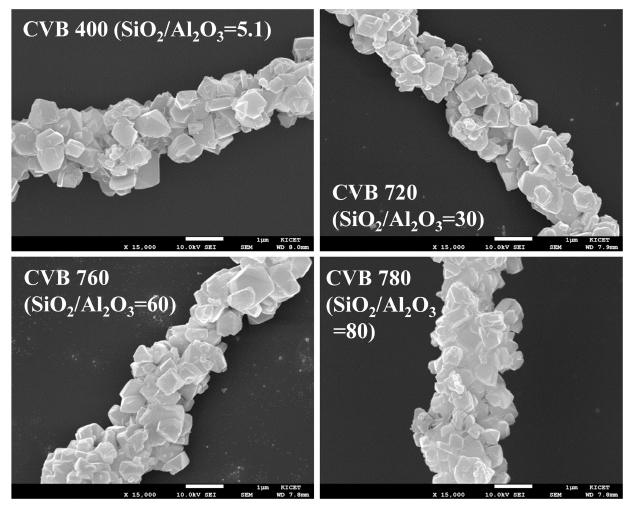
The SEM images of thermal surface etched flexible zeolite fibers with different SiO2/Al2O3 ratios at 400 °C are shown in Fig. 5. The grain shapes of zeolite particles were observed at the surface of the fibers, because zeolite particles covered by polymer were exposed on the surface by thermal surface etching. The surface morphologies of the flexible zeolite fibers with different SiO2/Al2O3 ratios were almost similar. It is because that the surface morphologies of zeolite powder itself with different SiO2/ Al2O3 ratios were similar, and the degree of thermal etching was almost similar when it is etched at the same temperature.
The crystal structures of the flexible zeolite fibers with different SiO2/Al2O3 ratios were analyzed by XRD, as shown in Fig. 6(a). Y-Zeolite peaks (JCPDS #81-2467) were observed in the all flexible zeolite fibers with different SiO2/Al2O3 ratios after the 400 °C thermal etching process, indicating that a phase change did not occur in the zeolite fibers by thermal etching process. The N2 adsorption/desorption isotherms of the thermal surface etched flexible zeolite fibers with different SiO2/ Al2O3 ratios at 400 °C are shown in Fig. 6(b). The specific surface area was calculated by the Langmuir method, and the specific surface area of the flexible zeolite fibers with SiO2/Al2O3 ratios of 5.1, 30, 60 and 80 were 601.2 m2/g, 884.9 m2/g, 906.4 m2/g and 895.3 m2/g, respectively. The lowest specific surface area was observed at the lowest SiO2/Al2O3 ratio of 5.1, and the specific surface area values for the flexible zeolite fibers with the SiO2/Al2O3 ratios of 30, 60 and 80 were almost similar.
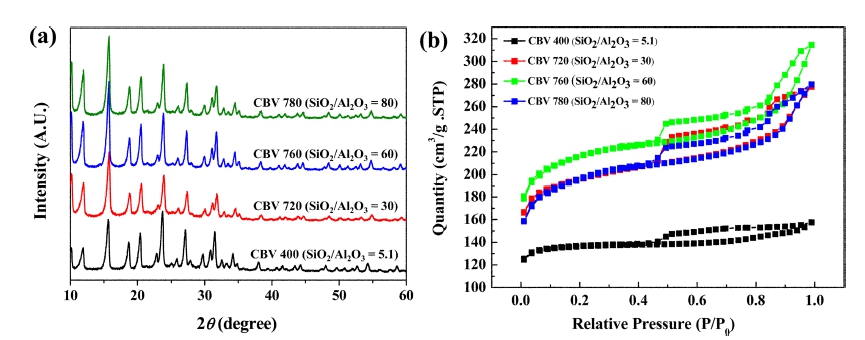
Fig. 6
(a) XRD results and (b) N2 adsorption/desorption isotherms of the flexible zeolite fibers with different SiO2/Al2O3 ratios.
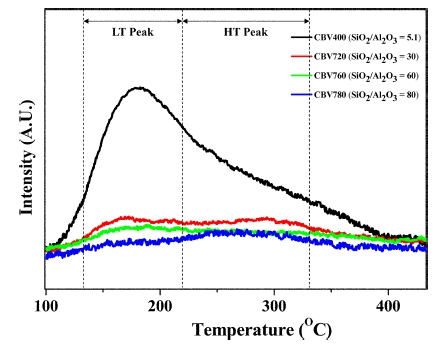
The surface acidity characteristics of the flexible zeolite fibers with different SiO2/Al2O3 ratios at a thermal etching temperature of 400 °C were investigated by NH3-TPD, as shown in Fig. 7. There are two separate desorption peaks with maxima at about 180 °C and about 300 °C, which correspond to the weak and strong acid sites of zeolites, respectively. The NH3-TPD of a zeolite typically showed the two peaks of a low temperature peak (LT Peak) and high temperature peak (HT peak), and Van Hooff and Roelofsen defined the LT peak as desorption of ammonia at the weakly acidic site and the HT peak as desorption of the ammonia at the strong acid site.15) The LT peak is caused by the desorption from weakly acidic silanol groups or from some extra-framework alumina species of Al(OH)2+ and Al(OH)2+, and the HT peak is related to protonic acidity. The largest total amount of acidity was observed in the flexible zeolites with the lowest SiO2/ Al2O3 ratio of 5.1, and the behavior desorption of NH3 was similar to the characteristics of typical Lewis type acidity. The behavior desorption of NH3 for the flexible zeolite fibers with the SiO2/Al2O3 ratios of 30, 60 and 80 was similar, but the total amount of acidity was slightly less with an increase in the SiO2/Al2O3 ratio.
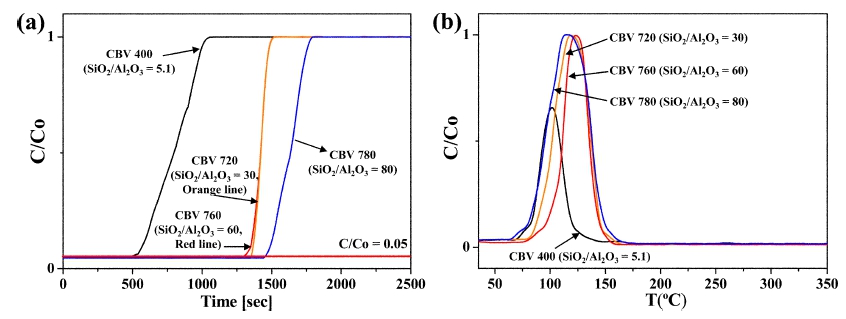
The breakthrough curves and TPD curves of toluene for the flexible zeolite fibers with different SiO2/Al2O3 ratios at a thermal etching temperature of 400 °C are shown in Fig. 8. The flexible zeolite fibers with the lowest SiO2/Al2O3 ratio of 5.1 had the shortest breakthrough times of about 500 s and a gentle slope of the breakthrough curve, and the total amount of desorption was also the smallest because of the smallest specific surface area and a large amount of acidity. The behaviors of adsorption and desorption for the flexible zeolite fibers with the SiO2/Al2O3 ratios of 30 and 60 were similar because of similar specific surface areas and similar acidity. The flexible zeolite fibers with the SiO2/Al2O3 ratios of 30 and 60 had better adsorption characteristics: longer breakthrough times of about 1300 s and steeper slopes of the breakthrough curves. The flexible zeolite fibers with a SiO2/Al2O3 ratio of 80, which had a similar specific surface area and the smallest amount of acidity, had the longest breakthrough time of 1,500 s and the largest amount of desorption. The hydrophilicity is generally increased by the introduction of Al2O3 in the siliceous matrix, and the flexible zeolite fibers with lower SiO2/Al2O3 ratio had the characteristics of higher amount of acid group and higher hydrophilicity. However, since toluene, a hydrophobic compound, has limited affinity to a hydrophilic surface, the flexible zeolite fibers with lower SiO2/Al2O3 ratio showed poor adsorption characteristics. In this regard, an adsorbent with higher specific surface area and a lower acidity seems to be necessary characteristics for better behaviors of adsorption and desorption of toluene.
4. Conclusions
For the synthesis of flexible zeolite fibers to prepare slim and compact VOC (toluene) air purifiers, flexible asspun zeolite fibers were prepared by an electrospinning method, and then the specific surface area was improved by a thermal surface partial etching process. The breakthrough curves and TPD curves of toluene over the flexible zeolite fibers were investigated as a function of thermal etching temperature, and better adsorption/ desorption behaviors of toluene over the flexible zeolite fibers confirmed; this result was due to longer and more complicated pathways in the web structure of the flexible zeolite fibers. Furthermore, the adsorption/desorption characteristics were improved by a higher degree of exposed zeolite powder on the surface by a higher thermal surface etching temperature. The effect of the acidity on the flexible zeolite fibers for the removal of toluene was investigated as a function of the SiO2/Al2O3 ratio of zeolites, and the adsorbent (the flexible zeolite fibers with a SiO2/Al2O3 ratio of 80) with a higher specific surface area and lower acidity demonstrated the better characteristics of adsorption and desorption of toluene.